Archive for the ‘brenda’ Category
if rats are made out of nothingness

New Labour won the Glenrothes by-election. Gordon will be gloating. He sits at night in his new primrose yellow room full of broken cogs and scattered springs and cannot believe his luck. He sniggers. He chortles. He laughs like a Kirkcaldy drain. How many dark nights did he sit over-winding his beloved timebomb, praying to the mythical deity that the bloody thing wouldn’t blow up in his face? But blow up it does and guess what: he’s off the hook! You’d almost think Gordon had done this deliberately, wouldn’t you? I gather he’s now asked Sarah to get him a wrecking ball for Christmas. He’s told her he’s come up with an ingenious solution to the recession in the construction industry.
I spoke to Talullah Hudspith a few days ago. I hadn’t seen her since Rosie’s leaving do. She asked me what I thought of Jack’s performance.
‘Quite remarkable,’ I said. ‘And brave. The man rocks, doesn’t he?’
Talullah and Jack have an odd relationship. Some say she has a thing about him; others say the exact opposite is true. I personally remain agnostic on the Talullah and Jack issue.
‘Do you think so?’ Talullah said, with more than a hint of a sneer. ‘I thought he was bloody ridiculous, actually. I mean, what on earth would possess a man of his age to prance around like that in front of all those poor women? He’s got no shame.’
In the light of this response you too will now no doubt be hypothesising about Talullah and Jack. I certainly was. But a tactical evasion seemed the order of the day.
‘So is he back at work?’ I asked.
Talullah chuckled, or perhaps snortled. ‘Oh ho, he’s back all right!’ she said. ‘The dirty hound’s always skulking around in the shadows somewhere. He’s never yet spoken to me about his antics, of course. He’s quite ridiculous, really. Do you know he’s now wearing dark glasses for work? He never takes them off. Who the hell does he think he is, Elvis Presley?!’
‘Yeah, I would be too if I’d done what he did!’ I said. ‘The guy’s probably just a bit embarrassed.’
‘Embarrassed?! Him?! That’s a laugh. You couldn’t knock him back with a shitty stick, man. No, he’s a star reborn, that’s what our Jack is. I wish he’d do us all a favour and just retire.’
‘So,’ I said. ‘How’s the delightful Mrs Gormley? Did she enjoy the night?’
‘Oh, Betty loved it! She’d do it again tomorrow if she could.’
‘Maybe Jack’ll play for her if she asks him nicely,’ I said. ‘If he really is a star reborn, he’ll have no problem with that. Nor will she, I suspect. Just as long as he keeps his pants on next time.’
Talullah’s from a theatrical blackground. She’s naturally dramatic. She’s the kind of woman who likes to start a riot. Maybe it just gets up her nose that Jack upstaged her.
Mandy has been into the office a couple of times this week. There have been almost daily sightings of the Arab in the white Mercedes and she’s getting very stressed. On Friday she and Mr Zee were waiting to see Debs when I arrived at the office. Mr Zee looked very smart, as always. His rich brown cape was almost shimmering in the morning sun.
‘How you doing?’ I said to him.
‘I’m okay,’ he replied. ‘You know.’
‘Yeah,’ I said, ‘I know. So are you still reading Bukowski?’
‘No,’ he replied. ‘I decided he wasn’t my cup of tea. I’m reading Neruda at the minute. They’ve got lots of his stuff at ZorrStore.com. I’m trying to get into Rumi too.’
Mandy then told me that the phone had rung seven times during the night for each of the last three nights, and each and every time it was the same old tune.
‘Is Flinty still with Molly?’ I asked.
Mandy shrugged and looked at Mr Zee.
‘We don’t know,’ he said.
‘Have you told the police?’
‘Yeah. Nothing they can do. The caller’s using a stolen mobile.’
When I got home that night there were three more big boxes of slippers in the hall. De Kooning was sitting on top of them playing king of the castle. Geraldine was talking to Margaret about the latest curse of the Citadel: rats. They were first spotted by Big Trevor while I was in Glasgow it seems, scuttling around beneath his railings.
‘They weren’t there until the builders came,’ Geraldine said.
I wondered if she thought the builders had imported them as a sort of alien species, or simply because no building site is complete without a good infestation of rodents.
‘So how did they get there?’ I asked, already allowing my mind to toy with the notion of their ex nihilo creation.
‘Well, it can only be the building site, can’t it?’ Margaret said. ‘They weren’t there until they started building that monstrosity.’
Okay, I thought, but how did they get here? Did Griff dress himself as the Pied Piper and lead them here from their old haunts along the quayside? Did they hear along the grapevine about the Citadel site and make their way here, like the Israelites to the Promised Land, like Americans to California? My guess was that they’ve always been here or that perhaps the sightings are apocryphal, a plague of the Citizens’ collective imagination.
‘We need to visit the site en masse and register our protest,’ Geraldine said. ‘Rats are dangerous. Did you know that they sometimes curl up on your pillow beside your face as you sleep! Imagine that. It’s horrific!’
‘Will we be safe?’ Margaret asked.
‘As long as we wear sensible footwear we will be!’ Geraldine said, obviously recalling the mass trespass during the summer when she fell off her high heeled boots. It’s not often Geraldine makes a joke about herself.
‘I’ll wear my Timberlands,’ Margaret said. ‘They’ll never get me in them.’
I went through to the conservatory to drink a cappuccino. There were a dozen or so pairs of slippers lined up across the floor. They were obviously part of the Christmas stock. Slippers with owls and guitars and ducks on them. Camper van slippers, cows and gingerbread men slippers. There were also a couple of pairs of fake fur leopard skin bootie slippers. I stepped over them and stood at the window. The sky was almost dark. There were vague lights flickering somewhere deep in the carcase of the Citadel. It looms over us like Kafka’s Castle. I began again to wonder where Hugo had put his little giraffe.
‘Edna will never come home now,’ Margaret said, after Geraldine had left. ‘She’ll never cope with the idea that she might wake up and find a rat sleeping next to her face. It’s an absolute crying shame.’
I stared out at the Castle. I wondered about the rats that are made out of nothingness.
‘I’m going to Brenda’s tonight,’ Margaret said. ‘Her friend who’s an astrologer is coming to her house. She’s going to do my horoscope.’
I nodded. I said nothing for a minute or so.
‘Are you taking some of these slippers with you?’ I eventually asked.
‘No,’ Margaret said. ‘But I am taking the boxes in the hall.’
When she left I had another cappuccino and sat for a while reading my book on Scottish art. Some of W G Gillies’ paintings are stunning. I love his border landscapes and they sort of feel like home to me too. It takes a lot of confidence to paint as freely as he does in those paintings. But I was particularly taken on Friday night by his 1973 painting The Garden in Winter. We sometimes fail to see the beauty that lies in the ordinary things, the things we can see from our windows. We sometimes fail to see how much those things really matter. I gave De Kooning his prawns and painted a new square canvas over with a Prussian blue ground.
I watched it dry and listened to Meg Baird’s album. I decided I would have to go up to Temple soon to see the house where Gillies lived and where he did all those late paintings.
I watched Newsnight. I went to bed.
.
the return of the muslim vampires
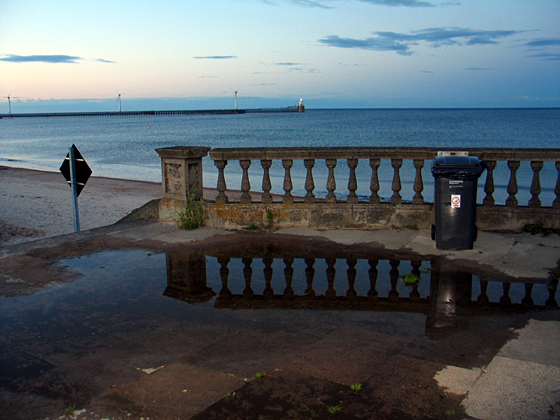
Yesterday morning I went to a meeting in Shiremoor. On my way back I decided to call and see my dad in Seaton Sluice. He’s getting his house refurbished – rewired, new kitchen and all that palaver – and I was wondering how things were going. When I got to the Sluice I saw Tristan’s white PermaPlumma van parked just around the corner of the Collywell Bay Road, more or less opposite the social club. I spotted Tristan himself in his white boilersuit and blue jacket, leaning against the fence looking out over into the harbour. It was sunny and cold, quite suddenly like winter. The white buildings on Rocky Island were gleaming in the sun and the whole scene looking north had a picture postcard quality about it. I parked up and went over.
‘Hey, Tristan, what’s happening?’ I said. ‘Have you got as job up this way to do?’
‘No, mate,’ Tristan said. ‘No job. Work’s dwied up a bit, I’m afwaid.’
He looked just a little despondent, a little stoical.
‘So what you doing in the Sluice?’ I asked.
‘I’m just getting out of Bwenda’s way,’ he replied. ‘She’s got clients all morning. I didn’t want to be under her feet.’
I nodded and shared the view with him for a few seconds.
‘Hey, so what do you think of the response of the Left of the credit crunch, Tristan?’ I said.
‘What wesponse?’ he replied, suddenly becoming more animated. ‘The so-called Left squats like a bullfwog on a log and cwoaks and cwoaks but never jumps.’
‘So what’s it waiting for?’
‘I dunno, mate! A sign, maybe, or a call from heaven.’
‘So what should it do, Tristan? What would it look like if the bullfrog jumped?’
‘You know something, mate, I don’t think this bullfrog knows how to jump. I don’t think it’s actually got the legs for it anymore. It isn’t organised, that’s the problem. Who are the Left? Who’s leading them? Without organisation, mate, this fwog ain’t jumping anywhere.’
I laughed and said that maybe this was true, but surely that it just begged the question of why there was no organised Left in the first place, why we had a frog that couldn’t jump.
‘Maybe it’s because it can’t see anywhere to jump to?’ I suggested. ‘Maybe that one smug log in the backwater is the only one this frog can sit on these days. There’s no other log for the socialist frog to swim towards, is there?’
‘This is a chicken and egg situation,’ Tristan said. ‘Pwaxis, mate, that’s the way to deal with this kind of pawadox. You’ve always got to be weady to jump. Jumping’s what changes the world. Jump and the future weveals itself! Wemember what Marx said: in the past it was the job of philosophers to understand the world, the job now is to change it. The fwog needs to get on with jumping, I say, and stop gazing at its navel and cwoaking. A fwog that loves the sound of its own cwoak is a fwog that will soon be dwowned in the tide of histowy.’
‘You make this frog sound a bit like Hamlet, Tristan,’ I joked. ‘To jump or not to jump, that is the question. A frog with its head up its own backside.’
I told Tristan I needed to be on my way. I found his position frankly a little undisciplined for a Trotskyist, somewhat lacking in theoretical rigour. But he is right, the Left’s response to the current global financial crisis has been remarkably passive, and you can only surmise that this is because they either don’t know how to respond or no longer have the capacity to do so. These two things are probably inextricably linked, of course. Marxists can gloat over their man’s acumen about capitalism, but which of them can tell us where to go from here? The Left seems to have lost the belief it once had that it can make history, and that it can even do so in circumstances not of its own choosing. The Left seems to be mostly comprised of Lutherans nowadays. They don’t need to be organised. All that’s needed is that each individual believes in the God of history. If everyone sits quietly in their soon to be repossessed homes praying to this God the revolution will inevitably occur. Capitalism will magically wither and die while they dream.
As I walked back to my car I mused on Tristan’s brave and perhaps slightly incoherent analysis, that the Left is a frog with no legs and nowhere to jump but somehow ought to jump anyway. Basho’s famous haiku came to my mind.
The old pond,
A frog jumps in:
Plop!
This poem has been translated by just about everyone, of course. The version I always recall is Alan Watts’ translation. I wasn’t sure how enlightening it was in terms of the Left and the global crisis in Capitalism, but it’s a fine little poem, isn’t it?
I called across to see my dad. His flat is upside down, polythene covering every floor surface, workmen coming and going, the door permanently open. My dad had his coat on and was obviously very cold. He offered me a sandwich; I declined. I told him I needed to get back to work and left. As I drove back down past the social club I could see Tristan. He was still looking out over the bay.
The schools are on holiday this week and it’s Halloween on Friday. Some of the kids in Ashington are using their cast off pillowcases as spook outfits and wandering from house to house knocking on doors. Just after I got back from the Sluice Gilmour rang me about this phenomenon.
‘We don’t have a resurgence of the Flinties, do we?’ he asked. ‘Tell me how worried we should be about this.’
‘Not at all,’ I suggested. ‘They are just kids trick or treating. They’re also wearing witches hats, Frankenstein masks and carrying pumpkin lanterns from Asda. Some of them have luminous plastic vampire teeth and fake knives through their heads. Do they sound like a bunch of Muslim terrorists to you?’
Gilmour agreed, they didn’t, although not without observing that stranger things have happened. And by chance he’d listened to Alan Robson on Night Owls last night and there had been some alarming calls from worried listeners in the Ashington area.
‘A lady called Hettie from Bomarsund rang up,’ Gilmour said. ‘This lady sounded quite agitated. She said to the presenter something like “It’s all happening again, Alan.” He tried to reassure her, but she was having none of it. He asked her if these children were throwing paper aeroplanes at windows again and then as a sort of Halloween joke he said, “Or is it bats this time, Hettie?” Hettie was not at all amused. “Alan, with all due respect,” she said, “this is not funny.” Alan apologised. Oh, Hettie wasn’t a happy bunny. Later a bloke called John from Westerhope came on. This guy was obviously some kind of conspiracy theorist. He seemed to think Ashington police were in cahoots with the Flinties to destroy the British way of life. The next caller was a drunken woman from Ashington.’
‘Oh, Cheryl!’ I said.’ Ha ha. Yes, we know Cheryl. She’d be complaining that the authorities weren’t taking her seriously, was she?’
‘Yes, that’s right. She said she’d seen someone dressed as – ‘
I interrupted him: ‘Robin Hood! Yes, she says that all the time!’
‘No,’ Gilmour said. ‘Not Robin Hood. The Lone Ranger.’
‘Oh,’ I said.
‘Anyhoo, my boy,’ Gilmour said, ‘It sounds like we don’t have to get ourselves into a lather about any of this, do we? So, tell me, how’s your dad doing? Is he okay?’
‘Yeah,’ I replied. ‘He’s fine. Still mending fuses in the factory and what have you. How’s yours?’
‘Oh, father’s absolutely chipper. He’s a bit worried that the demand for meat might drop off a bit if there’s a recession, and of course like anyone else he’s getting a bit nervous about property values and his investments. But all in all he’s very well, thank you. Oh, by the way, did I tell you my lad’s driving the quad now?’
‘Is he? The quad, eh? Hey, that’s great. He’s really coming on, isn’t he? By the way, how’s your daughter’s horse doing?’
Gilmour told me the horse and his daughter were both doing remarkably well. I then asked him why he didn’t turn up at Rosie Lake’s leaving do last Friday.
‘Oh, it clashed with something my wife had arranged,’ he said. ‘How did it go? Did they give her a good send off?’
‘Well, Jack Verdi did,’ I said.
‘Jack finally performed?!’ Gilmour said. ‘My goodness, miracles will never cease, eh? What did he do, the old hits from his back catalogue?’
‘Yeah, well, his back catalogue was certainly involved. Nobody’s told you about, have they?’
‘No. No-one’s mentioned it. Hey, it sounds like I missed a good night? I really wish I could have been there. I’ve got a couple of Jack’s old albums, you know. I like his stuff. Is his voice still as good as it was?’
I chuckled. Gilmour asked me why I was laughing. ‘Oh, I guess you just had to be there,’ I said. ‘I’m sure Freddy will give you the full low down when you see him.’
I think our call ended with Gilmour in much better fettle than when our conversation began. It certainly cheered me up.
Debs came up and told me that Mandy was in the office. She was thinking of trying to get a private tenancy outside of Ashington, maybe in Morpeth or Seaton Delaval. She wanted to live somewhere where Flinty might not find her.
‘If she found somewhere could we help her out with a bond?’ Debs asked.
‘Is running away from him the answer, Debs?’ I said.
‘Oh, come on,’ she said. ‘What else is she going to do? The man’s a nutcase. He’s never going to leave her alone.’
I looked at her and shook my head. ‘Aye, all right,’ I said. ‘It’s only money, I guess.’
It was another cold afternoon. As I drove down Alexandra Road at dusk the sky was icy blues, violets and orange. The streetlights had just come on. An old white Mercedes passed me going in the other direction. The driver was dressed like an Arab. I turned on the radio. On the five o’clock news I heard that Gordon had stepped into the furore about Jonathan Ross and Russell Brand acting like a couple of prats on Brand’s late night radio programme a week or so ago. Gordon’s the man with his finger on the pulse of the nation.
It was dark before I got home.
.
waiting for the miracle

My computer’s been down. In a way it was if the world had stopped. A bit like not going to work. A bit like being without a television.
Last week Boz got himself locked up. At the beginning of the week he was in the office talking to Lily about abducting his children and hiding away with them in the caravan at Sandy Bay. Lily pointed out that he had already sabotaged his own plan by disclosing his secret whereabouts. Boz threw a wobbler and stormed out. He went into the car park and began methodically ripping the wing mirrors off cars. This is no easy task – a bit like pulling out a rhinocerous tooth, I thought. Once extracted he threw the detached mirrors over the wall into the street. He detached five in all, including both the driver’s and passenger’s side from Meg Bomberg’s BMW. At least no-one will notice the wiggly scratch now, as Lily said.
Boz then went and sat on the wall and had a cigarette. He was sitting there almost serenely when the police arrived in their Ford Focus panda car. They rolled down the window. The officer asked him if he knew anything about the five broken mirrors lying in the road.
Boz shook his head. ‘Me?’ he said. ‘Naw, nowt to do with me, mate. Do I look like a vandal? Naw, it must be the numpties from Newbiggin.’
Lily walked out into the car park at this point. Boz glanced at her.
‘So do I look like a kidnapper to you?’ he asked the police officer. ‘Do I? Do I have the look of a man who would abduct children? Well, come on – do I?’
The police officer glanced across at his colleague. He had a wry smile on his face. Lily hadn’t said a word.
‘You think that’s funny, do you? Eh?’ Boz said, throwing his cigarette down and standing up. He scrunched his stub into the pavement. For a moment he stood looking at the police officer, nodding his head slowly. Then like a leopard he suddenly pounced on the Focus wing mirror and began riving at it.
The police officers leapt out, twisted his arm up his back, slapped him in handcuffs, and threw him in the back seat of the panda, its passenger side mirror dangling like an almost severed limb. Boz bellowed and sang that they were numpties, numpties, numpties, that all policemen are numpties. They took him away to the station.
Lily looked at me and shrugged. ‘Do you think it’s time to cancel the anger management sessions?’ she said.
That night when I got home the clock was still ticking. The global economy was in a state of chaos. De Kooning wanted me to pick him up and carry him to the kitchen. I did so and then went for a walk before night fell.
On Thursday morning I caught the beginning of In Our Time as I drove to work. By sheer coincidence, I would suggest, the programme was looking at miracles. In the introductory part they looked at the Jewish and Christian versions of the idea and the way it was bound up with the idea of God and His power to intervene in the world. It seems that the Hebrew word used in the Bible means both ‘wonder’ and ‘sign’. It interested me that these two concepts could be separated. The programme moved on to the Hindu and Taoist view of miracles, where a miracle can just be a wonder and not a sign at all. It seems that someone with these world views can witness as a miracle and regard it with a sense of wonder – and be fully aware that it defies the laws of nature – but not think it has a meaning. Such things are not signs. The Taoist has no idea why they happen and isn’t much bothered in any case. They just do. This is an attitude that is alien to the west, I was thinking. Western cultures are heavy on ‘the need for cognition’, so much so that some Western psychologists consider it to be one of our fundamental traits. We need to know why things happen. We want explanations. Everything happens for a reason. We need to give an event a meaning.
The programme mentioned the case of the Hindu milk miracle, which occurred in 1996, and involved a stone statue of Ganesha the sacred elephant drinking milk. Or seeming to drink milk, depending on your point of view. This caused great excitement in the Hindu community and Hindus from far and wide came to witness the phenomenon. Even in Britain sales of milk near Hindu communities soared as people went off to get a bottle and feed a spoonful to their local stone elephant. The excitement was about something wonderful happening and the desire to witness a supernatural event. There was little concern about what the event might mean, it seems. Of course even in India the need to explain quickly asserted itself in some quarters. Scientists rapidly came up with the explanation that the stone elephant appeared to drink the milk because of capillary action: the stone was porous. Hindus resented this wonder being taken from them. Why is it that things that have an explanation cannot still be wonderful?
I was thinking, of course, about the Napoleon in Margaret’s bedroom. Its tick was nagging at me. Maybe I should just regard it as a wonder, a clockwork Ganesha. Maybe I should try to persuade Margaret that this magic ticking really had no meaning, that it was a sign of nothing at all. What in fact was the evidence that it had a meaning, and what was the evidence that it had any particular meaning? Was there a message in the ticking, a secret language of ticks that a suitably inspired listener might translate? Is there a Rosetta Stone of ticking? I doubted it somehow.
When I got in De Kooning ran up to me, as if he had great news. Had the Napoleon stopped? I picked him up, but before I got to the door of Margaret’s bedroom I knew it hadn’t. I pushed open the door and looked over at it. It gazed back smugly. It was ticking steadily, indifferently, like a cow chewing the cud of time.
‘I think I’ll have a cappuccino,’ I said. ‘Do you want a few prawns?’
I sat in the conservatory with my cappuccino, trying to read The Guardian. I wondered if I should ring the Greek, but I knew what he would say: the clock will stop, be patient. I began to think I would have to take matters into my own hands and take a spanner to this insolent clockwork wonder. I began to fear that once word got out about the Napoleon’s perpetual motion, miracle freaks from around the globe would flock to our house for a glimpse of this wonder. They would come with camcorders, digital cameras and mobile phones and probably pay for the thrill of recording it, although what the value of a recording of a ticking clock – albeit an impossibly ticking one – would be was a little unclear to me. What would be important, however, was that Margaret and Brenda didn’t realise the money making potential of this freak clock.
Scientists and horologists from around the world would descend upon us. Theories would proliferate. The government would call for calm. Gordon would have to decide upon some Calvinist neo-liberal position on the question, a view with which all cabinet ministers would be bound to agree. It would have to be made very clear that even if this miracle is a sign, it’s not a sign of anything about the economy. There were clear dangers that it would be read that way in the current climate, given that the miracles the unregulated global markets have brought to us are now falling apart around their ears. Gordon would have to act to marginalise and neutralise the miracle of Margaret’s Napoleon.
It was becoming clear: a miracle can lose its gloss fairly quickly. Miracles might not be all they’re cracked up to be. Naturalists and supernaturalists, deists and atheists and Seventh Day Adventists, Neo-Druids and a host of other New Age pilgrims would squabble and debate night and day at our gate. Makeshift camps would spring up on the grass verges, mini-Glastonburies. The faithful would be found asleep or urinating in gardens. The neighbours would complain. Geraldine would probably go to the press. The miraculous clock would be as bad as the Citadel – worse possibly – another dreadful blight on their peaceful existence. The police would put permanent traffic cones down the street. Celebs would arrive for a photo opportunity. Robbie Williams might arrive. Or Jade Goody. My mind went back to the spanner: surely it would be better to nip this curse in the bud? But how could I do that without admitting that a miracle may have occurred? How could I destroy the evidence that I might be wrong about the nature of the world? I was in a cleft stick. I’d have to hold firm and wait. The Greek was surely right: the Napoleon would stop any day now.
I spent a lot of last weekend out and about, walking or cycling. I was avoiding the ticking, I suspect. When I was in the house I’d sit in the Conservatory staring at the dark dreadful matrix of the Citadel with De Kooning, playing music loudly enough to make absolutely sure not a tick could be heard. I listened a lot to Teddy Thompson’s latest album. It turns out to be an especially good record to drive away unwanted ticks. I think De Kooning liked it too. From time to time I got up with him and we danced a little as we looked out together at the darkening world.
On Monday I was going first thing to a meeting in North Shields. Margaret asked me to drop off another box of slippers at Brenda’s on the way. I got there at about half nine. Tristan answered the door. He came to the door in pale blue pyjamas and a pair of checky brown slippers, which looked brand new to me. His hair was tousled.
‘Morning, Tristan,’ I said. ‘Are you not working today?’
‘No jobs,’ he said. ‘Business is slow. It’s the cwedit cwunch, mate.’
Yes, of course, I thought to myself, the cwedit cwunch. It has consequences for us all, even a Trotskyist plumber from Whitley Bay.
‘So is this the beginning of the end for capitalism, do you think?’ I asked. ‘Is this the way the system collapses?’
‘It’s in sewious twouble, mate, that’s for sure. But they can’t afford to let it fall. They’ll pwop it up no matter what it costs. No point in expecting miwacles, as the man said. And as my father always weminded me, capitalism is adaptable. It’s wuthless. It’s survived this long and it’ll survive a while yet. And he was wight. I’m beginning to think the world will be on its knees before we’ll see socialism.’
It was nice to be reminded of the illustrious Wupert. Tristan, of course, is probably right.
‘So is Brenda in?’ I said. ‘I’ve got a box of mules for her.’
‘Yes, she’s just getting weady.’ Tristan said. ‘She’s got a client in about ten minutes. She’s been away for the weekend and she got back late last night.’
‘So where’s she been? Anywhere special?’
‘A poetwy festival. She loved it. She seems to get a lot out of mixing with poets. She finds it exciting. It’s a load of pwetentious wubbish to me. But each to their own, eh? ‘
I nodded. ‘So what kind of client does Brenda have this morning, Tristan – someone for acupuncture?’
‘No, weiki, I think.’ Tristan replied. ‘Mr Armitage. He’s been having twouble with his kidneys. Or is it his knees? Anyway, here he is now.’ Tristan nodded towards the road. An old man in a blue Rover was pulling up. I gave Tristan the box of slippers and bid him farewell.
‘Say hello to Brenda for me,’ I said. I was wondering what kind of poetry she reads. I was wondering if she reads Lorca. Perhaps she prefers Bukowski.
I drove on the North Shields, listening to some more Teddy Thompson. I was noticing the ways he reminds me of his dad, something that wasn’t very obvious to me at first.
When I arrived at the office Boz was sitting in reception.
‘So they let you out, Boz, did they?’ I said.
‘Of course they did,’ he said. ‘Do I look like a criminal? I hadn’t done anything in the first place. It was their fault, not mine. That’s the trouble with the police, they show people no respect.’
Mandy Potts was in the interview room with Debs. Debs told me she was worried because the phone calls had started again. Over the weekend they’ve had Yvonne Fair on three separate occasions. Someone has also told her that a white Mercedes was driving around the estate in the early hours of Sunday morning and that Elephant Carmichael’s been released on bail.
‘And she says Molly Armstrong’s on the game,’ Debs said. ‘Mandy says Flinty always tried to get her to go on the game when he needed money for drugs. She thinks he must be desperate. When he can’t get drugs he’s unpredictable.’
‘So what does she want you to do?’ I asked.
‘’Nothing, I think. She just wants to talk about it. She wishes he would just disappear, but she knows I haven’t got a magic wand.
‘Is she still with Mr Zee?’ I asked.
‘Yeah,’ Debs said. ‘The kids were with him while she came in.’
I listened to Teddy Thompson again as I drove home that night. When I got in I heard the Napoleon ticking. I let De Kooning out and got changed. I went out for a walk. I walked over to the old campsite beside the reservoir at South Newsham and then down to the beach. I walked along the promenade and then followed the beach road and Wensleydale Terrace to the park. I went along the quayside and through the footpath on Ballast Hill. I walked along York Street and from there through Morrison’s car park. I went all the way up Bowes Street and then along Renwick Road and past the council offices on my way home.
When I got back Margaret was in. As soon as I came through the door she asked me if I’d done anything to the Napoleon.
‘Nothing,’ I said. ‘I won’t touch it, I promise.’
‘It’s stopped,’ she said.
‘It’s stopped?!’ I said. ‘Your Napoleon’s stopped?!’
‘Yes,’ she said. ‘It’s stopped. Have you done anything to it? Please tell me the truth. Have you?’
‘No,’ I said. ‘No, I swear I haven’t. I’d thought about, of course, more than once. But, no, I haven’t touched it.’
Margaret shook her head. ‘I can’t believe it,’ she said. ‘I can’t believe it. What am I going to tell Brenda? Why would it suddenly stop?’
This was an odd question, the exact opposite of the question that had been bothering me. I had ideas, but I didn’t think Margaret was in the mood for them. What I wanted to tell her was that Teddy Thompson was to blame. But I didn’t.
De Kooning came trotting in from the garden. It was almost dark. I picked him up and went into the kitchen. I stood him on the bench and put the kettle on.
‘So what do you think of that?’ I said to him, almost gleefully, scratching his head for him in that way he likes so much. ‘The clock’s stopped. Just think – no Robbie Williams, no Katie and Peter, no Jade Goody. It’s a miracle, isn’t it, an absolute bloody miracle!’
.
eliza and the last day of summer
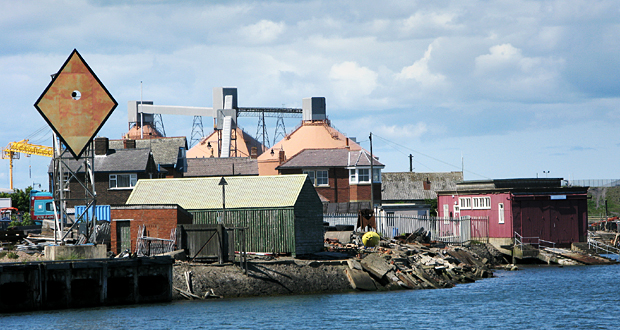
Last Sunday I went to Keswick to see Eliza Carthy at the Theatre by the Lake. It was a fine day that had the feel of the last day of summer. I strolled around the town – which was surprisingly busy, I thought – and browsed in the outdoor shops. It’s sale time because it’s the end of the season and next year’s stuff is about to come in, and perhaps also because the economic slow down is having an impact. I sat outside at the Lakeland Pedlar with my elderflower cordial and carrot cake and gazed up at Skiddaw. The mountains were lolling in a loose grainy mist, benign and summery. I was wishing I’d brought my boots. But I hadn’t.
I wandered along the lake path from Crow Park down to the National Trust Centenary Stone at Calfclose Bay. On the way back I sat for a while on a seat near the Ruskin Memorial at Friar’s Crag looking out over Derwentwater. Perhaps his unquiet ghost sat down with me for a while. Places are made of memories. I was thinking about how double-edged they are, how the past perpetually constructs and reconstructs the present, and how the present constantly reconstructs the past. I gazed at the soft roller coaster ridge of Causey Pike and the snaggy peak of Eel Crag, like a lover gazing at a beloved he cannot reach. Memory is a landscape of longing and loss. The power of association is greater than Ruskin wanted to admit. But I wasn’t thinking about any of the many days when I’d walked these hills, any particular adventure or experience. I was just opened up somehow, peculiarly undefended in the face of the mass and texture of the place. I seemed to be somewhere beyond the particularity of events, but somehow there and then in a very particular moment. I wished again that I’d brought my boots. I went past other walkers as if I was carrying a secret, as if I’d stolen one of the hills and it was in my rucksack, wrapped up in my black fleece. When I got back to my hotel room it struck me that I hadn’t taken a single photograph. Some days, I suppose, we must need to just let the moments be. Remembering, like art, is like an an act of love that sometimes feels like a violation.
I sat in my room near the window reading The Observer. But I wasn’t really paying attention. I wasn’t taking anything in. The articles floated by on the skin of my mind. None of them broke the surface tension or sank. I was preoccupied, wrapped in the paradox of being somewhere else at the very moment of being most fully here. It was probably beauty I was really wondering about, and how it had both immediacy and depth. The landscape of the Lakes is something that like most other people I experience as beautiful. There are paradigms of beauty we learn as children and find on every postcard. And yet while I knew that it was a common experience in its appearance and in its immediacy, I felt beauty must also be idiosyncratic and individual in its depth. Surely it’s more than a mere facade. Beauty is recognition. Beauty is knowledge of a kind. I was wondering if memory isn’t at its heart. I doubted that beauty could exist for a being without a memory. Beauty, I thought, in my Ruskinesque register, is a kind of angel of memory.
The articles in The Observer floated by. I was sounding a tad transcendental, I was thinking, a wee bit like a Platonist. A bit high-falutin’ and airy-fairy. Perhaps Ruskin’s ghost was still yammering inside me. I’d have to watch that. Beauty is recognition, but it is organic, material, iterative, cumulative, learnt, synthetic – I was looking for the words, the qualities to nail it down, to make sure it stays where it is, here in the real and ordinary lives of real and ordinary people. Beauty is not beyond us, not elsewhere, not the glimpse of another world. I was getting hungry. It was teatime. I was thinking that perhaps the study of idiosyncrasies of beauty must be like the archaeology or geology of memory. I was thinking I had wasted my money buying a newspaper today.
I had a quick shower and put back on the clothes I’d just taken off. I ate at Casa Bella, where the food is consistently good, much better than it ought to be for the price, I always think. I sat at a table near the window and watched the passers-by. I was feeling okay, I thought.
Eliza is lively and engaging, pale skinned and girlish, ordinary in a way. The intimacy of the venue suited her well and enhanced the sense of her being emotionally and personally close to her audience. This is probably particularly important for a folk artist, where being perceived as remote from her audience might be an unfortunate irony. The perceived distance between an artist and her audience is of course a key element in the experience of the performance. Eliza’s rapport seems utterly natural, as if it’s never had to be worked at. This is an illusion too, of course. She has a nice line in apparently spontaneous waffle, as she might call it, about things her audience of ordinary people know and can identify with, like boyfriends, mobile phones, families, babies, getting drunk, parties, rowing on the lake, and the pirate’s hook that happens to be hanging on the microphone stand. Tonight’s performance was ostensibly as much a conversation with the audience as a performance of the songs from her latest album. The conversation – in actuality a sort of monologue, of course – undoubtedly added context and thus depth to the songs and therefore altered and arguably enhanced them for her audience. The truth is that as entertaining and likeable as she undoubtedly was, I found myself at times wishing she would play a little more. There is depth and common experience – an inescapable humanity – about folk songs which is personal in any case and which can stand alone. I felt like a spoilsport at times, as if I was being a little churlish in my desire to hear her sing and play her fiddle more. And I was, because she is so personable and probably very genuine.
What I like about Eliza’s records – her music – is the intensity, the way the force of her music – rhythm, repetition, persistence, tone, texture, and what have you – ensnares me, wraps itself around me, possesses me. I like the way dark spaces are opened up- chasms – and the way the music is a kind of rope that swings and hauls me around spaces that seem simultaneously dangerous and safe, depraved, reckless and (ha ha – I’ve slipped this one past you once before!) sublime. I like how I’m made to lurch and stumble, teeter and soar, glide and fall. What I like is the palpable physicality of her music, how it reunites me with movement, with the dynamics or kinetics of being an animal in an animal’s world. Maybe this is one of the things the beauty of music remembers for us, the way the body moves, how we made and make the space where we find ourselves as bodies. I’d watched videos of Eliza on YouTube and she seemed to me to be also possessed by the physicality of her music. I had come to witness some of those moments. And I did. Eliza and her band are all strong musicians and seem to be deeply involved with their material. There were times when I got what I came for, the immediacy of Eliza fiddling and stepping and swaying around the stage like a distracted hobgoblin, driven to a dance that is as deep as we are, as deep as any of us can be, and stepping up to the microphone to fathom and release unfathomable emotions. Eliza surrenders her voice to her song, her body to her violin – that’s how good she is.
After the concert she came out into the bar and sat at the table with her CD’s. I bought another copy of Dreams of Breathing Underwater and asked her to sign it for me. She’s pregnant and I wished her good luck with the baby and she thanked me for that. Eliza wants to be the same woman off stage as she is on stage, I thought, and maybe she is, in some ways at least. But it would be a mistake to assume that a Yorkshire lass has any less of a secret life than Leonard Cohen.
The next morning I had intended to hire a rowing boat and go out on the lake for an hour. I was thinking I might drown the ghost of Ruskin once and for all. But it was raining steadily. I drove down past Thirlmere, over Dunmail Raise and through Grasmere in the quiet silvery rain and it looked very like the first day of autumn. I went to Ambleside and browsed around the outdoor shops there, but again bought nothing. I wandered around the town and spent a little while in the Old Courthouse Gallery looking again at the paintings of Libby Edmondson, which I particularly like and whose style in some ways reminds me of mine.
When I got back home there was only De Kooning in the house. I could hear the Napoleon still ticking in Margaret’s bedroom. De Kooning gave me a nudge with his head and I took him to the kitchen and gave him some prawns. I told him Eliza was good but asked him not to mention Ruskin. I went through to the conservatory as I checked my mail. There were seven large onions on the coffee table. The clatter and rumble of the Citadel men was relentless.
When Margaret came in I asked her if she’d wound the Napoleon up.
‘I have not,’ she said, emphatically. ‘I haven’t tampered with it at all. Brenda has advised me that intervening would not not a good idea.’
‘I didn’t know she knew about clocks.’ I said. ‘There’s no end to her talents, is there?’
Margaret rolled her eyes. She didn’t need to tell me that the awakening of a long dead clock would be regarded as a sign by Brenda. What it was a sign of was less obvious, of course.
‘Did you tell Brenda about my spider’s corpse theory?’ I asked.
‘Yes,’ Margaret replied, tersely. ‘She said that such an explanation is so far fetched and unlikely that it can be safely dismissed.’
And yet the idea that the clock might start up again in contravention of the laws of nature and in doing so have a higher meaning, which might be of very great significance indeed, isn’t so unlikely, it seems.
‘Oh,’ I said. ‘Okay.’
On Thursday I noticed the clock was still ticking and I asked Margaret again if she had wound it up. Again she said she hadn’t.
‘Then someone has,’ I said. ‘Because even if we don’t know why it started, what we do know is it won’t keep going unless someone keeps winding it up. Perpetual motion isn’t possible.’
‘I haven’t touched it,’ Margaret repeated. ‘And I won’t. But let me tell you this – that clock may never stop again. Brenda’s right, everything happens for a reason, and that Napoleon is no exception.’
‘I think I’ll call the Greek,’ I said.
‘You can call who you like,’ Margaret said. ‘There are some things that even the Greek can’t explain.’
I rang the Greek. He said to be patient. Sooner or later the Napoleon will fall totally silent again. But it hasn’t done so yet and it’s beginning to worry me. Imagine if the world according to Brenda just happens to turn out to be true.
.
a broken napoleon and a dead spider
Returning to work after a holiday is always a difficult transition, like stepping from a garden into a bullring. Transitions like this are often best managed by a ritual, and in my case this involves washing and ironing all my clothes, polishing my shoes, trimming my sideboards, and having a long bath. It’s as if the odour of recreation must be washed from me, as if to return to the old world I must make myself a new man. Going back to work is like rebirth. I must purify myself before my eviction from the womb.
Things have been surprisingly quiet at work. Sightings of the Arab have declined dramatically it seems (although Robin Hood may have become a permanent resident). Debs says that in part this is because Elephant Carmichael has been remanded in custody on charges of aggravated burglary and attempting to pervert the course of justice and Flinty’s keeping his head down. More significant though is that Flinty’s shacked up with Molly Armstrong in her flat at Rothesay Terrace down at the Station and is otherwise engaged, at least for the time being. What’s more, the schools are open again, the nights are drawing in a bit, and the weather hasn’t been good. The population of Flinties is dwindling rapidly, as if they’ve been nothing but summer migrants. I spoke to Gilmour a day or so ago and told him so and that I thought things were settling down. He told me that this was great news.
‘Looks like we’ve cracked this one, eh?’ he said. ‘I’ll let the Director know. Good work!’
‘Thanks,’ I said. ‘We do what we can.’
It rained heavily last weekend. Morpeth was flooded and Northumberland finally became the victim of freak weather and got the publicity and pity that for so long it has been denied. A disaster can be a cloud with a very silver lining. Eat your heart out the Vale of York: Charles and Camilla visited us today. They dallied a while, meandered along the loyal fringe of their postdiluvian subjects and shook a few of their damp northern hands. The television report showed them at a chip shop in Morpeth town centre. I think it was the Market Chippy on Newgate Street, next to the cheese shop. I like the look of Charles. He’s consistently odd. Somehow he reminds me of a gundog, one that perhaps lacks a little in the way of grey matter but who has an irrepressible sense of mischief. A springer spaniel perhaps. A one that would chew your furniture. He also sometimes reminds me of a bedraggled fledgling, an owlet perhaps.
The Widow Middlemiss hasn’t yet returned from Derby. Despite the heavy rain her property has suffered no further flooding. Griff has obviously taken steps to avoid another PR disaster. When I came in from work earlier this week Margaret was in the Widow’s garden dead-heading her French marigolds and hoeing the borders. I glanced across to see if Hugo was back. He wasn’t. I went inside and made myself a cappuccino. I was sitting in the conservatory with De Kooning pondering the realities of wage slavery when I became aware of a faint ticking. I followed the sound to the door of Margaret’s bedroom. I pushed it open slowly, as if I was about to find a bomb. What I found was a lot stranger: the ticking turned out to be the Napoleon Mantel Clock on her dressing table. It had come back to life. It was ticking enthusiastically. It had broken ranks with its twenty two silent and motionless companions. It now said it was almost five o’clock, which wasn’t right but suggested it had probably started working again about two hours earlier, at which time I knew Margaret would have still been at work.
‘The Napoleon in your bedroom is working,’ I said to Margaret when she came back in.
‘It can’t be,’ she said. ‘It’s broken.’
‘It can’t be broken,’ I replied. ‘It’s ticking.’
She went to the bedroom and checked. She was still wearing her wellies and green gardening gloves. She came back with her mouth hanging open.
‘How can this be possible?’ she said. ‘That clock is broken. The Greek said it was beyond repair.’
‘The Greek was obviously wrong,’ I said.
‘He’s never wrong. The Greek is never wrong. Never.’
My pizza was ready. I sat for a while eating and pondering the mysterious resurrection of the broken Napoleon. It had the look of a miracle about it. But it wasn’t, of course. I asked Margaret if it was okay if I examined it. I went into her bedroom and gazed at the ticking timepiece. I picked it up with both hands and looked deep into its face. It was now keeping perfect time. It had a sort of blank insolence about it. A smugness even. This was a clock that wasn’t about to give anyone an account of its baffling revival. I stood it back down on the dressing table, next to a copy of Eckhart Tolle’s book The Power of Now. Brenda had recommended this to Margaret a few days ago. I picked it up and flicked through a few pages. Zen meets narcissism. Absurd and incoherent. Pure Brenda. The perfect companion for a clock that rises from the dead, I thought.
I rang the Greek. He told me there was simply no way the Napoleon could be working. It was a broken clock. I told him it had. The Greek was puzzled.
‘Then I was wrong,’ he said. ‘It was never broken. A broken clock is a broken clock, and it cannot repair itself.’
I told Margaret I’d spoken to the Greek and that he’d said the clock must have been in working order all along.
‘If that’s so then why didn’t it start ticking before now?’ she said. ‘And why did it start now? There’s something funny going on here, I’ll tell you that. Clocks just don’t stop and then start again without reason months and months later. It doesn’t make sense.’
‘There’ll be an explanation,’ I said. ‘But we might never know what it is. Perhaps a dead spider was jamming the works and it has finally decomposed or its corpse has finally fallen from the cogs. That could have happened.’
She rolled her eyes. ‘Oh, yes, that’s very likely,’ she said. ‘The corpse of a spider falling from the cogs. I think I’ll give Brenda a ring.’
I glanced at De Kooning. He was washing his face with his paw. Behind me I could hear the television newsreader saying that a junior whip has come out and said openly that their should now be a leadership contest in New Labour. It was starting to rain and looking very dark outside. The economy’s in recession. I wondered what Gordon was doing tonight.
.
 yammering