the happiest man in the world
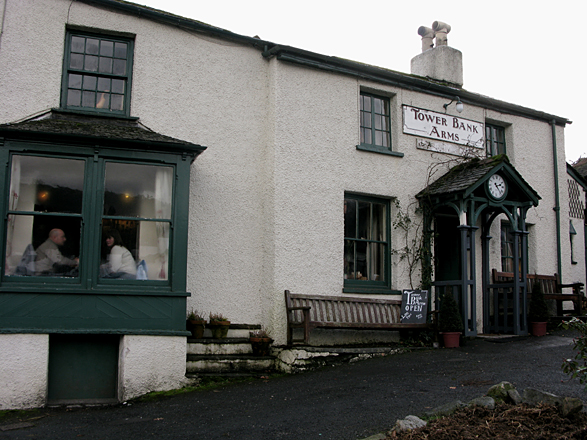
I spent all last week in Bowness. I rented a very comfortable, secluded house in the woods near Longtail Hill. From a picture window in the living room I could see over the town to the head of the lake and the Fairfield Horseshoe and the other hills above Ambleside.
On Tuesday it rained. I drove down to the Abbot Hall Art Gallery in Kendal, a gallery I’ve always liked since I visited it some years ago and first saw Paula Rego’s paintings there. The current exhibition is of the paintings of Robert Bevan and the Cumberland Market Group. I’m slightly embarrassed to admit that I wasn’t familiar with Bevan’s work until last Tuesday. He was an excellent painter. His best stuff was done in the last twenty years or so of his life, in that magical age for painting that flowered with the Post Impressionists and bloomed with amazing vitality for fifty years or more. Bevan – who the catalogue describes as a Neo-Realist – was cut down in his prime in 1925 shortly before his sixtieth birthday.
The Cumberland Market Group have nothing to do with Cumberland, despite the exhibition being in Kendal. The catalogue suggests the exhibition was originally shown in Southampton, and the Cumberland Market in question is a square in London in an area to the east of Regent’s Park, just south of the basin of the Regent’s Canal. Bevan had a studio in the Square and did some enchanting paintings of it, one of which is on the cover of the exhibition catalogue. It catches the geometry of the place with an apparent exactness, but the pastelly colours are beautifully modulated – lavenders, pinks, blues, greys, and creams. Some of the other paintings of the area in the catalogue deploy darker tones and have a greater tonal contrast, but all seem architecturally remarkably true in their detail. His best known paintings it seems are those involving horses. He does a mean horse, that’s for sure, catching perfectly their muscular grace and skittish dignity. But again it’s his composition and use of colour that impressed me most, the exactness, the control, the limited palette, the strong dark blues and the orange-tans of the coats of the horse traders. Bevan’s a painter I can hardly believed I missed.
On Tuesday night it snowed a little. On Wednesday morning I decided I’d take it easy. I wandered down to catch the ferry across Windermere. Bowness was a Viking settlement a thousand years ago and there’s been a ferry here since at least that time. The ferry now carries cars as well as pedestrians and cyclists. It crosses the quiet lake slowly, fastidiously, as if undoing history, as if recalibrating time. I’ve read that as we get older time passes more quickly because our metabolism slows down. The ferry trip from Bowness to the Hawkshead side of the lake seems to somehow alter the metabolism of the world. As you step off you could imagine that days, months, even years might pass before you make it through the woods. Each step might take an hour. You’re in the kind of place where nothing might ever change, where eternity starts to make sense. I decided I’d follow the waymarked path to Beatrix Potter’s old house at Hill Top in Near Sawrey, a distance of only two or three miles.
As I made my way up the hill and through the lanes and woodland paths to Far Sawrey it began to snow again. There was little wind and straight up and down soft hail stones dropped quietly all around me. I put out my hand and caught a few. Although I saw almost no-one on my walk there, there were quite a few visitors at Hill Top. The snow had stopped and as I entered Beatrix’s house the sun came out. The rooms of the house are quite cramped and dark brown. The doorways are low and the windows are small, as is Beatrix’s four poster bed. No wonder she felt such an affinity for rodents and other small creatures, I thought. Of course, the truth is I don’t know that much about Beatrix Potter either, although I’ve seen the film with Renee Zellweger, of course, and I’ve got a Peter Rabbit teacup that someone once gave me.
While I was strolling back I caught up with a white-haired old man walking slowly ahead of me with a wooden staff. He asked me if I’d been to ‘the Potter house’. I said I had. He remarked that he could tell I wasn’t a local and asked if I was on holiday. He told me he lived near Lindeth. I told him the house I was staying in was in the woods not far from there, near Lindeth Howe Country House Hotel. The old man reminded me that Beatrix Potter’s family used to rent that house in the early years of the last century, another thing of which I happened to be ignorant. He told me Beatrix loved the house and bought it for her mother in 1915. It seems Beatrix wrote and illustrated a couple of her stories while she was staying at Lindeth Howe with her family a hundred years or so ago.
‘You know this place well,’ I said to the man.
‘It comes with living here for so long,’ he replied. ‘I’ve never been further north than Grasmere and only once been south of Kendal. I went to Morecambe in 1957 for my sister Janet’s wedding. But I always say you don’t need to go far to see the whole of human life. Cast your eyes around these hills. There’s nothing much that’s happened anywhere else in the world that hasn’t happened to the folks that live right here – or nothing much that matters, at any rate.’
‘Aye,’ I said. ‘You’re probably right. But for the rest of us those things don’t happen in a place as beautiful as this. You’re lucky to live here.’
‘Yes, I know that. And there’s not a man on earth who could tell me otherwise. I’m the happiest man in the world. No man could have had a better life than I’ve had, I’ll tell you that.’
As we came out of the woods going down the hill just past Bryers Fold, the old man pointed over the lake towards what I took to be a house on the hill above Storrs.
‘Do you know who lived there?’ he asked. I shook my head. My ignorance was about to exposed again, I thought.
‘No,’ I said. ‘Should I?’
‘No, you won’t,’ he said. ‘It was Florence Nelson.’
The name meant nothing to me.
‘Who was she?’ I asked. ‘A writer? A painter?’
‘No, nothing like that. Florence was a murderer. Everyone around here knows the story of Florence Nelson. It all happened nearly fifty years ago now. Florence was a beautiful but rather eccentric young woman. She had her eye on a man called Ned Perfect. One day she got it into her mind that another local lass, the buxom and very alluring red-head Sharon Sweet, also had her eye on Ned. Florence saw Sharon giving Ned an orange one day and she decided there and then that her rival would have to die.’
‘Love’s a messy business sometimes,’ I said.
‘But not usually as messy as it was going to be for Sharon,’ the old man said. ‘You see, Florence had at that instant also decided on the way Sharon was going to die. She was going to be flattened by a steam roller. There were a couple of snags, though.’
‘Florence didn’t own a steam roller?’
‘Yes, that. And she didn’t have a licence to drive one either.’
‘Oh.’
‘Yes, you see, Florence always regarded herself as a good law-abiding person, and she was not about to take a steam roller on a public road unless she was fully qualified to do so. For the next nine months she went to Lancaster every Saturday morning until she passed her test. She purchased herself a second-hand steam roller, a Wallis & Steevens Advance six tonner. She painted it bottle green and hid it deep in the Black Beck Wood. She waited for her opportunity. She knew that every Sunday Sharon walked from her home up near the golf course all the way down the hill, straight over the crossroads and down Longtail Hill on her way to the service at St Martin’s. There’s no footpath on this road. Florence watched Sharon for weeks. Everyone knew you could set your clock by Sharon and Florence soon discovered that every Sunday at exactly thirteen minutes to one Sharon came around the blind bend near the bottom of Longtail Hill and, head down, continued climbing towards the junction. On the following Sunday Florence drove her steam roller out of woods and made her way up to the crossroads at Ferry View. She waited there until fifteen seconds before thirteen minutes to one, at which moment she threw the throttle wide open and set off hurtling down the hill. An instant before the machine hit her Sharon looked up and saw Florence at the wheel. There was a fixed deadpan expression on Florence’s face. No glimpse of pity, no glimpse of glee. No glimpse of any emotion but blind determination. Sharon was flattened beyond all recognition. Her remains were almost seven feet wide and over twelve feet long. She was identified by the silver crucifix she always wore and the wide arc of her lovely red hair embedded in the tarmac. Some say strands of Sharon’s hair can still be seen there, even after all these years.’
We crossed the road and followed the path through the woods and on towards Claife Station. It was a bright afternoon and the sun was glittering on the lake.
‘Florence was sentenced to incarceration for the rest of her days, of course,’ the old man continued. ‘She was sentenced six days before the day on which she would have married Ned Perfect. Throughout the trial Florence never once expressed the slightest remorse for what she did. She always blamed Sharon for her own fate. For Florence death was the price any woman would have had to pay if they even so much as dared to bat an eyelid at Ned. But the story doesn’t end there, of course. No, not by any means. Florence Nelson wasn’t finished yet.’
At that point the old man asked me to walk on as he needed to relieve himself and was becoming desperate. He said he’d catch me up in a minute or so at the ferry landing, which was only a hundred yards or so further on.
At the ferry landing I sat on the seat looking up Windermere past Belle Isle to the snow gleaming up high on Rydal Head. The ferry arrived about ten minutes later. The old man hadn’t made it on time. As the ferry slowly crossed the lake to Bowness I kept looking back for him. The white-haired man was nowhere to be seen.
On Thursday I drove to Coniston to go for a walk on the snowy fells. Before I did so I went to Brantwood, the house on the east shore of the lake which was Ruskin’s home for the last twenty five or so years of his life. Owen Vardy had described it to me as ‘astonishing’, and he was right. The house is spacious and light and full of beautiful paintings and furnishings and books and objects from nature. There were a number of Pre-Raphaelite pieces, which I thought to myself were sure to have had Owen swooning on his visit. He loves that sort of sublimated metaphysical yearning. Brantwood sits on the hillside overlooking the lake and has fine views across to the Coniston Fells – Dow Crag, Swirl How, Wetherlam, the Old Man himself. To live like this in a place like this could only ever be a privilege.
At the little bookshop I bought a couple of postcards and a little Penguin paperback from the Great Ideas series – ‘On Art and Life’ , which contains two essays by Ruskin, the first being ‘The Nature of Gothic’ which was first published in the second volume of ‘The Stones of Venice’ in 1853. The Ruskin quote on the cover of the paperback is “You must either make a tool of the creature, or a man of him. You cannot make both”. Few socialists could fail to admire Ruskin and to admit their debt to him. Even my dad’s got a soft spot for him.
I drove back down the tortuous undulating singletrack road into Coniston village. I parked at the Tourist Information Centre just opposite the internet café. On my way towards the fells I stopped off at Ruskin’s grave. He died in 1900 at the age of eighty one. Someone had placed two small bunches of fresh yellow daffodils beside his headstone. The whole graveyard was full of scattered purple crocuses and dense clumps of droopy snowdrops. I glanced up at the mining cottages. I headed for the the Old Man and the snow.
As I drove back into Blyth on Saturday for once the place looked drab and uninteresting to me. It looked messy and run down. For a brief moment it didn’t look to me at all like home.
.
the skies in nature aren’t made out of paint

At teatime last Friday I noticed a pair of glass earrings and a big green bottle of Becherovka on the table in the conservatory.
‘Have you seen Brenda?’ I asked Margaret, who was in the kitchen topping and tailing parsnips.
‘Yes,’ she said. ‘She brought me those crystal earrings back from Prague. Aren’t they lovely?’
‘Some of the old Czech herbal paint stripper too, I see. So how are things with her and Tristran?’
‘Oh they’re fine,’ Margaret replied, in an I don’t know what all the fuss was about sort of way. ‘They’re all loved up and happy again. They had an absolutely wonderful time. They bought each other amber amulets and they’ve both vowed to wear them forevermore. Brenda bought some really beautiful lace for herself too and a wooden marionette for her consulting room.’
I nodded. ‘That’s good,’ I said. ‘Tristan’s okay.’
I sat down to drink my cappuccino. De Kooning came in and jumped up beside me. I’m reading a book of poetry called ‘Beasts for the Chase’ by an American poet called Monica Ferrell. A friend in New Jersey sent me the book. Ferrell wasn’t a poet I’d heard of till then. She turns out to be a bit old-fashioned and prophetic in her tone at times, quite earnest, although quite good at her craft. She strikes me as one of those poets who imagine a poet is a seer, someone with special access to a world behind and beyond this one. Such a vision (!) always entails a belief in the supernatural, often under the guise of the primal. Such poets often invoke animals as their metaphorical selves or equivalents, their spiritual alter egos and agents in the other world. Such poetry always pretends to show us what we really are, what our essence is, and to show us the eternal world our souls inhabit, the world behind the veil of perception. It’s all seductive nonsense, of course. Poetry certainly somehow plugs fairly directly into the way we make the world and the ways in which we make it make sense. But it’s an exercise done with words, just as music is an exercise done with sound and painting an exercise done with pigment, canvas and brushes. I like Tam Lin as much as the next person, but anyone who thinks that at Halloween he was turned into an adder and a bear and a burning gleed really is away with the faeries. That sort of stuff doesn’t even happen in Glasgow. Poetry and truth have a much more oblique and complex relationship than some poets imagine. We need a poetics that is rigorously non-dualist. I’m sure there must be critics out there who’ve tried to formulate something to rescue us from the mire of misty-brained mythologies. I must go on to Amazon some time and see what I can find.
‘So, De Kooning’ I said. ‘What do we make of this stuff?’
He put his front paws on to my leg and looked up at me. His right ear flicked a couple of times.
‘Yes, you’re right, we prefer Ted Hughes, don’t we?’ I said. ‘We Brits like mumbo jumbo with a bit more muscle.’
It’s been much warmer for the past few days. On Sunday it was dry and almost spring-like. I went out for a bike ride to make the most of it. I rode across to Bebside and up the Heathery Lonnen to the Three Horse Shoes. I freewheeled down the hill from High Horton Farm and over the Horton Bridge and then went up through the new housing estates towards the Nelson Industrial Estate. There was a noticeable north westerly breeze. I took the road past the Snowy Owl towards Blagdon. I glanced over at the new opencast site. It’s on the estate of those famous stewards of the landscape, the illustrious Ridleys. Matthew Ridley was a prominent figure in the development of Northern Rock and not a man to let concern or consideration for the needs or feelings of other human beings get in the way of personal profit. In fact Matt can’t get his head around the idea that anyone can actually do such a thing, because surely it’s not human nature to think of anyone but yourself. The planning application was rejected by the County Council but overturned by the government on appeal. It’s another shameful mess. I turned left at Blagdon went south past the Holiday Inn to the Seaton Burn Roundabout. The wind was finally behind me. It’s about ten miles home from there. I went via Arcot Lane, High Pit and Shankhouse.
When I got home I did a bit of gardening. I took the secateurs to last year’s withered stragglers from the catmint, lopped some branches of some of the shrubs and cut back the fuschia almost to the ground. New growth is already beginning to appear from the earth and the snowdrops are already flowering. Winter’s on its way out.
I’d finished the painting I was doing of Seaton Sluice. During the week a pack of five Loxley 16″x16″ canvases had been delivered. I decided I’d do another painting of Seaton Sluice on one of those, using the first one as my source. I underpainted the canvas in cadmium yellow and read The Observer while that dried. Then with a big flat brush I scribbled, scrawled and slapped on a sky in titanium white, burnt sienna and burnt umber. It was dramatic and swirly and turbulent and as I let myself get into it I was aware that it was very Turneresque and that it was Turner I was stealing this sky from. It was probably the influence of the burnt sienna, a colour I have only recently added to my palette, used with white on a yellow ground. I think I was somehow remembering The Fighting Temeraire – there was a print of this painting on the wall at my old school, I now recall – and The Slave Ship, I think. Turner is hard to emulate in acrylic paint though because the paint dries too quickly and doesn’t allow you to use glazes very well or to achieve those beautiful subtle gradations and colour shifts. When I’m a better painter I’m sure I’ll want to use oils a lot more. The sky I produced was of course nothing like a sky you’ll ever see in nature. I don’t think that ever bothered Turner much, and it certainly doesn’t much bother me either. After all, the skies in nature aren’t made out of paint.
On Tuesday morning I had a meeting at the Blyth office. It was another nice morning and after the meeting I decided to have a walk over to the quayside to look at the river for a few minutes before I went back to Ashington. I spotted Tristan’s white PermaPlumba van parked on the quayside close to Eddie Ferguson House. Tristan was sitting alone on one of the benches at the other side of the fence.
‘Hi, Tristan,’ I said. ‘What brings you to these parts?’
‘Just killing time, mate,’ he said. ‘Nothing better to do, I guess.’
‘Still no work, eh?’
‘Dead as a door nail, my fweind. Dead as a door nail. I’m telling you, this wecession will close Bwitain down if Bwown doesn’t sort it out soon.’
‘Do you think he can do that?’
‘No, I know he bloody well can’t. But let’s not pwetend he had nothing to do with getting us into this mess. He should pay the pwice.’
‘So how was Prague?’ I said. ‘Margaret tells me it was the business.’
‘Did she?’ Tristan said, and turned to look me in the eye, as if to see if I was joking. ‘Well, Pwague’s a fine city, sure enough, a place worth seeing.’
‘But you wouldn’t go back?’
He shrugged and gazed out over the river towards the bauxite silos on the far bank. A couple of kids were fishing on the jetty just downstream from there. The first wind turbine loomed above them. ‘Can I ask you something off the wecord?’ he said. ‘Just between me and you?’
‘Sure,’ I said. ‘Anything you like.’
‘Have you heard of a bloke called Elvis Devlin? Wuns a bus company called Mephisto Twavel?’
‘Listen, I know about it, Tristan,’ I said. ‘Margaret told me.’
‘Yeah,’ he said. ‘Yeah, I thought you might know.’
‘It’s no big thing,’ I said. ‘It’ll go no further than me.’
‘Oh no, no,’ he said. ‘That’s fine. That’s fine.’
‘I thought you and Brenda had sorted that out. I thought things were cool between you again.’
‘Bwenda’s vewy needy, you know. She’s vewy insecure. She’s got twust issues, weally big twust issues.’
‘But this isn’t about anything you’ve done, is it?’
‘The thing about Bwenda is you’ve always got to do something to pwove you love her. That’s what the Pwague twip was about. All the fuss she made about her Chwistmas pwesents. Bwenda doesn’t know what the weal thing is. If I was the wichest man in the world and gave her evewything money could buy, it wouldn’t be enough. Tomowwow she’d want something else. Bwenda thinks that if you don’t give her pwesents you don’t love her. The thing is, she’s almost got me bwoke – but I daren’t tell her. I’m wunning our welationship on my cwedit card now. The cwunch is bound to come!’ He laughed a little.
‘Now you know how Gordon feels,’ I said, laughing too, trying to keep the thing in the air. ‘So what you’re saying is that the only way to make sure Brenda doesn’t believe you’re not about to go off with some other woman is to keep on giving her things, and that if you don’t she won’t trust you anymore?’
‘Yes, exactly. You know how matewialistic she is. But it’s weally about twust, not gweed.’
‘But surely there’s no way you can give her things indefinitely? You’re not Richard Branson!’
‘No, you’re damn wight, I’m not Wichard Bwanson. I’ve told her that. I said “Bwenda this is about twust. For you pwesents are pwoof that someone loves you.” That’s why she’s attwacted to wich men, like this Elvis bloke. It’s because they can give her an endless supply of expensive pwesents. You know, that’s why I think she pwobably went for me now. Because when we met I was doing well. I was wolling in it. She’s so insecure she needs you to give, give, give. I asked her: “Bwenda,” I said, “Would you still think I loved you if I couldn’t buy you things?” “Of course I would,” she said. “What on earth do you take me for?!” But she wouldn’t, I know for sure she wouldn’t.”
‘So what’s the answer?’ I said. ‘Maybe she needs to life coach herself a bit.’
‘Oh, yes, I’ve pointed out the iwonies of this situation, believe you me I have. Maybe there is no answer. But the cwunch is going to come before long, that’s for sure. I’m spent up and there’s no work coming in. You can’t wun a welationship on cwedit. Pretty soon I’ll be bankwupt.’
‘Maybe things’ll take a turn for the better soon,’ I said. ‘Gordon’s green shoots might be springing up all around us any day now.’
‘Fat chance of that!’ Tristan said. ‘And besides that would only pwolong the agony. It wouldn’t solve the pwoblem. Bwenda needs to learn to twust. The thing is of course that it isn’t weally men she doesn’t twust – it’s herself she doesn’t twust. And evewy time she cwaves for another pwesent she knows she can’t be twusted. People who can’t be twusted don’t twust others, isn’t that twue? Because they think evewybody’s just like them. Bwenda can’t see that anyone could ever love her for what she is. It’s a self-worth thing with her. It’s as if she thinks only expensive things will ever make her good enough. But of course they never will.’
We sat quietly for a minute or two watching the river. A seal popped up and I pointed it out to Tristan. He said it had been there all morning.
‘He’s cute, isn’t he?’ I said.
‘Yeah,’ Tristan said. ‘He’s really beautiful.’
‘Anyhow,’ I said, ‘I need to be making my way back to work. I hope things work out okay for you and Brenda.’
‘Thanks, mate. Me too. Oh, and by the way, do me a favour, don’t tell Margawet you’ve seen me. I don’t want it getting back to Bwenda where I spend my days.’
‘Brenda thinks you’re working?’
Tristan nodded. ‘Yeah, and I need to keep it that way. God knows what she’d do if she knew I wasn’t’
‘Your secret’s safe with me,’ I said.
I drove past Ridley Park and along Wensleydale Terrace, past the site of the demolished Wellesley School which now stands deserted waiting for the economy to turn to make it worth building houses there. I reached the South Shore estate and glanced over at the sea. At the roundabout I went up South Newsham Road. It struck me that Blyth no longer has outskirts. It has a settlement boundary which marks the point where fields will turn into housing estates. The transition is sudden, in no way gradual. You can’t really say you’re coming into Blyth these days. You’re either in or you’re out. You’ve arrived or you haven’t. I turned on the CD player and listened to The Killers’ Sam’s Town album. I played it loudly. I crossed the railway at South Newsham and cruised up the Laverock and on to the Spine Road.
I parked in the public car park at the bottom of the street. As I was walking up to the office I met Owen Vardy coming down the hill. He was wearing a loose wrinkly oatmeal-coloured linen jacket – it was at least a size too big for him – and pale baggy Chinos. He had a stripey brown and pink scarf wrapped around his neck, Dr Who style. He was leaning into every step, each of which appeared cautious and measured. Owen walks like a man on a treadmill, a treadmill he thinks might at any moment either stop completely or speed up dramatically. He was carrying an Asda ‘Bag for Life’.
‘Hi, Owen,’ I said. ‘Have you been shopping?’
‘No,’ he said. ‘Well, not really. I’ve been to a meeting about the Collingwood children. I carry my files in this bag. It’s the perfect size, you see. Actually, between you and I, I did take a quick toddle over to the high street to pick up a few vitamins.’
‘Oh, so what vitamins do you take?’
‘Oh, you know – zinc, vitamin C, B complex, vitamin A, vitamin D, vitamin E, selenium, folic acid, echinacea, evening primrose oil, flax oil, omega-3 and omega-6, saw palmetto, feverfew, calcium, magnesium, potassium, ginkgo biloba, ginseng, garlic, CoQ10 . . . you know, just the usual stuff.’
What, no Becherovka? I thought to myself.
‘So are you ever ill, Owen?’ I asked.
‘Oh yes, of course. I’m just the same as everyone else, you know, I catch colds and what have you. But there’s no point in taking unnecessary chances, is there? Oh, by the way, did you hear the latest about Jack?’
‘No,’ I said. ‘I don’t think so. Don’t tell me he’s been dressing up again?’
‘No, no. He’s got rid of his Skoda and bought a motorbike. A big shiny black one. I think it might be a Kawasaki. It’s a very dangerous machine, a very dangerous machine. I think he’s being very foolish, actually.’
‘It’s his life, Owen,’ I said. ‘Or death, as the case might be.’
‘Exactly. Do you know he’s the same age as me? In fact we were born on exactly the same day. You’d never catch me on a motor bike.’
‘I don’t think I’d bother trying,’ I said. ‘I wouldn’t stand a chance.’
For a moment Owen missed the joke. He looked at me quizzically, his head slightly to one side, a half smile frozen on his face. What was he listening for, I wondered. Then he got it.
‘Ho ho,’ he laughed. ‘Very good. Yes, very good.’ And then he slid straight back into parson-like caution and prudence. He put his fingertips on my sleeve. He leaned in close to me.
‘And you’ll not have heard what he said to Tallulah either, have you?’ he said. ‘He offered to buy her a full set of leathers – a red leather bodysuit. He offered to take her out on his pillion.’
I laughed. ‘Oh my God, he’s shameless, isn’t he?’ I said.
‘Exactly,’ Owen said. ‘He is shameless, and lacking in any sort of dignity too, I think.’ Just for a moment I fancied I caught the elusive vinegary whiff of piety and prurience.
‘Any how,’ he said, looking at his watch, ‘I really must be getting along now or I’ll miss my bus.’
Owen always travels by bus, for road safety and environmental reasons, he says, although given how much he must spend on vitamins I wonder if he could afford a car in any case. As we parted I was thinking I must read George Herbert again.
When I went into the office Mandy Potts was in reception with Apple and Sparky. She looked like she’d been crying.
‘Hi, Mandy,’ I said. ‘Are you all right?’
She shook her head slowly. She wasn’t. When I went through to the team room I asked Angie what Mandy wanted.
‘She wants to go to a refuge.’
‘Again?’ I said. ‘Why? Surely Mr Zee hasn’t turned nasty?’
‘No,’ Angie said. ‘Anything but. No, it’s not that. Elephant Carmichael called to see her last night. He gave her a message. He told the Arab said not to forget that what’s his is his forever. He told her the Arab said to say hello. When they got up this morning there were four piles of sand on the step. She said they looked like four little graves. ‘
.
prague, the skylark, the mephisto express

We had more snow last week, again on Thursday. For a while it looked like it would never stop. ‘So this is how the world ends,’ I thought to myself. Most members of my team went home early. There were rumours that the Spine Road might be closed so at about half four I set off for home. It turned out that the snow was already turning to sleet and rain by then. The wild apocalyptic blizzard was a false alarm. Nevertheless it was a slushy slither back down the Laverock and along Newcastle Road into Newsham.
The snow almost interfered with Tristan and Brenda’s Valentine trip to Prague. Once or twice on Thursday the airport at Ponteland was closed for a while. But the snow is the least of their problems, it seems. Tristan had discovered earlier in the week that Brenda has become friendly with a man she’s been life-coaching. The man’s problems revolve around his marriage, it seems, and making decisions about how he is going to spend the rest of his life. He owns and runs an executive coach company called Mephisto Travel and he has a big house in Tynemouth, it seems. He’s made his fortune and he’s looking forward to taking it easy and seeing the world. What he doesn’t now know is who he wants to be with him on his travels. The man’s name is Elvis Devlin.
‘Elvis Devlin?’ I said to Margaret when she told me the tale.
‘Yes,’ she replied. ‘That’s right. Do you know him?’
‘Do I know Elvis Devlin?’ I said. ‘Do I know Elvis?’
‘Yes, Elvis. Do you have a problem with that? It’s no sillier than your name, is it?’
‘You’re right. I just hope he’s not an impostor,’ I said. ‘I just hope he’s not a Devlin disguise.’
Margaret groaned and got on with cutting up the onions.
It seems that on a couple of occasions Brenda has been seen having coffee with Elvis Devlin at the Milkhope Centre near Blagdon. This is far enough from Whitley Bay to suggest that these encounters did not happen by chance, although that apparently is exactly how Brenda claims they did happen. (But in any case doesn’t everything happen for a reason, Brenda? I heard myself thinking.) Tristan’s suspicion is that Elvis might be singing Viva Las Vegas in her ear. So Prague nearly didn’t happen. Margaret says it’s a make or break weekend for them. She’s convinced that Tristan’s fears are unnecessary, but you know what the song says about suspicious minds.
On Friday morning the roads were okay and most people made it in. At about lunchtime I went downstairs to make myself a coffee. Lily was checking out the weather on the Met Office website. Michelle was having a sandwich and doing her sudoku book.
‘We’ve got another one,’ Lily said. ‘I’ve got another mother who’s got a spirit in her house. She says it knocks thing off the windowsills at nights and taps on the window.’
‘Has she got a cat?’ Michelle chipped in. Lily laughed.
‘No,’ she replied. ‘She hasn’t even got a broom. The place is mingin’!’
I stood in the kitchen with my hands in my pockets, gazing at the filing cabinets and waiting for the kettle to boil. I filled my cup and wandered back out into the team room. Angie came in and Lily asked her how the roads were. I sat down in Debs’ chair and put my feet on her desk.
‘You don’t believe in ghosts, do you, Lily?’ I said.
‘Nah!’ she said. ‘It probably is the cat. Actually it probably isn’t. She’s probably just nuts.’
‘Oh, I believe in ghosts,’ Angie said. ‘We used to have one on the house we had in Forest Hall.’
‘So do you think Lily should call in an exorcist for her client?’
‘Yes, why not?’
‘Probably for the same reason we don’t make assessments from star signs,’ I said. ‘And because it’d get me the bloody sack.’
‘What sign are you, Lil?’ Angie said. ‘Let me guess. Okay, okay, I’ve got it. You’re a Virgo. Am I right?’
‘No,’ Lily said. ‘I’m an Aries.’
‘Oh, yes, of course. How didn’t I see that? How stupid am I?’
‘I’m an Aries too,’ I said.
‘You’re not!’ Lily said. ‘You could never be an Aries.’
‘I am,’ I said. ‘Honestly.’
‘I don’t believe you,’ Lily said. ‘You couldn’t be.’
On Friday night I began a new painting of Seaton Sluice. I’ve painted it before. I’m ambivalent about doing it because it is making a concession to the conventionally picturesque, something I’m trying to get away from. I decided on a low horizon. I was doing a view from the bridge of Rocky Island and the Kings Head pub. I used the canvas I’d underpainted in vermillion a week or two ago. I painted the sky quickly with a big flat brush. Square chunks of white and yellow ochre clouds careering wildly around in a Prussian blue sky.
On Saturday I rode along to my dad’s on the bike. It wasn’t a bad afternoon and the paths were mostly completely clear of snow.
During the week my dad had been to the library. As I was drinking a glass of pineapple juice he gave me a photocopy he’d made of an article from The Blyth News at the end of May 1936. The article reported the death at age eighty one of Harry Clough, the father of Tom Clough, the Newsham Nightingale. “FAMOUS PIPER DEAD”, was the headline, with the by-line “Newsham Man Who Played Before Royalty”. He is said to have died at his home in Plessey Road, of which Brick Row must have been considered a part.
The article said that in 1905 Harry Clough had played for King Edward VII at Alnwick Castle. Until a few weeks before his death Harry had acted as a caller at Cowpen Coal Company, the article said. Here’s a typical paragraph from the article, which is really a eulogy:
His music like his character delighted his audience. In both cottage and palace he enchanted with the folk music of Northumberland. His nature was kind and genial without ostentation. Unassuming and without any love of fame, his art was always at the disposal of charity.
As I recall Harry was buried at Blyth Cemetary, back down on the beach road. I’d ridden past it on the way along. I wondered if I should stop off on my way back and see if I could find his grave. But no doubt I’d have no more luck looking for the grave of the Nightingale’s father than I had looking for the grave of his son.
I asked my dad which route the old road out of Newsham followed. The book on the Cloughs had said it was very rough.
‘It followed the route of Newcastle Road along to where the little roundabout is now, and it turned right there and went up towards the Laverock,’ he said. ‘Of course in those days the houses on the right weren’t there. The store field was there, where they used to turn out the ponies from the pit in summer.’
‘So was it a rough road?’ I asked.
‘It was wet. When it got over the old railway line to the relief pit it took a big sweeping bend around before going up the Laverock. It was often flooded there.’
Laverock is an old word for a skylark. Most people assume this is how the farm on the ridge got its name and that the road got its name from the farm. I’ve never seen any real evidence for this. My alternative theory is that the place name may have nothing to do with the skylark at all. In Cumbria there’s a place called Laversdale. The first element of this is from the Old English personal name Leofhere. I wonder if this name or something similar isn’t the first element in Laverock and that the second is rigg, meaning ridge. There are ridge and furrows in the field beside Laverock Hall Farm and these will date back to the medieval period at least. The farm is also on a ridge, the ridge along which the road from Seaton Delaval to Horton runs. So the history and topography are arguably there to support the possibility that this might be Leofhere’s Ridge. Furthermore, local people usually talk about going up or coming down the Laverock, as if the land form itself is the thing they are climbing or descending. They do not say they are going up to the Laverock. The word is also said with a final vowel that is very close to the i sound in rigg, although admittedly inevitably somewhat neutral. There are other examples around here of false etymologies arrived at and imposed by mapmakers, and this may be another. Rigg and rick are close enough together to allow an obvious aural mistake to be made. It was perhaps this mistake that threw an imaginary skylark into the sky above the ancient ridge.
As I rode home I glanced over to the cemetery, but rode straight by. It was getting late and the light was beginning to fail.
At about eight o’clock tonight I went out for a walk. It was a mild dry evening and there wasn’t much wind. I walked along Sixth Avenue past the front gate to the site of the Citadel. The gates were closed and the security lights were shining eerily on the colossal towering structure. It really is a hellish, oppressive monstrosity, the wrong building in the wrong place. No wonder it reminds me of Kafka’s Castle. I walked through the cut and on to Newsham Road. I walked up into Newsham and down past the first school. From there I crossed Winship Street into Elliot Street. They are already building on the site of the demolished Big Club. As I walked across I was thinking how these sites aren’t like widows: they don’t have to wait for a respectable period before they allow another building to occupy them. I had thought that apartments would be built here and I was therefore a bit surprised that building had started so soon, given the current depression in the housing market. I noticed a sign on the fence. It said “Considerate Construction”. You’ve got to laugh, haven’t you? I went over for a closer look and discovered that the new building appears to be going to be a new library. I was pleasantly surprised and for a moment impressed.
I went down Elliot Street past the take-aways and the betting shop, which was still open for business. An old guy in a flat cap was leaning in the doorway telling the woman inside a story about a bet he’d made. I crossed over to the Willow Tree, which was also open, although there weren’t many in. It seems to be under new management. I noticed there were flyers on the windows for a group called The Buskers, who it seems are playing there on Friday this week. I glanced over to the Brick Row open space. I wondered what sort of music they’d be playing. I wondered if the Cloughs would all be tapping their ghostly pipers’ feet. I walked back down Plessey Road, past the old Grammar school and on under the trees beside the bus stop.
When I got home Margaret was in. She was polishing the old Napoleon from her bedroom. It wasn’t ticking.
‘How did Brenda’s trip to Prague go?’ I asked.
‘I’ve no idea,’ she said. ‘I haven’t heard from her.’
‘But she is back, isn’t she?’ I asked.
‘Oh yes, they came back yesterday, I think.’
Or maybe she didn’t, I thought to myself. Maybe she’s already riding the Mephisto Express to Vegas.
I put the kettle on and went looking for De Kooning. I wanted to put him out in the garden for a while before I did a bit more on my painting of the Sluice.
.
while searching for the nightingale’s grave

It snowed on Thursday night. It was unexpected. For the most part the Northumberland coast had missed the snow that for the last week or so had hit the rest of the country and eclipsed the recession, British jobs for British workers and the relentless destruction of Gaza in the six o’clock headlines. But on Thursday night at about midnight it snowed for about half an hour and turned the landscape white. I joined De Kooning behind the curtain to watch the torrent of snowflakes ticker-taping through the blurred chambers of orange streetlight.
It took me about three times as long as usual to get to work on Friday morning. I crawled with a slow caravan of hatchbacks, 4×4’s and white vans up the temperamental incline to the Laverock Hall roundabout. Going north up the Spine Road to North Seaton I joined another cautious procession and after that a few more jittery queues down the hill into Ashington.
By lunchtime it was sunny and the main roads had cleared. I’d spent all morning authorising stuff on the computer and answering emails and I needed to get out of the office for a break. I put my Canon compact in my coat pocket and decided to drive over to Horton churchyard to find Tom Clough’s grave – The Prince of Pipers, as he’s known among the Northumbrian piping fraternity, to me The Newsham Nightingale.
After crossing the River Blyth at Attlee Park and climbing out of the misfit valley, the old Horton road snakes south along thebroad ridge between – to the west – the valley of the river or its tributary the Horton Burn and – to the east – the long slope down to Cowpen and Newsham and the North Sea. Horton Church sits on the high point of the road just before it drops a little to the Three Horse Shoes pub and High Horton farm. The pub sits opposite the farm close to the crossroads of the ridge road on its way to Seaton Delaval and the Heathery Lonnen as it becomes the road down over Horton Bridge to Bog Houses. The crossroads is close to the line of the old Plessey wagonway which leads over the fields and straight down to the river at Blyth. The eastern end of the wagonway’s route is now Plessey Road.
Bog Houses sits at the point where the up until then relatively steep sided valley of Horton Dean opens out into what was a large flat area of marshland, now for the most part drained and built upon. The slightly shabby little row of pebble-dashed terraced houses stands near the southernmost practical crossing point that the wagonway could follow. The remains of the old raised causeway across the burn are still visible in the field near Horton Bridge, between the old road and the new dual carriageway. Nowadays, we are most of the time disconnected from topography and the way it shaped the lives of people and communities in the days before motorised travel. Walking is a good way to discover why old routes went the way they did. It reconnects us with the shape of the land, the form of the earth beneath our feet. It shows us why places are where they are.
My guess is that both the Horton ridge road and the Plessey wagonway follow the lines of quite ancient routes and that the Shoes sits at what was probably a reasonably busy and significant crossroads at one time.
North of the river the Horton road becomes Bedlington Front Street and goes up to the next hilltop crossroads at the Red Lion pub in Bedlington. The road heads off west along North Ridge and eventually leads to Stannington and Morpeth. Perhaps it was a salters route joining up eventually with Salters Road itself to make its way across Northumberland to Rothbury and Alnham and on into the Cheviots to join with Clennell Street before crossing the border at Hexpathgate, just north east of Windy Gyle.
The road north from the Red Lion crossroads leads to Guide Post, Choppington and Scotland Gate. Perhaps this was a drove route followed by drovers who brought cattle and sheep down from the borders and beyond to take to market at Tyneside. Perhaps they were heading south towards common land at Shiremoor to rest and fatten up their stock after their long journey. Perhaps on their way south the herds or flocks stood a night or so earlier on Longhorsley Common, the night before that perhaps somewhere on the moors up around where Thrunton Woods are now. Maybe the area just north of the river at Bedlington was a stance for cattle too. It’s interesting that there are two old pubs at the south end of Bedlington Front Street: the Dun Cow and the Black Bull. I read somewhere that pubs called The Black Bull often occur on old drove routes.
When the Plessey wagonway was constructed a tavern at the crossroads above the Bog Houses causeway might have picked up custom from the men leading the coal wagons up and down from the river. It’s easy to imagine an old public drinking house here as it filled up at midday with drovers and miners and wagon men, farmers and agricultural workers and assorted itinerant travellers. Perhaps clerks and priests stopped in as they made their way between the church lands of Bedlingtonshire and Tynemouth. This may indeed have been the main purpose of this route, which after going through Seaton Delaval makes its way to Tynemouth through Holywell, Monkseaton and Preston Village, all place names with something to do with religion. So maybe the old inn got more than its fair share of ecclesiastical custom. Perhaps even the gravedigger from Horton churchyard too took a break from his labour and strolled down for a pint of strong ale.
This invisible history would help explain the siting of Horton church itself, which nowadays seems almost stuck out in the middle of nowhere. It sits in a elevated and very visible place, a place which might even have been a significant prehistoric site, perhaps for a stone circle or a burial cairn. There’s no evidence for that, so far as I know, of course, but it’s unlikely that on a site on arable land so close to a highly populated urban area much evidence would survive in any case. And yet this place was once wild. That too hard to see now. So who knows? We do know, however, that Christian churches were often built on the sites of important ancient pagan or pre-Christian monuments and constructions, as a sort of colonisation.
The standard references say the place name of Horton is first recorded more than 750 years ago and that the spelling has remained unchanged since that time. They state that its origin is from the Old English horh-tun, which means a settlement on muddy land. This suggests that the marshland in the valley of the Horton Burn gave its name to the settlement, the marshland the line of the road steadfastly avoids. I had wondered if the origin wasn’t hoh-tun, which would have made it the settlement on the spur of a hill and perhaps fit better with the location of the church. The historical evidence seems to suggest otherwise, however. It seems clear the original settlement was around High Horton farm and it was probably a crossroads town. But either way, high on the hill or down beside the marsh, perhaps hundreds of years ago another piper sat at the back door of his cottage playing old reels and airs in the evening sun in the summertime.
But I’m rambling. Let’s leave this imagined place for a while and get back to my search in the snow for the Nightingale’s grave.
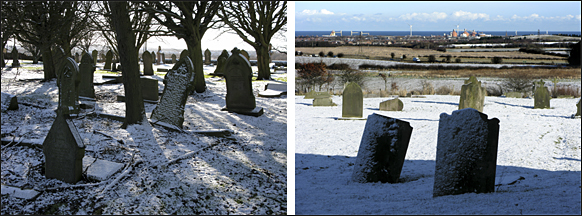
There aren’t any parking spaces on the road at Horton church. But there is a narrow footpath at the side of the road. I squeezed my car up on to it and against the wall far enough down the road to be visible to cars coming both ways.
When you go through the graveyard gate you see a jumble of old graves ahead of you. Battered and weatherworn stones. They don’t stand straight anymore. Many lean, some have fallen. The ground has settled and sunk and shifted over the long years since these first graves were dug. I was reminded of Hugo’s front garden. You could imagine that passers-by might have simply dumped these graves here at random over the decades and centuries. Here was mortality’s junkyard.
Of course the place has a structure, a superficial order – paths laid out around the graveyard, even though these are for the most part overgrown with grass and difficult to discern, especially in the snow. This is not a particularly well tended or much visited graveyard, it seems. Perhaps most of those that lie here are now more or less forgotten. And as it turns out this attempt at order is no more than a quixotic gesture against the wilful randomness of the universe.
I tottered in my smooth-soled work shoes through the crispy thin snow on the concrete path next to the church building, before heading off through the more sparsely scattered graves to the north and north east. These all seemed like old stones. In many cases wear and moss had left them almost unreadable. The Newsham Nightingale died in 1964, as I recalled. It didn’t look like his grave could be in this part of the cemetery. I wove my way over and between the graves over the snowy slope back up to the church. Have you ever noticed that when you walk across a grave you try to walk on tiptoes, as if to avoid disturbing the occupant, or perhaps because you fear you might sink in, as if a grave is filled with a sort of dreadful quicksand?
I crossed under the line of rugged bare trees into the southern part of the graveyard, where it seemed space was being used somewhat differently: it seemed more crowded. There also seemed to be some graves that had flowers on them and were still got visitors. At the edge of the area of graves, just before the area of still undug earth, I found the most recent group. I went methodically along the tightly crammed rows. In places this group of graves appeared to some extent (although not entirely or very exactly) to follow chronologically, according to year of death. I found the graves of fathers and mothers, grandparents, sisters and brothers. There were children’s graves. Some were infants who had died very young. One was decorated with toys and storybook grave guardians – Winnie the Pooh, a grey resin Peter Rabbit and a black and yellow bumble bee on a spindly wire wand. I felt sure that Tom Clough’s grave would be somewhere among this group, but it wasn’t. There had to be another set of relatively new graves in another area of the graveyard.
I went around the church again and back to the far north eastern corner, where I could now spot the flowers and ribbons of a still visited grave. But this wasn’t the Nightingale’s grave either. Close by there was a grave on which someone had planted a tree. It had grown and its thick, sinuous, muscular roots now curled like the arms of a great octopus and seemed to be delving deep into the owner’s grave. Somewhere six foot under these roots were wrapped around the occupant’s skeleton as if in a gesture of desperate love or overwhelming grief, as if they could not let the buried body go.
I was beginning to notice things about graveyards. First, that there is no strict order in force about who is buried where. A graveyard isn’t like a library – there is no index and the bodies do not lie in a particular order; there’s no sort of Dewey Decimal system for the deceased. You’d think it would be possible to lay them down in strict chronological order. But as we all know death comes unpredictably. The reaper can call at the oddest hours. There’s not one of us who couldn’t turn the Tallulah tomorrow. And a chronological system – although it would help the visitor to find the dead person he or she wanted with relative ease – would potentially not let the dead from a family lie together. A wife who outlived her husband by thirty years might find herself lying fifty yards away from him with a motley crew of strange bedfellows between herself and her dearly departed. Loving couples would have to conspire to pass way together if they wanted to avoid eternal separation in the burial ground. That would never do, obviously. And of course there’s also only so much space can be kept for one family, so eventually some grandson or niece is bound to wind up exiled to yonder end of the yard on their own.
I had wondered if the alphabetical graveyard wasn’t a good idea. There’d be distinct areas set aside for families whose surname began in a particular letter, so the Forsyths would lie down with the Fergusons, the Turners with the Thirlwells, and so on. Again this plan is likely to be disrupted by the Reaper’s arbitrary and sometimes quite profligate ways. It would just take a couple of Smith families with fifteen kids between them to be struck down by some previously unknown strain of a strange new plague to throw this plan into disarray. What would you do then – allow the S‘s to lie down among the R’s and T‘s? Or designate a new area for the S‘s on the undug land at the top of the cemetery? But that would defeat the object of the plan.
I wondered if another plan might be to order them according to age at death, setting aside the most space for the ages at which most deaths occur and proportionately less for the others, in strict accordance with probability as determined by actuarial tables. But this plan too would be easily defeated by the Reaper who one morning could decide to take a busload of fifteen year olds on a school trip and have them all drowned by launching their bus off the Kitty Brewster bridge and plunging them into the muddy river. These things happen, and they must be a nightmare for graveyard managers.
So at the end of the day the graveyard turned out to be a bit of a jumble, an appropriately complex mixture of order and chaos. They aren’t very user friendly for the stranger searching for a strange grave, but their disorder tells us something and reassuringly tells us that, while death will come to us all, some of us might be around a lot longer than any human filing system can readily anticipate.
A last thought on this – and something about which in this day and age perhaps something can be done – is around the permanence of gravestones. Old stones all suffer to a greater or lesser degree from the erosion and eventual erasure of the name by wind and weather. Trying to read these stones and discern who lies beneath them – although it might entail a pleasant and meaningful philosophical or poetic contemplation – is time consuming and frustrating for the time-poor twenty-first century grave finder. Surely there are modern composite materials which resemble granite or marble or another stone and which have a guaranteed erosion free life of at least 500 years. If there isn’t there should be, because I’m not only sure that the prospect of their name vanishing from their memorial stone appals and scares many people, I am also, by the same token, sure there would be a good market for such a material. If the market economy does the job the way they say it does, any day now these new long-life – yes, I know, I know, but what else would we call them, “eternity-proof”? – materials should now be becoming available to the bereaved and to those who like to plan their own funeral arrangements in advance. An epitaph should be forever, not just for as long as it takes an engraving in sandstone to lose it legibility.
I turned from contemplating the octopus rooted grave tree and saw just a little way up the slope a dark simple cross, probably made of metal but very much resembling a wooden cross. This might be the Nightingale’s grave, I thought. It would befit a man who has taken pleasure in the simple joy of music to have such a simple marker, and a one with arms upon which small birds might perch too. As I got closer I could see that this wasn’t Tom Clough’s gravestone. But it did seem to be Tom someone, and to my delight as I got closer it seemed to me that this was cross marked the burial place of one Tom Tremble.
‘Bloody hell,’ I said to myself. ‘This is Tom Tremble’s grave.’
Not that I knew who Tom Tremble was, of course: what I liked was the fairy tale sound and connotations of this name. Unfortunately I was to be disappointed. The name was difficult to discern easily from a distance because of the glare of the sun on the snow around it. When I got up close I found that this was in fact the grave of someone called “O.M. Tremble”. I was struck by the formality and terseness of that marking, of a gravestone that doesn’t tell us the first names of the buried person. When was this person born, when did they die? Were they not the beloved offspring or spouse or parent of anyone? Clearly this person or those who buried him or her (initials don’t disclose gender) favoured a sort of formal if inevitably ambiguous minimalism. This grave gives us only a name and nothing else, not even an epitaph. This tombstone decision throws an interesting light on that of Keats. In this case we see that a name on its own is intriguing but unhelpful and ultimately anonymous. O. M. Tremble is now nothing but a name, as they say. A name on its own might as well be writ in water as in stone. What a name needs is a story. What a name needs is a life.
O. M. Tremble’s modest cross contrasts well with the Leviathan stones some of the long dead have in this graveyard, and it’s true that the size of the stone doesn’t necessarily tell is anything about the worth of the life the dead person lived or their value to society, even though we tend to think it does. O. M. Tremble begins to look like an embarrassed, disgraced or self-effacing nobody, a clerk or a storekeeper perhaps, a criminal even, lain in a field of lawyers, captains of industry and lords of the manor. A grave is like a house and land: we think it tells us something about the importance of whoever it is dwells there.
I made my way back up to the church and looked again back down over the slope. I noticed that all the graves appear to face east. I seemed to recall then that this is a Christian thing, symbolic of the dead awakening into the dawn of a new life, a new day in heaven, or something like that. It isn’t a bad view for them either, out over the fields and the Spine Road to the town and the mouth of river – the pale grey wind turbines on Cambois pier, the Indian red Alcan bauxite silos, the gaudy yellow gantries at Battleship Wharf – and to the deep blue North Sea beyond. They must indeed see some grand sunrises here. The town has the same sort of junkyard look as the graveyard itself does at first glace, and in some way echoes that same ramshackle development – a mixture of opportunity, accident and design – that same mixture of chaos and order. It has the sort of look people like to call organic, by which they often mean unplanned and accidental but somehow also functional and good.
I left Horton graveyard without ever finding the Nightingale’s grave. I drove back down between High Horton Farm and the Three Horse Shoes, where despite the snow there were still a fair number of cars of people who were there for lunch. I knew the Horton gravedigger wouldn’t be one of them, of course.
I turned on the Radio 4 one o’clock news as I accelerated down the slip road on to the Spine Road. It was clear now. I drove back to the office quickly. I was thinking about Tom Tremble. How did he live? Who did he know? What things mattered to him? I was wondering about the story of Tom Tremble’s secret life. I was wondering what he looked like. I was wondering how Tom Tremble died.
.
fugitives, ghosts, and silver polar bears
At about lunchtime on the day after baby Davina was abducted by Tania and Joe I got a call from Sergeant Godfrey Garnet at the police to say she’d been found.
‘That’s good news, Godfrey,’ I said. ‘Where is she? Is she okay?’
‘We’ve got her here,’ Godfrey replied. ‘She’s having a great time. Some of the girls are giving her a feed and oohing and aahing all over her and getting all broody.’
‘So where’s she been?’
‘We’re not sure. We got a tip off from a member of the public. We picked them up at the Spa in Bedlington Station.’
‘So was she with Tania and Joe?’
‘Aye, she was. They had some sausages and a big bag of Doritos in their basket and were trying to find the baby milk when we got there. We’ve got them both banged up at the minute. We’re trying to find out what we can charge them with. We want to see if we can do her for kidnap.’
‘So can a woman actually kidnap her own baby, Godfrey?’ I asked.
‘We’re not sure,’ Godfrey replied. ‘We’re taking advice from the CPS about that.’
‘So can we come and get her and take her back to her grandad?’ I asked.
‘Of course. Whenever you like. She’s the centre of attention here so she’ll be absolutely fine till you can get someone across.’
Michelle was out visiting someone in Seahouses. I rang her on her mobile and told her the news. She was speechless with delight and relief. I reassured her that the baby was fine. She said she’d be back down in an hour or so.
‘No hurry,’ I said. ‘The police are happy to baby sit for a while. I’ll ring grandad and give him the news. We’d better arrange to get Davina checked over by a paediatrician when you get back, just in case. The police say she’s suffered no harm, though.’
The member of the public had spotted Tania, Joe and baby Davina on the 447 Blyth to Morpeth bus. Apparently they got on somewhere in Cowpen Estate. Joe was carrying Davina in his arms. She was crying. As Tania paid the fares, Joe took his seat. He laid the wailing baby down on the seat beside him. His behaviour raised the suspicions of Polly Telfer, who as it happens works as a cleaner at the Bedlington Police Station on Schalksmuhle Road. She had been listening to Alan Robson on the night before.
Joe and Tania seemed very nervous during the bus ride, constantly looking out of the window. Polly Telfer told the police that to her they looked like “fugitives”. They got off at the Spa in Bedlington Station. Polly got off just a couple of stops or so later and immediately reported her suspicions to the duty desk. Five minutes later there were four police cars and an armed response unit at the Spa.
An hour or so Godfrey rang back.
‘Will your people be long in picking this baby up?’ he asked.
‘No, not long,’ I said. ‘What’s the matter, has the novelty worn off?’
‘Not exactly,’ Godfrey said. ‘But there is becoming a bit of an atmosphere around here now, if you get my drift.’
I laughed and reassured Godfrey that Michelle would be there any minute.
On the following Sunday I drove up to Thrunton Woods. I parked in the main car park and followed the forest road up on to Callaly Crag. There was a fair bit of snow up there, even though there was none at all down by the car park. It was a sunny day. I looked for a while over to Fawdon Hill and Hedgehope and Cheviot beyond, both white with snow. I made my way south into the glare of the winter sun, over the moor through the open areas between the conifer plantings towards the valley of the Coe Burn. I saw no-one at all during this part of the walk. The heather was high and the old tracks were very squelchy in places. At one point I had the company of a buzzard mewing above me. I saw a couple of pairs of roe deer stepping anxiously through the dead bracken at the forest edge. I left the track for a while and fought my way through the rough billowing heather towards Black Walter, where I picked up the forest road again and made my way back up into the snow before taking the track back down past the area where they are thinning the trees to the car. I walked for about two and a half hours and saw no-one other than a couple and an old guy with their dogs on my way out and a couple of mountain bikers in the car park when I got back down.
Thrunton Woods and the moors lying to the south of Long Crag down to Debdon Burn cover a large area of open land which was once part of the Armstrong estate. Some of it might still be owned by his descendents, although the adjoining Cragside estate is now owned by the National Trust, of course. What’s curious about the Thrunton Woods area is the almost total absence of traditional rights of way, along with the apparent virtual absence of old settlements. This of course cannot truly reflect the way things were before Armstrong got his hands on this land, but must represent the eviction and exclusion of ordinary people and the public from this land. It’s interesting to contrast it with the area of very similar land over at Bewick Moor, which is riddled with rights of way, many of them bridleways following old routes between old settlements. Thrunton has at some point been stripped of that traditional infrastructure of routes. It more closely resembles places like Simonside, Hulme Park and Cragside itself in these terms, probably for very much the same reasons, the loss of traditional rights under pressure from powerful and influential landowners, families and individuals pursuing their own aggrandisement and jealously defending their exclusive right to chase and kill every animal that flew, swam or ran there. Some people say Northumberland remains in some ways a feudal county. You can see what they mean. Places like this are the sites of our own version of the Highland Clearances and are haunted by a similar sense of dispossession and desolation. There’s a wild irony in the beauty and solitude we now find here and for which we love these places so much. We find freedom. We trespass with ghosts.
I drove back down the A697 as it follows the line of the Devil’s Causeway for a while before going through Longframlington and down the long hill into the Coquet valley. I listened to the album You & Me by The Walkmen. Their music has a sort of loose jauntiness, a sardonic sort of ramshackle energy. The singer declaims and laments in a suitably inconsequential and encouragingly post-modern manner. It’s well worth a listen.
When I got back I noticed that the assorted boxes of slippers that have littered the house all winter had gone.
‘Where have the all the slippers gone?’ I asked Margaret.
‘Gone to Brenda’s, every one,’ she replied. ‘We’re thinking of giving them away to a charity shop.’
‘Really? Are you winding up the Slipper Shop?’
‘Probably. The recession has pretty much killed the business.’
‘Oh, that’s sad,’ I said. ‘Still it’ll give you more time to join the Citizens in the struggle against the Citadel.’
‘Oh, that’s a lost cause, I think, don’t you? No, Brenda and I are planning a new business. We reckon that in hard economic times people spend money on things that cheer them up. Brenda reckons cinema attendance always increases during a recession.’
‘So what are you two going to do – get jobs as usherettes?’
Margaret tutted and shook her head. ‘Don’t be silly,’ she said.
‘You can’t be going to open a picture house, are you? Surely not.’
‘No, nothing like that,’ Margaret replied. ‘We’re going to set up a funwear shop on eBay. We’re going to call it Frills, Fleeces and Furry Things.’
I nodded. ‘Sounds good,’ I said.
I gave De Kooning a shout and picked him up. We went into the conservatory to read The Observer.
On Monday I got a phone call from an old colleague, Dr Bertrand Sticks. Sticks is a sort of computer boffin these days, although at one time he was a front line social worker. It wasn’t exactly his forte. He has a sort of other worldly detachment about him. He is also somewhat displaced in class terms, having about him the look of one of Harry Potter’s more rotund friends.
‘Hi Sticks,’ I said. ‘What you been doing with yourself? It seems like yonks since I’ve seen you.’
‘It is yonks,’ Sticks said. ‘About four and a half years of yonks.’
‘So what you doing with yourself these days? Are you still in the Stylophone Quartet?’
‘No,’ he said, for a moment appearing to lose his poise. ‘No, that folded about three years ago. I spend most of my free time these days trying to design a new kind of robot, which I hope to build eventually.’
Sticks is a man with an unnatural interest in gadgets. He is one of the broad family of those who think the world is essentially mechanical and most closely resembles a clockwork mouse. The fact that he occasionally lapses into what sounds like mysticism is somewhat confusing, of course.
‘So how will this robot be different?’ I asked.
‘It will possess emotional complexity. My robot will replicate such emotions as fear and arousal with such exactness that it will be indistinguishable from a human being.’
‘Sounds impressive. How far have you got?’
‘I’ve got some drawings. I know how it will look. It will look like a silver polar bear.’
I liked the sound of this. A silver polar bear robot with human emotions. Science can surely hardly go much further than this.
‘The reason for the appearance is that it will commemorate what I think was for me the crucial break through I made in this project. I have recently succeeded in devising a programme which responds to the image of a polar bear with exactly the same complex set of emotions as a naked man would if he were to encounter the actual beast in a natural setting, in his igloo in Greenland, for instance.’
‘Great stuff, Sticks. Sounds absolutely fascinating. But that isn’t why you rang me, is it? You don’t want me to sit around naked looking at pictures of polar bears, do you?’
‘No, I don’t. I’m looking for two or three volunteers from front line practice to help me with the development of our version of the Ernas, the Electronic Risk and Needs Assessment System. As you know there’s a big push towards computerised information recording. The next big steps beyond that are seen as on the one hand gathering the information by direct computer input from service users themselves – probably at terminals in one stop shops, maybe in booths at supermarkets – and, on the other hand, developing models which will allow the computer to analyse that information automatically and immediately issue a plan. As you know, work is also being done on ECI’s – electronic client identities – as a step towards requiring and enforcing compulsory compliance with the plans. The goals are greater efficiency and consistency, arms length risk management, and better performance in terms of meeting timescales. And of course it should free up social workers to do more interesting work.’
‘Sounds like its goal might be to do away with social workers all together,’ I said.
‘Ho ho, ever the sceptic, eh?’ Sticks said. ‘The old Luddite flame still burns as brightly as ever in you, I see.’
I laughed. ‘When people live with lunatics they become lunatics, Sticks. If the only relationships we have are with machines we will become machines. That’s what I fear, Sticks. We both know this stuff’s really all about saving money and keeping the poor in their place.’
‘Okay. So, what are you saying? Do you want to be in on this or not?’
I paused. ‘Yeah, okay,’ I said. ‘Why not?’
‘That’s the ticket!’ Sticks said. ‘Better to be one of those shaping the future than to just leave it in the hands of fools and madmen. You can’t run away from it, you know. It’s good to have you on board, my old friend.’
For a minute or two I sat looking out over the rooftops. Paul Virilio’s statement crossed my mind: The speed of light does not merely transform the world. It becomes the world. Globalization is the speed of light. I began to imagine it was summer and I was walking again across the moors at Thrunton.
Sticks is coming over to see me next week to talk about multiple choice questions and risk factors. He wants to find ways to break all social work judgements and decision making into a series of binary choices. I’m looking forward to seeing him. He’s completely deranged, of course, but at least you can’t say he isn’t a laugh.
.
a sort of macabre sweepstake
Last Wednesday morning I was at a meeting in Morpeth first thing. When I arrived back at the office about mid morning Jesse and Pippa from admin were in the team room talking to Michelle, Lily, Sally and Angie. They were discussing a game Pippa’s daughter plays with her colleagues at the place where she works.
The object of the game is to be the person who picks the well known person who dies before any of the people picked by anyone else. It seems each person can pick three people – let’s call them their Gees Gees (which could stand for Grim Gallopers) – and they pay £5 into a kitty for each of their Gee Gees. No two people can choose the same Gee Gee. The person who has picked the Gee Gee that dies first collects the whole kitty. At that point everyone in the game has the opportunity to pick a new set of Gee Gees. It’s a sort of macabre sweepstake.
A week or two earlier Pippa’s daughter’s workmate – Kathy – had won: Patrick McGoohan, the star of the one-time cult TV series The Prisoner had died. He was eighty. His demise brought Kathy a windfall of £540, or, to be strictly accurate, £525, as her original stake should be deducted from her winnings.
Pippa’s daughter had been sitting with Hugh Hefner, The Pope and Amy Winehouse. In the way the game is played at Pippa’s daughter’s company (sorry, I don’t know Pippa’s daughter’s name) on there being a winner everyone gets the option to keep the Gee Gees they hold or to throw in one or more. Pippa’s daughter chose only to keep Amy Winehouse. Rather than go for old people who might go on forever she decided to go for a full hand of younger people with dangerous lifestyles. She added Pete Doherty and Lewis Hamilton to her portfolio.
‘Why don’t we play that game?’ Angie said. ‘I’d pick Margaret Thatcher.’
‘That’s just wishful thinking,’ Lily said. ‘If that worked I’d go for Richard Madeley. He’d be gone tomorrow.’
‘Oh, no, he’s not very old,’ Sally said. ‘I think I’d put my money on Patrick Moore.’
‘Isn’t he already dead, Sal?’ Angie said.
‘No. No, he isn’t,’ Sal said. ‘I saw him on The Sky at Night just a couple of weeks ago.’
‘Yes, Sal, but was he alive?’ Lily said. They all laughed.
‘Don’t you think this game’s a bit sick?’ Jesse said.
‘Yes,’ Angie said. ‘It is. But isn’t that the point?’
‘Why don’t we make up our own variation?’ Michelle suggested. ‘What about trying to pick the next local authority to have a child death on one of their social workers’ caseload? Who bags Haringey?’
The others cringed and frowned.
‘Why stop there?’ Angie said. ‘Why don’t we just put the money on the kids on our own caseloads?’
‘Hush up, Ange,’ Lily said. ‘Don’t tempt providence.’
I made myself a coffee and wandered upstairs to my office. At first I was pondering the idea of tempting providence and wondered if this was another manifestation of magical thinking. Maybe it’s closer to the idea of speaking of the devil. Maybe it’s to do with the idea that God is not mocked. And yet what kind of insecure and fickle deity would it be that needed to throw Its weight around like that for such a trivial provocation? Maybe it’s just something to do with a primitive belief in the power of words.
I sat down with my coffee and looked out over the rooftops. I began to think about painting. I haven’t painted anything since I finished my canvas of Corby’s Crag. I have been thinking about painting somewhere more urban. I like Gillies’ paintings of Temple, and although it seems to be a village and probably quite rural, I want to find and show the beauty in the things beneath our noses. I want to say we don’t have to go far to find something worth looking at.
When I logged on to my computer I discovered I had received an email from Alice McTavish in Fort William. She was writing to tell me that there had been a fair amount of snow up there this winter and she was wondering if I was planning to come up for a few days skiing. She offered to make me a mushroom risotto. I wrote back and said that I couldn’t get any holiday until the end of February. I asked her to make sure none of the snowflakes melted before then.
At about lunchtime Tania picked up baby Davina during a supervised contact session and simply walked out of the office with her. Michelle followed her down the street, telling her she was being daft and doing herself no good. Tania was having none of it. Davina was her baby and she’d do what she liked with her. Michelle told her she couldn’t because we had a court order and Davina had to stay with her dad, who was now approved as her emergency foster carer. Tania just walked on.
Michelle was powerless. What was she supposed to do, rugby tackle Tania and wrestle the baby from her grip? She ran back to the office. She was in a panic. She rang the police and gave them a description and potential addresses Tania might go to. The police went straight out but had no luck. They visited Joe’s house too. His mother said she had no idea where he was. He hadn’t been home since yesterday. The plot was thickening. A young mother with no real interest in her baby had abducted the baby and gone off with a hare-brained youth. Maybe Michelle’s about to win the kitty, I thought to myself. I didn’t say it out loud, of course.
Next morning baby Davina and Tania were still missing and we had no clue where she was. I took a call from a police inspector and agreed to publicity. Later that day the missing baby began to be mentioned on the news bulletins on Metro Radio, along with pleas to the public to contact the police if they had any information about the whereabouts of mother and baby. The whole day passed without any news. Michelle sat in the office, unable to do anything. The rest of the team made her cups of tea and told her not to worry, the baby would be found fit and well, they were sure. Gilmour rang to see if there’d been any news. He also asked how Michelle was.
‘Not good,’ I said.
‘Let’s hope for everyone’s sake that this baby is okay,’ he said.
For a moment or two I imagined that the universe was indeed at the command of some perverse force. That things don’t ever go wrong by chance or accident. That they go wrong because the world is in the hands of providence, and providence is amoral and prone to mischief and cruelty. Providence is metaphysical spite. It’s funny that such a nutty belief will probably be reassuring to some people. We’d rather believe that we’re in the hands of a monster than think we’re in the hands of no-one at all. At least you can talk to a monster.
After tea Margaret was baking onion tarts. De Kooning was hiding somewhere. I went for a walk through the Isabella and over the reclaimed land to Tynedale Drive. I walked all the way to Cowpen Road and then down past the cemetary to the North Farm. I came back along Renwick Road, past the Thoroton Hotel and back along Broadway to Rotary Way. Later I went along to my dad’s to return the library book on the Cloughs, which was almost overdue. I drove up the Avenue and through Seaton Delaval on the way back. I turned on the radio and flicked through the stations. Alan Robson was on Metro. Hettie from Bomarsund was on the line.
‘Hello, Alan,’ she said. ‘It’s Hettie from Bomarsund here.’
‘Good evening, Hettie. What do you want to talk to us about tonight?’
‘Good evening, Alan. Alan, have you heard about that young lass who’s kidnapped her own baby? Isn’t that a terrible thing? I think she must be in a terrible state to do something like that, don’t you, Alan.’
‘Well, I don’t really know that much about it, Hettie. I mean, can a mother really kidnap her own child?’
‘Yes, but this bairn was being looked after for her by a foster parent, Alan. She’s obviously got needs, Alan. Don’t you agree, she must be a girl with needs?’
‘You might be right, Hettie. If that lass happens to be listening now, Hettie, what would your message to her be?’
‘You know what I’d say to her, Alan? I’d say, “Take your baby back, pet. People are just trying to help you. If you hurt your bairn you’d never forgive yourself.” My heart goes out to her, Alan.’
‘Thank you, Hettie. Let’s go now to line two, where we’ve got John from Westerhope. Good evening, John. What do you want to say to the night owls tonight.’
‘Hello, Alan. What I want to say is that with all due respect your last caller is exactly the sort of person who’s got this country in the pathetic state it’s in today. Do you know what my message to that girl on the run with her baby would be? It would be “Good for you, girl.” It’s the do-gooders who have taken away all our freedom and brought the country to its knees, Alan. Social workers only take people’s kids off them to give them to middle class couples who can’t have them or to put them with lesbians and paedophiles.’
‘Well, I’m sure there are a lot of people won’t agree with you there, John. Surely sometimes social workers are right to take children off their parents, aren’t they? What about Baby P?’
‘Exactly, Alan! Exactly! That’s proves my point, doesn’t it? If this lass’s child had really been at any risk of harm at home the social workers would have left her with where she was. That’s what they do, Alan. You can hardly open a newspaper these days without coming across the story of another poor kid social workers have left to die.’
‘I’m not sure you’re right on this one, John. But of course I respect your point of view. Let’s have another record. I’m sure there are plenty of others out there who want to have their say on this lass’s baby. We’ll be back after this.’
Chesney Hawkes came on. The One and Only. I drove past Newsham Coop and over the railway crossing, past the Black Diamond and the Newsham Hotel and around to the Willow Tree. I glanced over the grass where the Brick Row once stood and through the dark spaces where the Newsham Nightingale once piped, across to the anonymous little council houses beyond and the little yellow rectangles of their windows. Tania and Joe were probably holed up with baby Davina in just such a house tonight. They were probably with a bunch of raucous kids, drinking cans of lager and smoking cannabis, arguing about whose turn it was to be on the Wii, passing Davina round like a stray kitten they’d brought in from the street. A tattered-eared pitbull called Tyson was probably sniffing at her face.
As I drove into the top of my street Chesney stopped singing and Alan Robson returned to the mike.
‘So, welcome back, night owls,’ he said. ‘Tonight we’ve been talking about the girl who’s stolen her baby from social workers and gone into hiding with her. Right now on line four we’ve got Cheryl from Ashington. Hello, Cheryl. How are you tonight? This bairn’s from around your way, isn’t it?’
‘Hello, Alan. It’s Cheryl here. Yes, Alan, she is. I could tell you who she is, Alan, if you want to know.’
‘Oh no, Cheryl. No, no, I think we’ve got to respect this lass’s right to privacy, haven’t we?’
‘Yes, Alan, that’s true. But what you don’t know is just what’s going on around here . . .’
At that point I turned the radio off. The last thing I needed to hear was that baby Davina had been abducted by Robin Hood and his Merry Men and was being taught to use a bow and arrow in Bothal Woods.
I slept badly that night. I awoke at least three times. Baby Davina was on my mind. The first time woke up I was wondering who was feeding her. She was in a dark place crying frantically. She was completely alone. De Kooning made his way to the top of the bed and sniffed at my face. He began to purr. I pressed him back down on to the duvet and gave him a stroke.
‘Go back to sleep, De Kooning,’ I said. ‘It’s not morning yet.’
Next time I awoke I was thinking about Michelle. I knew she’d be lying awake. I knew she’d be worrying herself to death. If anything happened to baby Davina she’d carry the can. Her photo would appear in The Daily Mail. She’d be pilloried. She’d be destroyed. I heard De Kooning begin to purr again. I put my arm out of the sheets and rubbed his tummy. He gave my hand a little play fight.
‘Go back to sleep, De Kooning,’ I said. ‘It’s not morning yet.’
The third time I awoke I had been having a terrible dream. I dreamt I was King Lear. Or perhaps I was some other character from that play. The Fool, perhaps. Or Edgar. Or Gloucester. I was probably an amalgamation of several of the characters all in one dream person. I was caught in a storm. I was blind and stumbling close to the edge of a cliff. I dreamt I was gathering samphire. I dreamt I was gathering samphire and I heard De Kooning fidgeting. He was purring again, loudly, like a tractor.
‘Go back to sleep, Cordelia,’ I said. ‘It won’t be much longer now.’
.
the nightingale’s cage and the prince of pipers
When I arrived at the office on Tuesday Jack Verdi and his colleague Owen Vardy were in reception. They had come for meetings about different families. These two men have a strange affinity with one another, something their appearance belies. It’s believed they even have the same birthday. Jack – who has now taken to wearing skinny leg black jeans and trainers – is increasing rock-Gothic black and motorcycle dangerous, a man in shades, a refugee from the crypt. Owen by contrast is David Livingstone without the pith helmet. He has about him something of the demeanour of a country parson, gentle and reed-like, with a rather tentative and deferential style. Unlike Jack, Owen seems not to want to rage against the dying of the light, not even to seek to challenge it subversively. Of course, the word on Owen is that he may not be quite as meek as he seems and that somewhere inside that parson-like persona there burns a still unquenchable fire. What these two men share, besides their birthday, is that they are from the same generation, that they both were once professional musicians – Owen was part of a quite successful folk-rock outfit called Proudlute – and that both have known fame. Both are trying to get their bearings in an obscure post-celebrity netherworld. Both also share an enduring fixation with John Keats. When I arrived they were discussing Keats’ epitaph, and appeared to be disagreeing about whether it would be an appropriate epitaph for us all today.
‘Ah ha,’ I said as I approached them, ‘Verdi and Vardy, the undertakers, I presume.’
Keats is buried in a grave in Italy. Famously, he did not want his name put on his gravestone. He wanted it only to contain his epitaph, the line he told his painter friend Severn he wanted: “Here lies one whose name was writ in water”. This phrase deploys an image taken from the play Love Lies Ableeding, written by Beaumont and Fletcher some two hundred years earlier. The image is generally taken as speaking of our transience, the brevity and impermanency of life and fame and renown, and how we are all destined to die and to be forgotten. It says the world will not remember who we were. In Keats’ case you might also argue that his identification and involvement with the sensuous, sensual substances of the world is also represented in the image, that it suggests that who he was is written in the concrete stuff of nature, the things he let himself somehow unite with and become. A good example of negative capability, perhaps. But either way, a name written in water will not endure, at least not at the level of individual identity, of being discernible as anyone in particular. No-one’s name will long survive their passing. It is a tad ironic, of course, that the anonymity of Keats’ gravestone and the pessimism of his epitaph have enhanced its fame and made it more likely to be remembered.
Owen was saying that he wanted the same epitaph on his grave. Jack was arguing that times had changed and that the epitaph needed to be updated accordingly
‘It’s a new age, man,’ Jack said. ‘If Keats had been around now he wouldn’t have accepted death so easily. Life expectancy has increased dramatically since those days. People are no longer resigned to an early death. Hey, one day soon people might not even need to die! The epitaph needs to reflect that change. “Here lies one whose name was writ in rock,” that’s what my epitaph’s going to be, man!’ Jack chuckled, at his own felicitous ambiguity, no doubt.
‘That can’t be right,’ Owen said. ‘The whole point of the epitaph is its universality. It’s our transience and the temporary nature of our existence that binds us together as human beings. It’s the very thing that makes us human, Jack.’
‘No, man,’ Jack said. ‘That’s bollocks. It might have been that way once, but not now, man, not now. If Keats was around now he wouldn’t be moping around with this romantic despair and dissolution mullarkey. He wouldn’t be even one percent in love with easeful death. He’d be saying grab the future and strangle it, dude! Carve your name into the stars, man! The spirit of Keats is transformative, man, and we’ve got to pay the cat his dues. If Keats was around today he wouldn’t slip so quietly into his grave – they’d have to drag him off the stage, man, crowbar the axe from his hand.’
Owen looked pensive, like a man looking into an empty bird cage. Someone told me that Owen in fact did once keep a pet nightingale. Jack says the only pet he ever had was a flea. He said he found it on himself after he had spent an afternoon in a room in the Chelsea Hotel with Janis Joplin. He says he just couldn’t bring himself to crush a creature that had been on Janis’s body, that may have tasted her blood and felt the warm throb of her skin. He tells how he put the fortunate flea in a jam jar and kept it with him on the tour bus for weeks. He named it Jimi. One day the band was on Route 66, driving through the night on their way to a gig in St Louis. A roadie who had been drinking a lot of beer was desperate to relieve himself. It is generally believed that Jimi probably died by drowning, although some like to think he escaped into the night when the jam jar was hurled from the bus and shattered on the pavement of a small unknown town somewhere in middle America. Some will tell you Jimi’s still out there, living the good life in a motel east of Albuquerque. This tale may be apocryphal, of course. In true rock tradition, Jack’s not the sort of man who would let factual accuracy stand in the way of the construction of his personal myth.
‘No, man,’ Jack said, ‘it’s the desire to cheat death, to defy it, to overcome it, to transcend it – that’s what makes us human, that’s what binds us together. Not the willingness to surrender demurely to the Reaper.’ I wondered if he was alluding to Tallulah at this point. Surely not.
Owen shook his head gently. ‘I really, really don’t agree,’ he said. Jack was leaning against the wall, wiry and spectre-thin in his skinny leg jeans, inscrutable behind his Aviators. What struck me was the way he was more and more deploying the vocabulary of a rock musician again. If I’d closed my eyes when I was listening to this conversation I might have thought it was Keith Richards speaking.
As I walked along the corridor I thought that one of the differences between Jack and Owen is that Jack has no children. I wondered if he had whether he’d have a different attitude to death, a different attitude to life. It’s surprising how much difference that can make, at least for some people.
When I went into the team room Michelle collared me to talk about baby Davina. After a short spell in foster care Davina was returned to her mother, Tania, and both had gone to live with her dad. Unfortunately Tania has on several occasions gone awol for two or three nights on end, leaving the baby with her dad. She was away again and her dad was at the end of his tether.
‘There’s just no attachment,’ Michelle said. ‘It’s never going to work. I think it’s time to call it day with Tania. Grandad is prepared to go for Residence and I think that’s the way we need to go now.’
Attachment is the new love for some social workers and other professionals. Some of them seem to think that if attachment is good then parenting will be good. Attachment theory is on its way to becoming a theory of everything for some professionals, the only real construct they’ll ever need. Things are not that simple, of course, and some day soon someone’s going to have to write the book Attachment is Not Enough. But what is true is that if a parent has a poor attachment to his or her child, the child’s needs are not likely to be fully met and the child is far more likely to suffer harm. A child to whom no responsible adult is attached is a child a wolf will soon devour.
‘So where’s Tania gone this time?’ I asked.
‘Her mother’s, she’ll say. But she hasn’t. I’ve been there. My guess is she’s lying in bed with Joe again, not answering the door and having a merry old time while grandad feeds the baby and changes the nappies.’
‘Yeah, okay,’ I said. ‘Talk to grandad and pull a planning meeting together.’
Angie had been hovering nearby and wanted to talk about her new client, Naomi Bell.
‘Are there attachment problems there too?’ I asked.
‘Probably,’ Angie said. ‘The place is a pig sty and the kids are running amok. But the main problem is she’s barking. I asked her about what support she had and she told me she was close to her mother, who gave her lots of advice and kept her right. The trouble is her mother’s been dead for years.’
‘So maybe she was speaking historically.’
‘No. She was speaking to her mother while I was there! “Mother,” she calls out. “Mother, are you there?” Spooky, or what?!’
‘And was she – there, I mean?’
‘Yes, it seems she was. She told Naomi to feed the bairns bananas and porridge and everything would be fine.’
‘Hmmm, tasty suggestion. Does she have a CPN?’
‘Nope.’
‘A psychiatrist?’
‘No.’
‘A sympathetic GP?’
‘No, none of those. What she’s got is a medium.’
‘A medium?’
‘A medium, and a spirit guide called Fatima.’
‘You’re thinking of a referral the mental health and a strategy meeting, right?’
‘Right.’
‘Okay, let’s do it. Invite the medium, invite Fatima – mother too if she’s available. Let’s remember the spirit of Working Together.’
I’ve been reading a book that my dad discovered in the library called ‘The Clough Family of Newsham’. It’s published by the Northumbrian Pipers Society. Some members of the Clough family were important and celebrated Northumbrian smallpipes players, particularly Tom Clough. My dad knew they were pipers but hadn’t realised how famous a Northumbrian piper Tom had been. Tom, a pitman, is said by the book to have been known as The Prince of Pipers. I had never even heard of the family and the name meant nothing to me. But it turns out that my dad actually knew Tom and his son, Tom junior, another well known piper. My dad remembers that sometimes in the summer Tom would play his smallpipes in the backyard of his house in Brick Row at Newsham, which is demolished now but stood in the area opposite the Willow Tree that is now grassed over, just before you get to the railway crossing. When my dad was a kid he and his friends would hear Tom playing in the yard and sometimes throw things over the wall as a prank.
On Thursday night I walked up Plessey Road to the Willow Tree to look at the space where Brick Row had stood. I had never heard of this street and it must have been demolished decades ago. It was called Brick Row because it was the only row built of bricks. My dad lived in Stone Row – you can guess why it was called that – which ran at right angles to Brick Row along the eastern side of railway line to the Stationmaster’s house. That row has gone too, but the Stationmaster’s house remains, black and redundant at the far reaches of a somewhat anonymous estate of social housing – maisonettes and small semis. I listened for and tried to imagine the “amazing, hypnotising runs of notes”, the “startlingly clear and inspirational” playing and “masterly rendition of old airs” described by the authors of the book. I listened hard but I’m not sure I heard any tune I knew, only the sound of the wind whining through the railings in the darkness and the grumble of the traffic across the line over on Newcastle Road.
The book says Tom senior suffered from an increasing loss of his hearing in the late 1940’s. It’s suggested by some that this may have been because in September 1940, during the war, a bomb destroyed their house. Others suggest that he had been almost deaf for years before that because of a mining explosion. We don’t really know why, but there’s no doubt Tom’s hearing went. He had a poetic streak and in the 1950’s wrote this:
My hearing now is not so keen, As what it was or might have been. In whispers soft the old pipes say, ‘Just fill the bag. We know the way.’
It sounds a bit like he might have been the Beethoven of the smallpipes. In one of his notebooks he wrote “Music is some Divine Essence that clarify’s the Soul enabling it to take momentary glimpses into heaven.” This phrase might have made a good epitaph for him, I guess. He died in 1964 and is buried up on the hill in Horton churchyard. I’ve no idea what his epitaph is, but I might stop by there one day on my way to work to visit his grave and find out. Maybe I’ll hear the plaintive lilt of his smallpipes in the wind. But then again, there’s every chance I won’t..
.
a fish called bwenda
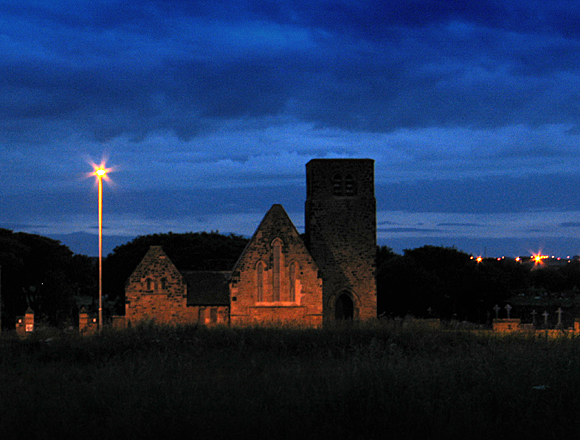
On one of the days between Christmas and New Year Margaret sent me over the Brenda’s to deliver a box of sale slippers. Tristan came to the door.
‘Oh hello, mate,’ he said. ‘Mewwy Chwistmas. Are you coming in?’
‘Merry Christmas, Tristan,’ I replied. ‘Yeah, I’ve just got to deliver this box for Brenda. Is she around?’
‘She’s in with a client at the minute, but should be fwee soon.’
‘What’s she doing, a bit of post-Christmas life coaching for one of Santa’s little elves?’
‘Not quite,’ Tristan laughed. ‘But it’s not far off. She’s got Mrs Bywo in with her. This lady is about as tall as a painted teapot and dwesses like a demented wagamuffin. Bwenda knows her from her poetwy group. I tell you she has twied just about evewy thewapy Bwenda knows, for evewything fwom colour blindness to celebwityphilia. She’s come in today for some urgent acupuncture because of stwange tingles in her feet, which she thinks she got from being too close to a starfish while she was talking to the mermaids on the wocks at Cullercoats on Chwistmas Eve.’
‘I didn’t know acupuncture worked for that,’ I said.
‘Imaginawy tweatments often work well for imaginawy complaints,’ Tristan replied.
‘Hmm, good point,’ I said. ‘Any way, how are you? Did you have a good Christmas? Was Santa good to you?’
Tristan grimaced and shrugged, in the way that Trostskyists do. ‘It could have been better,’ he said.
‘Don’t tell me Santa didn’t come,’ I said.
‘Oh, I did okay that way,’ he said. ‘The usual chocolates and aftershave and what have you, and Bwenda got me an electwic scwewdwiver, which will come in vewy handy if business ever picks up again. Oh, and thanks for the socks, by the way, which I thought were weally wadical for me. No, the pwoblem is that I’ve been a bit in the doghouse with Bwenda since she opened her pwesents fwom me.’
‘Oh bloody hell, mate,’ I said. ‘You didn’t cut corners, did you?’
‘No, I shelled out an arm and a leg. But it seems I got the wong bwands for her. You know, Bwenda, she’s got expensive taste, and I thought the stuff I got her was wight up her stweet. I got her a Louis Vuitton handbag, a Cartier watch and a Burbewwy twench coat. When she unwapped them I thought she’d be cockahoop, but she wasn’t. She looked a bit down in the mouth. “Are they fakes?” she says to me. “Fakes?!” says I. “Of course they’re not fakes. You’ve no idea what that little lot cost me.” “Are you sure?” she says, looking at me thwough her hair as if I might be pulling a fast one here. “Absolutely sure,” I says. “Do you want to see the weceipts?” Eventually she came awound to accepting that they were all the weal thing, but she still wasn’t happy – because, she says, evewyone knows you can easily get fakes of these bwands. “Even Chavs wear them,” she says. “Yes,” I says, “but yours aren’t fakes, are they? Not like theirs.” “Yes, but how will anyone know that?” she says. “They don’t look any diffewent.” I tell you mate at that point I was wishing I had bought bloody knock-offs and saved myself a lot of money. “So what do you want me to do, Bwenda?” I says. “Pin a These Are Not Fakes label on them to tell the world they’re weal?!”‘
‘It’s a strange world we live in, isn’t it?’ I said. ‘Someone wearing a fake imagines the world thinks it’s the real thing, and someone wearing the real thing imagines the world thinks it’s a fake! Maybe we should all go back to going around naked, eh?”
‘Anyhow,’ Tristan went on, ‘she eventually came awound, but not before I said I’d make it up to her by taking her for a short bweak in Pwague for Valentine’s Day. Not that I can afford it, of course. Work’s all but dwied up. You can’t get moved for bloody plumbers now that house building’s stopped.’
At that point I heard the door of Brenda’s consulting room open. Mrs Byro came out and shuffled down the hall to the front door. I could see what Tristan meant. At first glance Mrs Byro appears to be to haute couture what Hugo is to horticultural design and you’d assume that her wardrobe must be a junkyard, a random accretion of disparate garments. She is no bigger than a hobbit and has long hippy dippy hair of a curiously neutral colour. She struck me as the kind of woman you’d imagine must always choose her outfit for the day before she puts the light on. She has that sort of ostensibly accidental charity shop eclecticism that you never actually see among the poor (who are for the most part running around in fake Levi’s carrying fake Louis Vuitton handbags, of course). But I suspect it would be a mistake to think that the Mrs Byros and the Brendas of this world are at opposite ends of the spectrum in terms of their wardrobe strategies. They are in fact sisters.
‘Hi, Brenda,’ I said. ‘Merry Christmas.’
‘And a very merry Christmas to you too,’ she replied, giving me a big hug and a kiss on each cheek. ‘Did Tristan tell you about Prague? Oh, I’m so excited!’
‘Yes, he did,’ I said. ‘It sounds fab. Hey, and thanks for the Christmas present. It’s really interesting and, er, you know, unusual.’
‘Yes, I thought you might like it,’ she said. ‘I thought it would look good on your desk at work.’
‘Hey, I’d never thought of that. Yeah, I see what you mean, though. It’d be really good to be able to just turn it on whenever things become a bit too stressful. I must remember to get some batteries for it on my way home.’
I gave Brenda the box of sale slippers and drove back up the coast, listening to Lucinda William’s latest album. She’s made better, but it’s good. It hardly matters what she sings though, her blistered paint and rusty broken nails voice says it all.
When I got back Margaret was peeling some carrots. I asked her what Brenda had got her for Christmas. ‘Did she get you a fountain too,’ I asked.
‘No,’ Margaret replied. ‘She got me a Strength Rune silver necklace, a collection of Nam Champa soaps, a Green Man candle holder and some candles. Oh, and a black beret. It’s all very good quality stuff, of course.’
‘Yes, it all sounds very Brenda to me,’ I said. ‘But it doesn’t sound especially you. When did you last wear a beret?’
Margaret continued peeling carrots. She said nothing. I picked up The Guardian and wandered through to the conservatory. De Kooning joined me.
‘If you had a friend who was a goldfish,’ I said, ‘and she had bought you a Christmas present, what would you have liked her to have got you?’
De Kooning looked up at me for a moment. He licked his paw and began to clean his face.
‘Okay’ I said, ‘if the choice was between a wrecked pirate ship aquarium ornament and a catnip-filled fluffy toy mouse, which one would you go for?’
De Kooning stopped cleaning himself for a moment and looked at me as if I was daft.
‘Okay, okay, it’s a no-brainer, you’re right. Unless the goldfish was called Brenda. If Brenda was your goldfish friend you would have got the pirate ship.’
Sunday was bright and frosty. I drove up to Lordenshaw. I walked over to Spylaw and from there contoured across the moors around the southern slopes of Simonside before climbing up to the crag on the path that passes Croppy’s Hole. There was a fair amount of ice here and there and the peat on top was frozen rock solid. But it was dry and sunny and it was easy walking over the top on the newly laid stone slabs. To the north there was snow on Cheviot and Hedgehope Hill, shining like a bride in the winter sun. It was a beautiful day. It was 2009. As I walked east off Dove Crag I began to think about Basil Bunting.
When I got home Hugo was on his drive. He was working on the Alligator with what appeared to be an angle grinder. He gave me a wave as I went up my path. I went out into the back garden and looked over the fence into Hugo’s garden, which I hadn’t seen for a while. It was much the same as before, except that there was a straggle of silvery tinsel on the moose’s antlers. The waterfall was turned off and the pond was frozen. The ducks and the otter were in there usual places. The grey heron gazed at the ice and never blinked, not even once. It was late afternoon. The last rays of the sun were glinting on the still naked girders of the Citadel.
.
as good will stalks the fairy-lit earth
It would have been a miracle if all the slippers had gone when I returned from Ambleside. They hadn’t. Over the weekend one after another, like Magi logging on to LastMinuteMyrrh.com, Citizens came to collect their orders. Big Trevor had ordered no fewer than six pairs. For his mother he’d ordered some lambswool moccasins in dusky pink. For his mother-in-law the same, but in a more restrained natural light tan. His two sisters and sister-in-law all got shiny silk sequined mules with a low heel in silver, black and red. His daughter got a pair of Winnie the Poohs, which Margaret says have been one of the best sellers over Christmas. Interestingly Trevor didn’t order any slippers for himself and nor did anyone else order any for him. Perhaps Trevor’s a barefoot sort of man at home, I thought. Or perhaps he’s hoping to get a pair for himself in the Slipper Sisters eBay shop sale, which was starting on Christmas Day (because that’s when Marks and Sparks start theirs, Margaret explained).
While I was away the Widow Middlemiss returned home. Her brother and sister-in-law are staying with her until the New Year. It seems she had been quite anxious about returning and had feared that when she got back she would find her house overrun with a plague of frogs. Fortunately this was not the case, although it did occur to me that as was it was winter now and the heating in the house hadn’t been on for months there could be any number of them hibernating behind her settee or under her bed. She sent Margaret a glittery white Christmas card with a picture of an angel on it. Inside the card she thanked Margaret for all her help at the time of the flood. She also gave Margaret a similar card to pass on the Brenda. On Sunday morning Maureen and the Whelp turned up at the Widow’s door. How do they do that? How did they know she had returned? Do doorstep evangelists have some sort of special radar which enables them to detect the presence of people like the Widow? Are they for instance like sharks, which are said to be able detect a single drop of blood in the ocean from more than five miles away and without fail to always find their way to its source within a matter of seconds? How do they do that?
At work most of the toys from the Salvation Army and other charities were delivered and distributed in my absence. We don’t get as many as we used too, though, and there are always a number of parents who turn up at our door in the days before Christmas asking if we can help. For the most part the answer is no. Whatever other Christmas bonuses he gives out there is no allowance for toys for the children of the poor, perhaps because that whole process would look a bit Dickensian and evoke images of the Poor House. The Poor House is not the sort of image New Labour is really looking for.
Lily took Boz’s kids through to the hospital to see him. He’s no longer on a secure ward and expects to be discharged early in the new year. Lily said he was very calm and ‘absolutely lovely’ with the kids. He had bought them presents and had a little Christmas party with them on the ward. They all wore Christmas hats and played pass the parcel and musical chairs with some of the other patients. Angie asked if the Mad Hatter had been there. Lily said he hadn’t. Apparently he’s on Prozac now and not half as much fun as he used to be. As I listened to this conversation I recalled that the Mad Hatter had been found guilty of murdering time and his stopped at teatime watch came to mind. I wondered if Margaret would be resetting the time on her twenty three clocks for 2009.
On Christmas Eve Angie visited Mandy, Apple and Sparky. Mr Zee was still there and the situation was calm and settled. Mr Zee’s job interview was cancelled because the company went into liquidation and so the possible crisis has been averted, as least for the time being. Angie asked Sparky what he was hoping to get from Santa, and he said a Zorro suit just like his ‘daddy’s’. Unfortunately Flinty has become aware of this development in the relationship between Mr Zee and the children. He rang Angie on Christmas Eve, ostensibly to ask again how he was supposed to get his presents to them. Angie reminded him that he’d already been told several times that if he got them delivered to the office they we would see to it they got to the children in time.
‘Aye, but how can I do that?’ Flinty said. ‘I’m not allowed to enter Ashington, am I? What are you saying, that I should break the conditions of my parole?!’
‘No, Mr Flintoff,’ Angie said. ‘I am not suggesting you do anything of the sort. I would suggest that it would be very irresponsible for you to ever do such a thing.’
‘Aye, exactly,’ Flinty replied. ‘So how are the kids going to get their presents?’
‘Last time we spoke you said you could get your sister to drop them off. I thought that’s what we agreed would happen.’
‘But what if she doesn’t want to do that?’
‘You said she wouldn’t have any problem doing that. Did you ask her?’
‘That’s not the point, though, is it? What if she’d said no?’
‘So she said yes? So she can drop them off and we’ll make sure they’re delivered.’
‘Any way there’s another thing I’m not happy about. Someone tells me that that freak is making my kids call him dad. Is that true?’ It better bloody well not be.’
‘So far as I am aware Mandy’s current partner is not making the children call him anything,’ Angie said.
‘Hey, listen, pet. Them’s my bairns and I’m telling you now that neither you nor anybody else in this world has the right to let them think some weirdo from a fancy dress parlour is their dad. Got it, pet? I’m their dad, not that freak.’
‘Mandy’s partner has a very good relationship with the children, Mr Flintoff,’ Angie said. ‘It would be quite wrong to judge anyone merely by the way they dress. But for your information I can assure you he does not dress the way he does as a form of fancy dress. He’s actually a very serious person.’
‘Serious person, my arse! What sort of serious person needs to dress up as some sort of fictional Mexican bandito?! Eh?! If it isn’t just fancy dress, what is it, eh? Is he in disguise or something? Is he being hunted down by the Federales or something?!’
Flinty had a point, of course. There is a big difference between dressing up and being in disguise. A man dressed as an Arab to evade the attention of the police is a good example of the latter, and his behaviour is obviously open to explanation by reference to his predicament (although the reasons for his choice of disguise might be less clear). The reason why someone would simply want to spend all his or her waking hours dressed as Count Dracula, Mickey Mouse, Snow White, Godzilla or Zorro is rather less obvious, and in any case if someone did the term ‘wearing fancy dress’ would probably not be an adequate account of their behaviour. But Angie wasn’t wanting to debate the complexities of this issue with him or to provoke him further by raising The Arab question with him, an identity which in any case he’d simply categorically deny he’d ever assumed.
‘I think you’ll find, Mr Flintoff, that we all have a right under Human Rights legislation to dress as we choose, just so long as it doesn’t offend public decency or break some other law.’
‘And you don’t think that a geezer dressed up in cowboy boots and a cape living in the same house as my kids offends me?! What planet are ye from, pet?’
‘Obviously not the same one as you, Mr Flintoff,’ Angie replied. ‘Can I suggest that this conversation is getting us nowhere. If you get your sister to bring the presents in I’ll make sure they are delivered in time for Christmas.’
‘Hey, don’t bother, pet. I’ll tell you what, I’ll deliver them myself!’ he said, and hung up. Flinty’s sister brought the presents in to the office an hour or so later.
Every morning on the days before Christmas I noticed there was a lot of sand around the photocopier, especially on Christmas Eve morning. ‘Morning, Frodo,’ I said as I passed him. ‘How’s tricks?’
‘Is Tom having any holiday this Christmas?’ I asked Jesse from admin when she came up with a letter for me to sign.
‘No, I think he’s in every day,’ she said. ‘I don’t think he’s very big on Christmas.’
‘Has he got any family?’
‘Actually, I’m not sure. Tom’s a very, very private person. He never talks about his home life at all. He’s a sort of international man of mystery.’
‘So he doesn’t have a partner?’
Jesse shrugged. ‘If he does it’s not one he’s ever told anybody about,’ she said.
‘Kids?’
Jesse shrugged again.
‘Parents? Grandparents?’
She shook her head.
‘A girlfriend, a boyfriend, a best friend, a confidante?’
Another shrug.
‘A cat? A budgie? A goldfish?’
Late that afternoon there was only a skeleton staff left in the building. Tom had let all the other admin workers finish early and was in the main office, manning the telephones. I wandered through and sat down at one of the desks.
‘You all ready for Christmas, Tom?’ I said.
‘Yes,’ he said. ‘I am. I’m looking forward to a few days off.’
‘So do you do anything special at Christmas? Are you a party animal or a stay at home kind of guy?’
‘Oh, I’m not one for parties.’ he said, and smiled.
‘No, me neither,’ I said. ‘And doesn’t all this present buying business drive you loopy?! There’s supposed to be a recession going on. I don’t know about you, but to me it still seemed like Bedlam again out there this year! Still, what’s the point of having money if you’re not going to spend it on anyone, eh?’
Tom smiled, meekly. I noticed a parcel lying on his bag. It was wrapped in fine silver paper with gold spots on it and tied up with a blue satin ribbon. From its size and shape I would have said it looked very much like a new toner cartridge for a Xerox M35. There was also a ream of Premium Ivory Bond and a brand new green extendable leash on the floor near him, as well as another big gift wrapped bundle which looked to me as if it probably contained a quilted stable rug coat for a small horse.
‘Do you want to get away?’ Tom said. ‘I’m happy to hang on here. We can always get you on your mobile, can’t we?’
‘Thanks, Tom. That’s very kind of you. Yeah, I might do that.’
I suspected Tom wanted everyone to go so he could take Frodo home for Christmas. I sat for a minute or so. I got up, leant over towards Tom and shook his hand.
‘All the best to you and yours, Tom,’ I said. ‘Have a really good Christmas.’ What I was wanting to do of course was to remind him that a Xerox is for life, not just for Christmas.
‘Yes,’ Tom said. ‘All the best to you too. Merry Christmas.’
When I got home the house was full of the smell of the sweet onions Margaret was cooking for Christmas Day. I fed De Kooning a plate of prawns and sat for a while flicking through Bill Smith’s book on D Y Cameron. Then I went out for a walk. I crossed Broadway Circle and went along to the top of Waterloo Road to look at the house with the Christmas lights and the inflatable Homer Simpson dressed as Santa. I walked down past the still unfinished market place refurbishment and the bus station and on down to the quayside. It’s easy to convince yourself on a night like this that all is well with the world and that good will really does stalk the earth.
When I got back home Margaret was wrapping up the last of her presents.
‘Did you get Brenda something?’ I asked.
‘Of course,’ she said. ‘I got her a pair of winter gloves and a matching muff in leopard skin faux fur and a sweet little Radley purse with a lime green dog. I also got her a Chanel Coco Mademoiselle Gift Set – perfume, body cream, body wash, everything. Coco‘s her favourite. She’ll really love it. Oh, and I got her some silver earrings from The Biscuit Factory, handmade ones with little birds dangling down.’
‘Did you get anything for Tristan?’
‘Of course. I wouldn’t leave him out, would I? I got him a three-pack of striped socks from Topman.’
‘Hmmm, good choice,’ I said. ‘Troskyists are really big on stripes this year.’
‘Oh, by the way, that’s your present from Brenda over there,’ Margaret said. ‘The one beneath the tree in the holly and mistletoe paper.’
I picked it up. It was a cube, each side being perhaps twelve inches in length. I shook it. It rattled a little and I fancied it might have slurped or gurgled too. I very much wanted it to be an electric screwdriver set, but its weight and sound told me it wasn’t. I wondered if I stared at it long enough and wished hard enough I could change the contents of my unopened gift into what I wanted it to be. I wondered if it was a Plaster of Paris Paint It Yourself horse’s head or an illuminated world globe showing the map of the British Empire at the end of the Nineteenth Century. It was probably not a good idea to entertain such thoughts though, just in case. Be careful what you wish for, as they say.
‘Do you know what it is?’ I asked Margaret.
‘No, of course not,’ she replied.
I decided to open it. It was a battery powered Zen-style Feng Shui Windchime Table Fountain. That’s what it said on the box. I took it out. It somehow reminded me of the whale’s jawbone arch at Whitby, although of course that isn’t made of silver plastic. The Table Fountain is obviously meant to be a therapeutic ornament, something to soothe me.
‘Oh, isn’t that lovely!’ Margaret said. ‘It’s so unusual, isn’t it? You must remember to thank her for it.’
‘Yes,’ I said. ‘I will. By the way, you did put my name on her present, didn’t you?’
‘Yes, of course. Why? You haven’t bought her something on your own, have you?’
‘No,’ I said. ‘I haven’t. Not this year. I only wish I had.’
.
kurt schwitters and the empty box of fate
I spent last week staying in a cottage at Under Loughrigg close to Ambleside. I usually have a week away walking in the hills in December, and last week was an especially good time to go this year as it meant I escaped the mayhem of Margaret and Brenda trying to post off all those slippers in time for Christmas. But last week wasn’t such a good week weather-wise. It rained almost every day and on a couple of days rained very hard. Some nights I could hear the Rothay running high and rushing by below my bedroom window.
Monday wasn’t a bad day. There was still quite a good covering of snow on the mountains. In the morning I left town by the old coffin road going north towards Grasmere. As I made my way up the hill toward Rydal Hall fugitive glimpses of sunlight were catching the snow high up on Fairfield, my destination. As I often do when walking where he lived, I tried to put myself in Wordsworth’s shoes and to imagine how walking this path must have felt to him. I often convince myself that this is a futile exercise: even my footwear and map militate against it. Wordsworth had a relationship with the weather and the place that I can hardly begin to imagine, I suspect.
It was cold on Fairfield and felt damp. I made my way down the snowy descent to Grisedale Tarn, which lay below me like a slab of grey pewter in its bowl of broken rock and white snow. From the tarn I followed the bridleway back down to Grasmere. I wandered around the village and had a cappuccino before making my way back by way of the paths to the south of Grasmere and Rydal Water. It turned out to be the best day of the week. After a frosty start on Tuesday the rain began.
Each morning I opened the curtains and looked out to see rain on Wansfell. Last Christmas I had a cottage over that way, not far below Jenkins Crag, close to where Kurt Schwitters lived when he first came to stay in Ambleside in 1945. The weather was better last year and I spent several good days up on Wansfell looking for Schwitters’ footprints and walking the paths he must have so often walked in the last years of his life.
Because it was raining much of the time last week I found myself spending more time than usual in the cottage. Sometimes I’d sketch, sometimes I’d read or listen to music. Sometimes I even watched daytime television. I saw programmes I’d heard people talk about but never seen before.
Late one rainy afternoon I sat watching the dusk closing in, descending like a dark amorphous cloak over Wansfell. I turned on the television and Deal or No Deal appeared, hosted by Noel Edmonds. Edmonds has bleached blond hair, oiled and slicked back, and a scraggy goatee beard. He reminded me of Richard Branson, who also has this cheesy swashbuckler look about him. I initially simultaneously recalled both Amundsen and the Aryan Nation. Putting those echoes aside, I noticed how much of the Barnum and Bailey Ringmeister Edmonds had about him. A small, middle-aged man, perhaps no taller than a vacuum cleaner, he was clad in seasonal browns and russets, perhaps with a little gold or scarlet trimming here and there. He was wearing a high shouldered sort of jacket with a collar of a different colour to the body. It may have been velvet and for all I could see may have had a fitted waist and tails. I think he was wearing a waistcoat and he was in a collar and tie. His look seemed to encode a sort of amiable if vaguely counterfeit authority and expertise. He reminded me of a medicine man of some sort, the sort of quack doctor who at one time in America travelled from town to town in a caravan selling hair restoring potions, wonder cures for warts, patented tonics, snake oils for every occasion, that sort of thing. Dr Swapshop, perhaps, or Dr Houseparty.
It’s easy to dismiss a programme like this as cynical, manipulative poppycock just because that’s what it happens to be. But maybe this programme actually shows us a lot about how we construct, imagine and deal with risk in our society. It appears to set desire and dream against reason, but the hero(ine) of the show is always the (relatively poor and needy) contestant, and we are quickly persuaded – as are the studio audience – to identify with the contestant’s wishes and fears and to believe in the dream. The Dream of course is the usual fairy tale that if you want something enough you will get it. The hapless viewer is sucked into a regressive world of magical thinking. We join the contestant and the audience in believing that wishing can alter the way things are. The scrupulous – and inscrutable – sealed boxes seem to suggest that as no-one can tamper with them a rational decision can be made knowing there can be no cheating. But the inscrutability of the boxes means that until they are opened they could potentially contain any amount of money, and magical thinking leads us to think that we have the power to change that amount – or rather that whatever amount is in there will be the direct consequence of our fears and wishes. The boxes are the property of providence and contain nothing until the future reveals them. It’s another version our old esse est percipi conundrum. The future is empty. It will only be filled by events that have yet to happen.
The other player in this game is the banker, whose money it is that we are to suppose the contestant is playing for. From time to time this inevitably somewhat metaphysical banker intervenes by telephone via the dapper little Dr Swap to make the contestant an offer for the box in front of him or her, the box that contains the amount of money the contestant will win if he or she chooses to go that far. The banker’s interventions are supposed to be cold, rational and driven by a calculation of self interest. But within the context of the game of course they are as dubious and manipulative as any other element. Our mistrust of bankers comes into play: how do we know this banker doesn’t know what’s in the box all the time? The banker’s offer can never be taken at face value, even if he (let’s assume he’s male!) appears to merely respond to the fortunes of the contestant. If he offers a large sum to someone who’s on a winning streak it might mean that he actually knows there’s a bigger sum in the box and he is trying to prevent the contestant winning it. The offer can therefore be seen as evidence that the contestant is indeed in for a big win; the offer should be rejected. On the other hand a small offer to a contestant on a losing streak might look like an attempt to make them think they’re bound to lose when the banker actually knows all along that there’s a lot of money in that final box. So this offer too, which in rational terms may also represent as much as the contestant is ever likely to win, is rejected. Similar self-deceptions occur if we assume the banker doesn’t know what’s in the box. A good offer in this case encourages the contestant and his or her audience to see this as evidence of the efficacy of magical thinking. It says the banker too knows that wishing hard enough really does change the future. A bad offer has a similar effect, because it too can be read as the banker attempting to discourage dreaming or encourage fear because he knows the power they have. In this world of fortune and fate every sign must let you believe that you can be a winner too.
Of course in this game the truism that the future has not yet happened and therefore no-one can know what it holds is entirely illusory. The inscrutable boxes that contain the future cannot be changed. Not unless you believe that wishes and fears do determine the future. If you believe this a swan will hatch from the duck’s egg that was irrevocably laid in the contestant’s box, or, if your fears are too strong and you don’t wish hard enough, your immutable treasure will dwindle to a trifle.
As the thick saturated mass of night fell on Wansfell that afternoon a young woman with a toothy smile had a run of good fortune: by chance she opened four boxes in a row that had only low amounts in them, thus increasing the probability – and belief – that her box contained one of the large sums. The banker responded by offering her £10,000. On a balance of probability basis this was more than the contestant was likely to win: most of the remaining boxes contained less than that, even though one did contain £250,000. But faced with the go for it, girl dream that drives these things, reason went to the wall. Encouraged by her boyfriend and the rest of the audience the young woman chose to open more boxes. She lost three of the remaining four large amounts in quick succession. The banker made another offer: £1,200. Again on a balance of probability calculation this was a reasonable offer, but as there was still a one in eight chance that she might win £35,000, she pressed on. She eventually opened the box in front of her and won £5. The offers the banker made were never enough to coax her out of her belief in the power of wishing, and that’s probably the only real calculation our make believe banker ever made. At the end the young woman with the toothy smile said sorry to her boyfriend for failing. Perhaps she felt that she hadn’t wished hard enough or that she had feared failure too much, although I imagine she later rationalised it all as a failure to make a rational choice based on probability when it became advantageous to do so. ‘I should have just taken the ten thousand, shouldn’t I?’ she’ll say.
The next contestant that afternoon was Gordon Brown. Gordon, like the young woman with the toothy smile, began well enough and had some early success in eliminating a better than chance number of low amount boxes. The telephone rang: the banker was offering Gordon £20 for his box. Little Dr Swap, standing on some books to enable him to see over the table top, rolled his eyes. Gordon smirked knowingly. He’s a man who knows all about bankers: when they act like this you can be sure they’re up to something, and that something is probably feathering their own nests.
‘I, er, owe it to the nation to honour our manifesto promise on this, er, issue. I am able to announce today that in respect of the, er, Honourable Gentleman’s offer our position is this: er, no deal,’ he said. He laid his hands on his inscrutable future, as if it was the dispatch box at question time. He had about him a smug certainty. If there was ever a man to defeat the banker, Gordon was that man. The audience cheered. Gordon winked at his wife Sarah, who was sitting in the front row of the audience with one of their children on her knee.
Gordon next opened box number seven, the one in the possession of The Man in a Cowboy Hat.
‘I’m prayin’ for you, pardner,’ The Man said.
‘Go for it, Gordon,’ someone from the audience called out.
The box was opened. It contained only £1.
The audience cheered. Gordon smiled bashfully, and turned to look at Sarah. He was visibly chuffed. He went over and shook The Cowboy’s hand, as if to thank him for his act of exceptional good will. The Cowboy smiled, as if he was a hero too. ‘I guess my prayers were answered,’ he said.
The phone rang. The banker upped his offer to £2,000. Gordon smirked again. He looked like a man who thought he had already all but vanquished the possibility of defeat.
‘It is my, er, responsibility to manage the nations asset prudently. Through prudence and good management this government has established the healthiest set of unopened boxes in a generation. I am confident that we can withstand any, er, minor, er, mis, er, fortunes. We are therefore in a position to say again to the Honourable Gentleman: no deal, sir.’
The audience loved it. St Gordon could do no wrong. But then, just as it had with the young woman with the toothy smile, fortune took a turn for the worst. In what seemed like no time at all Gordon was reduced to only four unopened boxes. Three of these boxes contained amounts of £15 or less; the fourth contained £250,000. The telephone rang. Standing as tall and proud as a pepper mill Dr Swap lifted the handset slowly to his ear. He nodded and then nodded again.
‘He’s now offering you . . . ‘ Dr Swap paused and took a deep breath. For a moment he reminded me of a miniature Kirk Douglas. ‘£15,000. Deal or no deal?’
Gordon smirked and smiled knowingly.
‘No deal,’ Gordon said, without hesitation. Here was man who felt the hand of history on his shoulder. ‘I have not come here today to make a deal. I have come to restore pride to our nation. I have come in the can do spirit that has always characterised our nation. I can win the £250,000. I will win the £250,000. Anything less will be failure.’
The audience went bananas. The tension in the room was electric. Sarah had her hand over mouth.
‘Which box do you want to open next?’ Dr Swap asked.
Gordon looked at the three remaining choices. He chose to open box number nineteen, the box belonging to The Swiss Cheese Girl.
‘Good luck, Gordon,’ she said. ‘Vee all vont you to vin.’
The Swiss Cheese Girl opened box nineteen. The audience gasped and the studio fell into a dreadful silence: the £250,000 was lost.
Gordon hung his head. He suddenly looked ten years older. The phone didn’t ring. Gordon opened another box and the £15 was now also gone. There were now only two boxes remaining: £10 and 10p, and one of them was definitely his.
The telephone rang. Little Dr Swap listened attentively.
‘Oh, that was nasty,’ he said. With an expression that resembled a bewildered chicken he turned to Gordon. ‘He’s offering £7.50. Deal or no deal?’
Gordon looked back over his shoulder. Sarah was sitting with Alistair Darling. They both smiled half-heartedly, shook their heads and shrugged their shoulders. Gordon looked down at his unopened box. Surely all hope was now gone. But Gordon was not a man about to smile bravely at the cruel hand fate had dealt him. No, Sirree.
‘I have an offer to make the Honourable Gentleman,’ Gordon said.
‘You have?! That’s new!’ Dr Swap said, suddenly as upright and tall as a meerkat standing on its hind legs.
‘I want to ask the Honourable Banker to allow me to put half a million pounds into each of the two remaining boxes,’ Gordon said. ‘Deal or no deal?’
The audience gasped; the audience murmured.
‘Well, I never!’ Dr Swap exclaimed. He put Gordon’s offer to the banker.
‘He says it’s highly irregular. But he is prepared to consider it. But first he wants to know what happens to money in the box you don’t open,’ Dr Swap asked.
‘That money will be his,’ Gordon said. ‘I only get to keep my, er, winnings from the box I open, in accordance with the, er, rules of the game.’
The offer was put to the banker. The banker’s reply came back immediately.
‘He says it’s a deal!’ the dapper one said, with a gnome-like gleam on his face. He carefully placed the phone back into its cradle.
The audience clapped, stamped, whooped and cheered. Sarah and Alistair gazed at Gordon in what looked like a mixture of amazement and adoration. Little Dr Swap was again looking around the audience in much the same way as a meerkat might look across a desert. He was in new territory too. Gordon nodded to Alistair, who made a quick mobile phone call and confirmed that the money was now in the boxes. The game could go on.
‘Well,’ Dr Swap said. ‘I think I know what you’re going to do now.’
Gordon was just about to answer when the phone rang again. Our Little Swashbuckler assumed an expression of frozen disbelief. He slowly picked up the receiver. You could have heard a pin drop in the audience.
‘Okay. Yes, I see. Okay, I’ll put that to him.’ Dr Swap turned to Gordon and paused. ‘He wants to make you a final offer.’
Gordon smiled, almost smirked again. Self-satisfaction was returning to his face. He was truly back in the game.
‘The banker wants to offer you the amount you would have won originally had you been left with only the highest value box. He is offering you . . . £250,000. Deal or no deal?’
The audience emitted yet another collective gasp. This was a game like no other. The banker had never before offered that kind of money to anyone. Gordon nodded and again smirked just a little. He looked over his shoulder. Alistair and Sarah were nodding enthusiastically. They had manic grins all over their faces.
‘It has always been our hope to bring success to this country,’ Gordon said. ‘To act in the interests of all of the people, not just some of them. We have not achieved what we have by taking unnecessary risks or behaving in a reckless way. By following a policy of sound financial management we have become the envy of the world and restored this nation’s stature in the world. Now is no time to abandon the successful course we have set. Tell the banker I will accept his offer. Tell him he has a deal!’
The audience cheered enthusiastically. Sarah and Alistair sprang from their seats and ran across to Gordon and embraced him. Little Dr Swap shook his head and smiled. He sidled over and shook Gordon’s hand.
‘That was quite amazing, Gordon,’ he said. ‘I don’t think we’ll ever see a game like that again. Against all the odds you achieved your goal – you won the £250,000. Gordon, you are a winner!’
Later that evening the rain eased off. I walked into town and went to Zefferelli’s to eat. It’s always a very good place to go and for me the most comfortable and pleasant place to eat in Ambleside. I ordered garlic bread followed by vegetable chilli and rice. As I waited for my food I listened to the conversation the two couples on the table next to me were having. They were obviously well-educated and well off. I think one of them perhaps lectured at a university, perhaps in politics or sociology. He also seemed to speak fluent Italian and at times demonstrated this a little too loudly.
They were debating Gordon’s performance that afternoon. Three of the four took the view that it would increase his poll ratings significantly. The lecturer bloke wondered if a snap election early next year wasn’t now a possibility. The other man felt the Conservatives should be given a chance. The lecturer argued that both major parties would follow very similar policies and that winning an election at present would be a bit of a poisoned chalice. Things could only get worse.
After I’d eaten I wandered around Ambleside for a while. There were a few Christmas lights dangling above the street and strung across shop windows and their reflections shimmered darkly on the wet pavements. It looked very seasonal. As I walked I remembered that Schwitters is said to have sometimes gone to the cinema that now also houses Zefferelli’s restaurant. I began to wonder what films he might have seen there. I like to think he would have gone to see It’s a Wonderful Life and perhaps also The Big Sleep with Bogart and Bacall. I like both of those films and decided that when I got back I would see if I could get DVD’s of them both.
On Friday it rained very heavily. In the morning I wanted to visit Schwitters’ grave but it was chucking it down. I sat drinking a cappuccino and watched the Jeremy Kyle Show instead. Kyle appears to be the ratfaced scourge of the Chav Nation, television’s self-appointed grand inquisitor of the underclass, who appear to submit themselves to abuse and humiliation as if it is in some way their version of living the dream. If you worship the Great God Celebrity it seems to matter little how you get yourself to its altar. Kyle would never get away with talking the way he does to any other group in society, of course. The powerlessness of his victims is a key element in his show, although perhaps one we only become aware of if and when we reflect critically on the power Kyle himself appears to exercise, the way he mistreats his guests with impunity. Would he talk to Andrew Sach’s granddaughter like that, or Kate and Gerry McCann? Kyle’s programme is one of those that seems to enable the middle classes to feel superior but which in reality is fascinating and reassuring because it acts out the secret nightmare of their own lives, the dark shadows of what they really are. Kyle’s programme revolves around sexual intrigue and betrayal, infidelity, promiscuity, paternity and disordered family life. He deploys the DNA test and lie detector test with much the same cavalier brutality that a witchhunter might have deployed thumbscrews or the ducking stool. I think the grotesque enjoyment we might get from watching this programme is superficially sadistic, but ultimately secretly deeply masochistic. We may be the witchhunter, but we are always also the witch. On Friday Gordon Brown was on the programme. Remind me to tell you about that some time. It was really quite revealing.
Early on Friday evening the road south to Windermere and the road north to Keswick were both flooded for a while. The Rothay was running high behind the cottage and once or twice I went out with a torch to check that it wasn’t about to burst its banks. By midnight the level was beginning to fall again. I went to bed and listened to its rush. In the morning I left early. I needed to talk to De Kooning about the empty box of fate. I was hoping all the slippers had gone.
.
 yammering