Posts Tagged ‘fort william’
le rêve de l’horloger
The bomb exploded, as we always knew it would. The pieces scattered everywhere, from Throgmorton Street to Canary Wharf, or maybe from Wall Street to Cannery Row. And Gordon seems surprisingly chuffed, because it can be made to look like someone else’s fault. Now he can bustle smugly around Old Blighty or Gay Paris playing the part of the only real clocksmith on the block. We all know that Dave and Nick couldn’t change a plug. Pass the man his eyeglass and bring him the springs and cogs. This is no time for a novice.
Surprisingly deft neo-liberal leger de main from the Kirkaldy Clutz, you might think. A real touch of vintage Blairism, turning a crisis into an opportunity, making the past disappear up the sleeve of mere misfortune. Hey, look guys, it doesn’t matter now who lit the fuse, what matters now is who can put the thing back together again, right? Not all of Dave’s horses or all of Nick’s men, that’s for sure. So Gordon now takes centre stage in a restoration fairy tale written by New Labour PR men. It may look to you like he gave away the family cow for a handful of unregulated globalised magic beans – although, no, in fact it was stolen from him by rustlers, demons, Icelandic trolls, house devils from the Mid-West, short trading sprites, nasty hobgoblins of every stripe – but let’s not talk about that in any case. Let’s talk now about how the doughty Gordon will defeat the giant in heaven and bring us back wealth beyond our wildest dreams. Only Gordon can repair this mess and bring order back to the world. This is his destiny, the mantle only he can wear, to be the man who mends the broken clock of prosperity. It would be churlish to deny him his chance of a redemption narrative. (It flashed into my mind just now that Gordon belongs in a Conrad novel. Tony on the other hand is a lot more P. G. Wodehouse, I think.)
So this is Gordon’s Churchill moment. The Credit Crunch to him is what the Falklands War was to Thatcher. But in the real world ordinary people just look bewildered and afraid. It would be a mistake now for Gordon if he tried to tell us things aren’t as bad as they seem. It helps now if ordinary people imagine a vast catastrophe. Time for our dark robot to tell them what’s happened is exactly that. Time to tell them it will take no less than a miracle now to ever make things work again. And time to tell them their luck’s in, a saviour walks among them. St Gordon of the Bail Out, no less.
I couldn’t sleep last night. I dreamt I was in Fort William. I was riding The Jacobite to Mallaig. I was with Alice McTavish and we were nibbling on celery sticks, dipping them into houmous and gaucamole, chatting quietly about W. G. Gillies, the Glasgow Boys and Adam Smith, and watching the wild places slipping by. Somewhere between Glenfinnan and Mallaig the train was derailed by bandits, a gang of hermit crabs. One by one they took everyone on the train captive and carried us all back to their giant shell where we were made to work until the end of time making shortbread for export to China.
It’s just as Gordon says, we are living in extraordinary times.
.
some memories of alice and bill
‘Excuse me, mate, can you spare some change?’ The balding middle-aged man in a winter coat had a Cockney accent. He was sitting against the whitewashed wall in the subway between the railway station and the High Street. It was the same guy who the day before sold me a copy of The Big Issue beside Lochaber House. I ignored him this time.
Fort William – An Gearasdan in Gaelic, as the road signs north and west of Crianlarich always remind us – wears its problems on its face. The biggest town in the Highlands – ten thousand people, a port and an industrial town (aluminium etc) – it has a fair number of manual workers. It also has deprivation of a kind the single linear shopping district of the High Street cannot conceal. Although you’re sometimes hard pushed to be sure who is a tourist and who isn’t, the lack of truly high order shops and the obvious presence of a number of distinctly low order ones tell you that the invisible poor are here somewhere. At first glance of course you’d wonder where they actually lived. Certainly not in the long line of pleasing residences (many of them B & B’s or small hotels now) that line the main road into town. The poor in fact are tucked away in housing estates elsewhere – about a quarter of the population live in houses rented from the local authority – most notably in The Plantation, an estate which lurks out of sight above and behind the High Street. In Scottish government terms this area is identified as ‘severely deprived’.
Tourism is obviously crucial to Fort William’s economy. And yet it seems to be struggling to transform itself into a modern tourist destination, its solitary ribbon of a high street and the nagging presence of its poor conspiring with its remoteness and relative smallness to make this transformation problematic. It isn’t Edinburgh. It can’t throw up the same kind of impermeable enchanting façade and it isn’t big enough not to be dragged down by its blemishes.
One evening I ate in one of the pubs on the High Street, pub grub being hard to avoid in this town. I was browsing through the menu when the waitress came over and asked me if I was ready to order.
‘I’m a vegetarian,’ I said. ‘I guess it’ll be the mushroom stroganoff.’
She laughed. ‘Yes,’ she said, ‘we do plough a rather narrow nutritional furrow in these parts, don’t we?’
She was a striking woman of perhaps forty or forty five. She had red hair and her eyes were sparkling, playful and as blue as porcelain. Her name was Alice McTavish. She knew Newcastle and guessed that I came from around there. She told me she went to university in Edinburgh – to do biochemistry, she told me later – but had dropped out to work as a dancer for a while. Later she worked in hotels and restaurants in London and Liverpool before returning to Fort William to look after her disabled mother who suffered a stroke a few years ago, a random event of the kind that shapes all our lives. Alice works now as a waitress during the tourist season only, mostly just to keep in touch with the world, she says.
‘I used to work in McTavish’s, the restaurant,’ she said. ‘No relation!’
‘Where is it?’ I asked.
‘It used to be in that space next to the Grand Hotel at the bottom of the street. It burnt down a couple of years back.’
‘Oh, I’ve noticed that space,’ I said. ‘Aren’t they going to put some new shops there?’ The Grand Hotel is a bland concrete building. It’s now boarded up. Like the hotel next door to it – which is larger and still a going concern – it seems to be a sort of relic of the bus tours of the Scottish Highlands, which I imagine must have been a really big thing in the 1960’s and seventies and which you still sometimes see advertised in provincial newspapers. Although the bus tours are still going – nowadays they seem to bring in mostly the elderly or the less affluent from the industrial areas of northern England – they increasingly seem to be an anachronism, and ironically perhaps yet another albatross around the neck of a town that dreams of becoming a modern holiday attraction.
‘So what would you like to see them put in the space where the restaurant used to be?’ I asked.
‘Oh, something up-market would be nice,’ Alice said. ‘We could do with that. Maybe a nice clothes shop, maybe a Marks and Sparks. Maybe a jewellers and a nice wee art gallery. A Starbucks and a wee piazza. A good Italian restaurant. We could do with a bit culture around here.’
‘Whisky, bagpipes, shortbread and tartan is culture, Alice,’ I said. ‘Isn’t it?’
‘It is, and I love it, of course. But even up here we sometimes hanker after modern things too, you know.’
Alice’s clothes were in fact very modern and fashionable – indigo, green and ivory, cotton and linen. She wouldn’t have looked out of place in Edinburgh or London. I commented on this.
‘Aye, but I didn’t get these at Mc&Co!’ she said. Mc&Co is a somewhat old-fashioned and down market but reasonably respectable clothing shop which occupies part of the Lochaber House complex. There is a branch in Ashington too. Their demographic, as they say, appears to be broadly the rather less affluent social groups.
‘So where do you go to shop?’ I asked. ‘Stirling? Glasgow? Inverness?’
‘Oh, no,’ she said. ‘I get my stuff over the internet. I got these things from Monsoon and Debenhams.’
‘So you don’t really need an actual shop, do you? You can be thoroughly modern no matter where you live.’
‘Ah, but it’s not the same, is it? A lassie likes to see what it is she’s buying, you know, to try a few things on and all that.’
‘Hmmm. But why would Marks and Sparks put a shop here? Where would they get their customers from?’
‘Well, the tourists would buy stuff too. They’d get a lot of passing trade.’
This is oddly enough true. Even though most tourists would be able to get the same top or skirt in a branch of a chain shop close to home, it somehow becomes a different garment if it’s bought on holiday, especially if it’s in Scotland. On holiday we lose our spending inhibitions. We temporarily enter a different life-world, a parenthetical life-world of sorts. And things bought in Scotland are in any case mysteriously different. The spirit of Scotland inhabits them and gives them a special value, a magical aura. Place matters. It makes things what they are. It reconstructs everything, be it the book you read or a pop song you hear every day on the radio, an encounter with an otter or a brief love affair. Place makes transcendent souvenirs of certain memories. They become a part of the core of what we are.
‘Aye, but there’d be no customers in the winter,’ I said. ‘There’s the rub.’
Alice nodded. ‘I know,’ she said. ‘I know. Thank God for the internet, eh?!’
Towards the end of the week I caught the steam train to Mallaig. As we chugged along the forty odd miles through some of the wildest and most beautiful landscape you could wish to see I found myself musing about modernity and the marketing of Scotland, the product, and the inescapability of me being a consumer of that product. Scotland is all rugged mountains, huge skies and vast stretches of water, Scotland is tradition and history, and it’s easy to imagine that going to Scotland represents a radical escape from modernity and consumerism. But there is nothing accidental or unmediated about the experience. I come to Scotland to consume what I imagine is nature and the tradition of a harmonious, sustainable relationship with the natural environment. Scotland in my mind is solid and real, the model of a good way of life. I come to Scotland to confirm a construct I already have of what this place is. I come here to find what I know is here. It’s a reassuring game and we all play it. The modernity is in the process, a process that transforms the substance of the world. The ancient is made new; the new is made ancient. I have come to collect a product I bought somewhere else.
Modernity rests on layers of deception, none of them final. It is an onion without a core. It asserts as axiomatic that the new is better than the old. But it also says that nothing is ever good enough, that everything can be improved upon. It rests upon an induced endemic sense of dissatisfaction. We are persuaded to desire things we will very soon be persuaded to reject. The layers get more pernicious and bitter as we peel them back. We are persuaded next that the products of the restless new world are more than mere things, that what we are is nothing less than the constellation of what we have or consume. We are what we consume and we are also therefore that which we desire to consume. We are what we want. This anguished sense of entitlement turns wants into needs. But despite this overwhelming urgency we will not want these things for long. Indeed this fuels the urgency, since we must have the thing we want while it is worth having and we know that this value won’t last, that the shelf life of all things is limited. Modernity tells us we cannot and should not wait, because we are incomplete until we get the things we want. Soon we will be incomplete because of our association with these very same things. We live in a world where we love ourselves today in the clear knowledge that tomorrow we are likely to dislike ourselves. Soon our being will depend upon the next new thing. Modernity is a ruthless façade.
Modernity has no scruples and is endlessly flexible. The same thing can be sold twice. Modernity encompasses every deception. The traditional can be consumed as voraciously as the novel. The classic car, the country house, the work of art, the antique, the retro, the repro, the replica . . . There’s a market for anything. And while there are things that can be harvested many times there are others that can only decay. Modernity is cheap, because everything is made to be replaced.
When I got back I came through the subway again. On that day a girl was busking there. She had a good voice and played guitar with some grace. She was singing a song in Gaelic. She wore scuffed maroon calf-length lace up boots with gaping holes in the toes and had long, somewhat lank hair. I threw a pound coin into her guitar case.
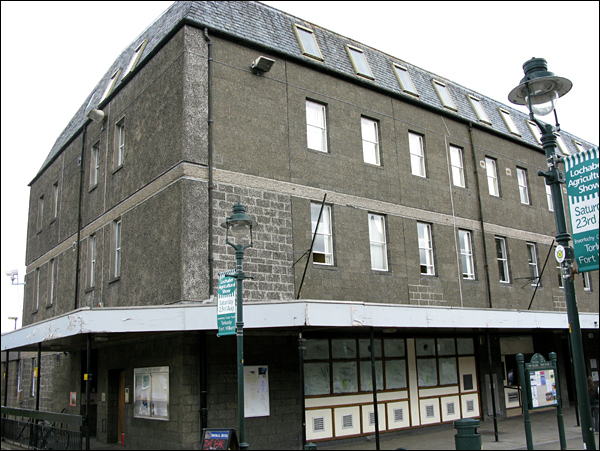
I walked down past Lochaber House and took a photograph of it. It looks to me like another product of the 1960’s wave of modernisation in these parts. The simple virtues of concrete must have been very seductive in those days. The building now lacks any discernible architectural grace, resembling a giant breeze block, hollowed out so that termites can labour perpetually within its dank grey carcase. Surely no-one could have designed or constructed such a building with the idea that it might endure and be regarded as in some way beautiful. It’s as if it was constructed on the functional principle that it will never be loved and therefore no-one will cry a tear over its inevitable demolition in the relatively near future. It’s a version of modernity that seems crude and ugly to us now, which is not to say of course that it may not have represented political aims a good deal more progressive and egalitarian than those that drive the current relentless rise of the shopping mall, the foundation hospital and the academy school.
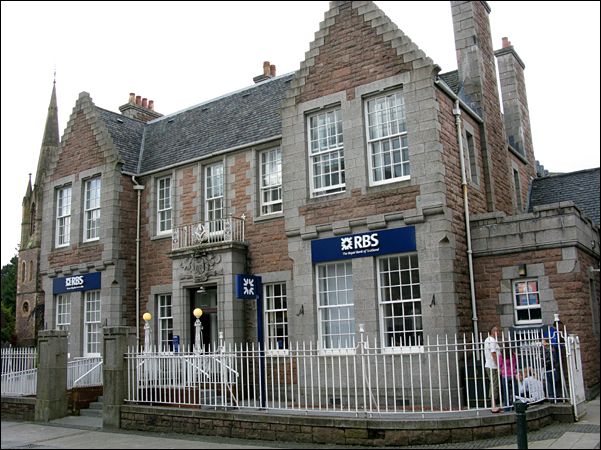
We are accomplices in the promotion of a pernicious Panglossian delusion. Appearance is everything. Facebook, facelifts and facades. The good is what looks good. Over the road from Lochaber House stands the building that houses the Royal Bank of Scotland, a solid construction of grey and pink stone, built in 1911. It reminded me of a seashell in its deceptively delicate intricacy. It embodies a sense of concern about beauty and design. Inside it I imagined bankers and cashiers and clerks would be going about their business like a scrupulous community of hermit crabs. Here we have modernity deploying the traditional to give a sense of something enduring and secure, the sort of place you’d be convinced your money is safe and will be put to work in the pursuit of decency, fairness and a responsible society. The sort of place you can trust. Here, we imagine, is a brand which is taking Scotland and the values it represents to the rest of the world. We somehow allow ourselves to be convinced that by becoming the customers of such a company we are investing in a world that is stable, solid and beautiful. This appearance is more or less the polar opposite of the reality, of course. The Royal Bank of Scotland identifies itself as The Oil & Gas Bank. Globally they finance projects that have in total more carbon emissions that Scotland itself. They are up to their sporrans in dirty work from the Amazon to Angola. Modernity occupies tradition in the way that some wasps occupy the living bodies of caterpillars by laying eggs in them; tradition is a paralysed, helpless host. I photographed the RBS building too, and then the Tesco Express building not far from it, another uninspiring concrete block.
As I was putting my camera back in my rucksack Alice came by. I told her about my day. We agreed that Glenfinnan station was very quaint and interesting. Alice was on her way to work. I told her I was leaving in the morning but I hoped to be back before too long. I asked her how her mother was and she told me she was fine. We walked together up the High Street. The cockney guy was near the tourist information centre. He was selling The Big Issue with another bloke who was also from the south of England.
Later that evening I walked alone down to the shore of Loch Linnhe and for a while watched the oyster catchers, herring gulls and hooded crows foraging on the shore. A common seal occasionally popped its head up out of the water as it went about the business of finding fish to eat. The following morning I drove south, through Glen Coe, past Loch Lomond and Glasgow and down the motorway to Carlisle. I listened to the radio for a while. I followed the A69 east for a while and then took the military road along Hadrian’s Wall. It was supposed to rain. It didn’t though. I was looking forward to seeing De Kooning and hoped that he was well. And as it turned out he was.
.
between gauntanamo and the grey corries
Most of the day I’ve been trying to get things in order at the office before I go off on holiday. The truth is that this is a virtually impossible task. The most that can be done is to lift down or push back those things that are teetering on the brinks of the highest shelves so that they won’t fall while you’re away. This task was done with a mixture of hopeful determination and resentment. But I was constantly prone to a lack of concentration. Already my heart was in the Grey Corries where space itself shrieks and sobs, whispers, breathes and yammers. Where shadows plunge into impossible, unimaginable abysses, where ridges and outcrops leap and glower among dark and ragged skies. The thought of those places made it hard for me to tidy my desk.
Gilmour rang me in a panic earlier in the week. The press had picked up on the discussions on Metro radio. The Journal and the Daily Mail had both been in touch asking what we knew about the Flinties and what we were doing about them.
‘These aren’t Moslem kids, are they?’ Gilmour asked, almost pleading.
‘No,’ I said. ‘It’s not clear that they have any religious affiliations at all, in fact. They’re just a bunch of kids running around in pillow cases.’
‘So what’s this throwing aeroplanes at people’s houses about?’
I told him the tale of Flinty’s return and how he’d become a sort of folk hero and spawned this daft craze. I told him about Batman and Bob Marley too.
‘Okay, so what are we doing about it?’ he said.
‘Nothing,’ I said. ‘What should we be doing, confiscating the pillowcases?’
‘Well, no. But we’ve got some scared people out there. We do need to do something. Or at least we need to seem to do something.’
‘Like what?’ I asked. ‘Incarcerate them in a pillowcase camp, set up a mini Gauntanamo behind the Woodhorn Museum? Get a bit of extraordinary rendition going and ship them off to Middlesbrough?’
‘What about getting some youth workers down there or setting up some activities and play schemes? Perhaps we need to put in some support for parents – educational input and parenting courses. And we need to think about the victims. I’ll speak to adult services. We need to see if we can get some counselling for anyone who’s been traumatized by these young people’s activities. I’ll speak to the police and see if we can get extra patrols in hot spots. We need more police presence in the community, some good old-fashioned Bobbies on the beat. We need to be talking about getting more CCTV on these estates. People need to feel secure. We need to take the lead here. We need to coordinate a full multi-agency response. We’ll see if we can get housing on board. Maybe they can do something about some of these families under the anti-social legislation. I wonder if we should be talking to church leaders too? What do you think?’
What I thought was that he might be over-reacting just a bit. What I thought was that kid will be kids. What I thought was that Flinty was the only real risk to anyone here and it would be helpful if he was arrested. But I somehow doubted that this was what Gilmour wanted to tell the press. He had gone into full shock and awe mode. I wondered how long it would be before we considered the Guantanamo option.
‘Okay,’ I said. ‘What about the funding?’
‘Oh, I’m sure the money will be there for this one. Listen, this sounds good to me. I’ll get on to the press office. We’ll say we’re aware of this problem and we’re on to it, but that we’re sure these young people do not pose any threat to the general public. We’ll say we’re working with the community to find solutions and putting in specialist workers to help these children and their families. We’ll say there’s no evidence that these young people are in any way involved with Moslem groups.’ He paused for a moment. ‘No,’ he went on, ‘I’ll leave that bit out. But we’ll set up a help line. What about using your team to man it?’
‘No chance,’ I said. ‘We’re run off our feet. And anyway, what would we say to anyone who rang? And why do we want them to think we can do anything in any case?’
‘Hmmm,’ Gilmour said. ‘Okay, no help line. Okay. That’s fine. Anyhow, how you doing, my boy? How’s your dad?’
‘Oh, he’s fine. Still working in the boiler room, you know. Yours?’
‘He’s very well, thanks. Absolutely tickety boo. Did I tell you my lad’s driving the quad now?’
‘Yes,’ I said. ‘I think you did. Your daughter’s got a dappled horse too, hasn’t she?’
‘She has, yes. Beautiful beast.’
‘And the horse isn’t bad either, eh?’
Gilmour chuckled.
‘Have you had your holidays yet?’ I asked.
‘Not yet, no. We’re off to Provence again in a couple of weeks. You?’
‘I’m off to Scotland next week to do some walking. I’m looking forward to it.’
Gilmour bid me farewell and went off to speak to Public Relations. Just after he hung up Michelle told me there had been another sighting of Captain Hook. He was walking along Pont Street eating a bag of chips. It’s said he has a slight limp, as if he’s hurt his left foot.
I’ll be leaving for Fort William tomorrow morning. After tea tonight I carried De Kooning out into the garden and we gazed together at the Citadel. They’re putting the concrete floors in now and the huge aluminium window frames.
‘Watch what you’re doing while I’m gone,’ I said to him. ‘Don’t you go wandering over there, okay?’
He laid his head against my arm for a moment. I’ll miss him while I’m away, I always do.
We went inside and I began to get together the things I’m taking with me. I like to take a small selection of CD’s and a book or two. I decided to take the latest albums by Eliza Carthy and Meg Baird, both of which are excellent, as well as The Essential Leonard Cohen. I’ll take my book on Scottish art to read, along with a couple of books of poems by Kathleen Jamie. Tomorrow I’ll travel north. On Sunday I hope I’ll walk the Grey Corries again.
.
 yammering