Posts Tagged ‘morpeth’
a broken napoleon and a dead spider
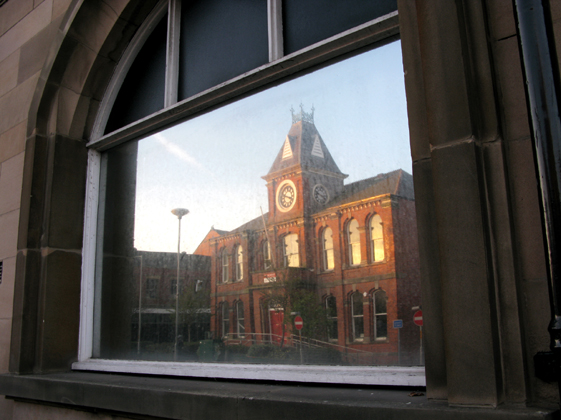
Returning to work after a holiday is always a difficult transition, like stepping from a garden into a bullring. Transitions like this are often best managed by a ritual, and in my case this involves washing and ironing all my clothes, polishing my shoes, trimming my sideboards, and having a long bath. It’s as if the odour of recreation must be washed from me, as if to return to the old world I must make myself a new man. Going back to work is like rebirth. I must purify myself before my eviction from the womb.
Things have been surprisingly quiet at work. Sightings of the Arab have declined dramatically it seems (although Robin Hood may have become a permanent resident). Debs says that in part this is because Elephant Carmichael has been remanded in custody on charges of aggravated burglary and attempting to pervert the course of justice and Flinty’s keeping his head down. More significant though is that Flinty’s shacked up with Molly Armstrong in her flat at Rothesay Terrace down at the Station and is otherwise engaged, at least for the time being. What’s more, the schools are open again, the nights are drawing in a bit, and the weather hasn’t been good. The population of Flinties is dwindling rapidly, as if they’ve been nothing but summer migrants. I spoke to Gilmour a day or so ago and told him so and that I thought things were settling down. He told me that this was great news.
‘Looks like we’ve cracked this one, eh?’ he said. ‘I’ll let the Director know. Good work!’
‘Thanks,’ I said. ‘We do what we can.’
It rained heavily last weekend. Morpeth was flooded and Northumberland finally became the victim of freak weather and got the publicity and pity that for so long it has been denied. A disaster can be a cloud with a very silver lining. Eat your heart out the Vale of York: Charles and Camilla visited us today. They dallied a while, meandered along the loyal fringe of their postdiluvian subjects and shook a few of their damp northern hands. The television report showed them at a chip shop in Morpeth town centre. I think it was the Market Chippy on Newgate Street, next to the cheese shop. I like the look of Charles. He’s consistently odd. Somehow he reminds me of a gundog, one that perhaps lacks a little in the way of grey matter but who has an irrepressible sense of mischief. A springer spaniel perhaps. A one that would chew your furniture. He also sometimes reminds me of a bedraggled fledgling, an owlet perhaps.
The Widow Middlemiss hasn’t yet returned from Derby. Despite the heavy rain her property has suffered no further flooding. Griff has obviously taken steps to avoid another PR disaster. When I came in from work earlier this week Margaret was in the Widow’s garden dead-heading her French marigolds and hoeing the borders. I glanced across to see if Hugo was back. He wasn’t. I went inside and made myself a cappuccino. I was sitting in the conservatory with De Kooning pondering the realities of wage slavery when I became aware of a faint ticking. I followed the sound to the door of Margaret’s bedroom. I pushed it open slowly, as if I was about to find a bomb. What I found was a lot stranger: the ticking turned out to be the Napoleon Mantel Clock on her dressing table. It had come back to life. It was ticking enthusiastically. It had broken ranks with its twenty two silent and motionless companions. It now said it was almost five o’clock, which wasn’t right but suggested it had probably started working again about two hours earlier, at which time I knew Margaret would have still been at work.
‘The Napoleon in your bedroom is working,’ I said to Margaret when she came back in.
‘It can’t be,’ she said. ‘It’s broken.’
‘It can’t be broken,’ I replied. ‘It’s ticking.’
She went to the bedroom and checked. She was still wearing her wellies and green gardening gloves. She came back with her mouth hanging open.
‘How can this be possible?’ she said. ‘That clock is broken. The Greek said it was beyond repair.’
‘The Greek was obviously wrong,’ I said.
‘He’s never wrong. The Greek is never wrong. Never.’
My pizza was ready. I sat for a while eating and pondering the mysterious resurrection of the broken Napoleon. It had the look of a miracle about it. But it wasn’t, of course. I asked Margaret if it was okay if I examined it. I went into her bedroom and gazed at the ticking timepiece. I picked it up with both hands and looked deep into its face. It was now keeping perfect time. It had a sort of blank insolence about it. A smugness even. This was a clock that wasn’t about to give anyone an account of its baffling revival. I stood it back down on the dressing table, next to a copy of Eckhart Tolle’s book The Power of Now. Brenda had recommended this to Margaret a few days ago. I picked it up and flicked through a few pages. Zen meets narcissism. Absurd and incoherent. Pure Brenda. The perfect companion for a clock that rises from the dead, I thought.
I rang the Greek. He told me there was simply no way the Napoleon could be working. It was a broken clock. I told him it had. The Greek was puzzled.
‘Then I was wrong,’ he said. ‘It was never broken. A broken clock is a broken clock, and it cannot repair itself.’
I told Margaret I’d spoken to the Greek and that he’d said the clock must have been in working order all along.
‘If that’s so then why didn’t it start ticking before now?’ she said. ‘And why did it start now? There’s something funny going on here, I’ll tell you that. Clocks just don’t stop and then start again without reason months and months later. It doesn’t make sense.’
‘There’ll be an explanation,’ I said. ‘But we might never know what it is. Perhaps a dead spider was jamming the works and it has finally decomposed or its corpse has finally fallen from the cogs. That could have happened.’
She rolled her eyes. ‘Oh, yes, that’s very likely,’ she said. ‘The corpse of a spider falling from the cogs. I think I’ll give Brenda a ring.’
I glanced at De Kooning. He was washing his face with his paw. Behind me I could hear the television newsreader saying that a junior whip has come out and said openly that their should now be a leadership contest in New Labour. It was starting to rain and looking very dark outside. The economy’s in recession. I wondered what Gordon was doing tonight.
.
the dark dust of summer
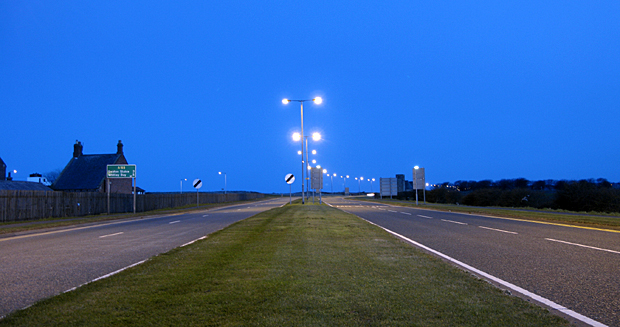
Galloway was grand.
Things change so quickly at this time of the year. While I was away the climbing rose has become an unruly in your face splatter of ragged golden blossoms. The foxgloves are at least six inches taller than they were when I left, their spires all beginning to unbutton now in whites and pinky-purples with lovely speckled gapes. The catmint is a higgledy-piggledy drunken sprawl of blue stalks. And the flag irises have all flowered, a cluster of sirens in diaphanous hoods of watery blue, each one as pale as a jackdaw’s eye. They remind me somehow of the Breton women in Gauguin’s paintings. They have that same shy allure but without the blackness.
Hugo has painted silver the spear-like tip of each black railing along his garden wall. I couldn’t see any new flotsam in his front garden. His security cameras stare resolutely at the street. The Alligator still lies where it has lain since time immemorial, and looks no different than it ever did. This is not to say no change has occurred, of course. Some changes are subtle and almost imperceptible in the absence of a running record to document the process, be it transformation or decay.
The Citadel is truly massive now, and is extending not only vertically but horizontally too. It must now be more than two hundred metres from one end to the other, expanding like a giant red crab in a series of huge extensions, each one mitred into the preceding one in an obtuse articulation, as if this monster will soon enclose us all in its dark embrace. It looks down on us anonymously, like the stadium at a race course, or perhaps like the vacant tiers of an amphitheatre. It dominates us already and already it is clear that it will literally blot out the sun for much of our street. The roofline of the Citadel will be our new horizon. Although our house will be less affected than some, I estimate that for the greater part of the year the sun will now set at least several minutes earlier than it did before because of the irresistible shadow falling across us. And in the summer months I estimate we will lose the sun from our conservatory perhaps forty-five minutes or an hour earlier than we have done in previous years. The Citadel will make our days shorter and take away our evening sunshine. Griff obviously doesn’t much care that we will now end our days in the dark shadow of this grotesque monument to his self-importance. And nor does Gordon. The so called modernisers care little for the sun, except as something else they can steal from us with one hand and sell back to us with the other.
I picked up De Kooning and together we surveyed the new landscape. Hugo was in his garden doing something to his pond.
‘What’s Hugo doing to his pond?’ I said to Margaret.
‘Who’s Hugo?’ she replied.
‘It’s Fletch,’ I replied.
‘Why did you call him Hugo,’ Margaret said. ‘It’s not his name.’
‘Yes, I know that,’ I explained. ‘But from the way he looks I thought it ought to be.’
Margaret rolled her eyes. She told me that the man known to some of us as Hugo but more correctly referred to as Fletch was cleaning his pond. While I was away it seems all his carp have died. He doesn’t know why, but Margaret is fairly sure it’s because of contamination of the pond water with dust from the Citadel. She may well be right, of course, although Griff said the hypothesis was simply ridiculous when Geraldine rang him. The Citizens have a sample of the polluted pond, however, and are determined to get it analysed by an expert to prove that Citadel Dust is to blame. And as Margaret says, if Citadel Dust can kill perfectly healthy fish just imagine what it might do to us. The same thing, of course. Obviously a brand new slogan is ready to be born: Citadel Dust Kills.
As the pond cleaning machine whirred away Hugo sat on an old kitchen chair, the moose standing at his right side. A scene from Ragnarok crossed my mind.
‘How was Galloway?’ Margaret asked.
‘Oh,’ I replied. ‘ Galloway was grand.’
‘That’s good,’ she said. ‘By the way, we’ll be having the Slipper Shop launch party next Sunday. People will be arriving at about two and we’re expecting it to go on till about six or so. Perhaps you can arrange to go walking during those hours.’
‘I’m sure I can, yes,’ I replied.
‘Oh, and before you say anything, yes, I’ve changed the clocks. It’s on Brenda’s advice, in the light of the coming launch party. She feels that we need maximum equilibrium and has suggested the new time on the basis of Feng Shui principles. She feels that this will be the most propitious time we could possibly have.’
‘That’s fine with me,’ I said. ‘No problem.’
I hadn’t actually noticed that the clocks had been changed. I glanced at the Cuckoo in the kitchen. We now have twenty three clocks all saying quarter to three. It will take me a little while to see if I prefer propitious equilibrium to the spiritual optimism of the previous time. But if it sells slippers I guess it would be churlish of me to care much either way.
It was a sunny afternoon, but Margaret told me that generally the week had been rather cool and that there’d been rain at times. I told her that the weather in Galloway had really been much better than that.
slaughterhouse bob and the mysterious mr ferret

Yesterday I went to another meeting in Morpeth. Well, actually, it was the same meeting that I’d gone to the day before, but on that day I had the wrong day in my diary. One of the people at yesterday’s meeting was my old boss Gilmour. He and I have had some serious disagreements in the past, but generally we get on well with one another. Gilmour’s a very affable man, if on occasions a little fastidious or tetchy and at all times immensely vain. But handsome men are often cursed with such narcissisism. Maybe they think that if they aren’t loved for how they look they won’t be loved at all. Such men are never going to see themselves as ugly.
Gilmour sits well with senior management and looks every inch the part. He comes from a very different background to me. His father, Robert Gilmour, is a wealthy landowner and farmer in the south of England. He breeds Lincoln Red cattle. Gilmour is very sensitive to any perceived attack on his father, almost unnaturally so. For this reason if for no other whenever he’d been down to see his family I’d have to ask him about Slaughterhouse Bob, a moniker which instantaneously turned Gilmour Junior into a teeth grinding, fist clenching madman. This behaviour became a good deal more frequent when his father became involved in a TV programme, providing me with the pretext to unleash my childish abuse on a more or less daily basis. I regret such behaviour now, of course, but the habit of winding up Gilmour is a hard one to give up.
‘God, you’re lovely today!’ I said as I walked into the meeting. His companions – Head of Department Harry Gillan, two men from personnel and Petra from legal – raised an eyebrow or two. Gilmour glowered at me and laughed.
‘You too,’ he said, adding ‘you lanky bastard’ under his breath as I took the seat next to him.
The meeting, rather ironically, concerned a disciplinary investigation I am undertaking into a worker suspended from work for allegedly gratuitously insulting colleagues and clients alike. The worker is Hermann Evans, who works in the north of the county. He’s been around for years and has a reputation as a maverick, a man who doesn’t give a hoot for the shallow niceties of organisational etiquette. He is suspended from work pending the outcome of my investigation, but has complicated matters by getting himself diagnosed with a work-induced stress-related psychological illness, and by taking out a grievance on the grounds of racial discrimination. Hermann is three parts Bavarian, one part Welsh, and is claiming that any offence he caused was accidental and arose from his failure to recognise the nuances of the English language. He claims this is because he still thinks in German.
Hermann has a long history of using apparently gratuitously insulting expressions and I discovered that he has been spoken to about this by managers many times over the years. One of the earliest examples occurred some years ago and involved Hermann habitually calling an unruly, unkempt group of siblings “the ferret children”. He did this, it seemed, not only because of their appearance and manners, but as a pun on their surname, which was Merritt. When talking to their mother Hermann would repeatedly refer to her children as “the lesser-spotted ferrets”. In his assessment report he twice referred to the boys’ absent father in writing as “the mysterious Mr Ferret”. Mrs Merritt complained about this behaviour and he was spoken to. He was unapologetic, and responded by saying that it is characteristic of the ferret to live in a state of denial. He was taken off the case.
More recently Hermann has persistently referred to a certain formidable broad-hipped female headteacher as Brunhilda, doing this both with parents and their children and in formal meetings involving school staff and other professionals. One person said to me that he had never heard Hermann refer to this headteacher by any other name and that he seemed unable to bring himself to use her real name. When referring to her as Brunhilda he spoke in a plain matter of fact tone, as if in fact this was her real name.
Other recent examples involve Hermann calling a child he was working with who suffers from enuresis the peapod, a local doctor whose eyebrows meet in the middle Freddie Faust, and two of his fellow team members Lardarse and Lulabelle. It’s remarkable how tolerant the organisation has been with Hermann. My theory is that there are two main factors here: first, no-one wants to become the butt of his abuse, and second, everyone secretly enjoys his outrageousness and thus covertly encourages it. It livens up the day to see what he might come up with next.
Hermann finally came a cropper when he came up with a new label for the Director: The Gay Goldilocks. Hermann being Hermann, and riding on the back of his I don’t really know what I’m saying, I still think in German, you know excuse, he soon ceased to use the Director’s real name at all and simultaneously appeared to begin to go out of his way to find a reason to bring him into the conversation, something that would be a rarity in usual circumstances, given that the Director is little more than a mythical being to most people in the organisation. It was only a matter of time before he was suspended, and it happened in dramatic style at an Adoption Panel. The Gay Goldilocks was in the chair. Hermann grandstanded with a bravura performance of vintage Bavarian deadpan slapstick – porridge, the three bears, crumpled bedsheets, the lot. That was Hermann’s last morning at work.
From the interviews I’ve carried out I’ve come to believe that his colleagues also became increasingly inclined to mention the Director to Hermann, throwing up balls for him to whack over the fence. There were also a significant number of interviewees who smirked as they recounted Hermann’s exploits, and a number who said they sometimes couldn’t help laughing at his comments because he seemed to have a knack of spotting something true about his victims. No-one of course expressed the view that there was an ounce of truth in his characterisation of the Director.
Gilmour asked me what I made of Hermann’s excuse that he didn’t mean to offend and that the inappropriateness of his remarks arose from his poor English.
‘It’s a preposterous excuse,’ I said. ‘If he didn’t know what he was saying there’d be no truth in his characterisations. Sometimes his observations are frighteningly exact. No-one would hit the bull’s eye so often if he wasn’t a darts player’
Gilmour, Harry and the men from personnel looked at me quizzically.
‘Except in the case of the Director, of course,’ I added. ‘Even Hermann sometimes throws a bad arrow.’ The personnel guys nodded sagely. I’m pretty sure Petra sniggered.
When the meeting ended I asked Gilmour how his wife and seven children were. He said they were all doing great. His eldest daughter has a dappled grey horse and his son drives the quad bike now.
‘And how’s your dad?’ I asked. ‘Still growing cows?’
‘Yep,’ Gilmour replied, now with the unflappable poise of a man with ambition. ‘How’s yours?’
‘Oh, he’s just the same, you know. Still working at the pit.’
When I got home I discovered Margaret on the phone talking to Brenda. Brenda and Tristan were back from Florence and had obviously had a wonderful time. I decided to go out on my bike before I had tea. It was a dull evening but dry. I rode out to Blagdon Hall and back through Annitsford and Shankhouse. When I got back Hugo was on his castle drive with a hammer in his hand. I cruised past his spiked railings and up the path. I heard him beginning to beat the Alligator as I closed the front door.
Margaret had gone to see the snaps of Brenda and the Troskyist at the Cathedral of Santa Maria del Fiore and to hear of the marvels of the Uffizi. The house smelled of onions. I fed De Kooning some fresh prawns and made myself a Quorn and cheese sandwich. I put on the Decemberists again and looked at Haldane’s book on the drove roads of Scotland.
Tomorrow I’m off to Galloway for a week. I go there every year at the beginning of June. The days are long and the world is green and I will walk from morning till night.
 yammering