Posts Tagged ‘tesco’
some memories of alice and bill
‘Excuse me, mate, can you spare some change?’ The balding middle-aged man in a winter coat had a Cockney accent. He was sitting against the whitewashed wall in the subway between the railway station and the High Street. It was the same guy who the day before sold me a copy of The Big Issue beside Lochaber House. I ignored him this time.
Fort William – An Gearasdan in Gaelic, as the road signs north and west of Crianlarich always remind us – wears its problems on its face. The biggest town in the Highlands – ten thousand people, a port and an industrial town (aluminium etc) – it has a fair number of manual workers. It also has deprivation of a kind the single linear shopping district of the High Street cannot conceal. Although you’re sometimes hard pushed to be sure who is a tourist and who isn’t, the lack of truly high order shops and the obvious presence of a number of distinctly low order ones tell you that the invisible poor are here somewhere. At first glance of course you’d wonder where they actually lived. Certainly not in the long line of pleasing residences (many of them B & B’s or small hotels now) that line the main road into town. The poor in fact are tucked away in housing estates elsewhere – about a quarter of the population live in houses rented from the local authority – most notably in The Plantation, an estate which lurks out of sight above and behind the High Street. In Scottish government terms this area is identified as ‘severely deprived’.
Tourism is obviously crucial to Fort William’s economy. And yet it seems to be struggling to transform itself into a modern tourist destination, its solitary ribbon of a high street and the nagging presence of its poor conspiring with its remoteness and relative smallness to make this transformation problematic. It isn’t Edinburgh. It can’t throw up the same kind of impermeable enchanting façade and it isn’t big enough not to be dragged down by its blemishes.
One evening I ate in one of the pubs on the High Street, pub grub being hard to avoid in this town. I was browsing through the menu when the waitress came over and asked me if I was ready to order.
‘I’m a vegetarian,’ I said. ‘I guess it’ll be the mushroom stroganoff.’
She laughed. ‘Yes,’ she said, ‘we do plough a rather narrow nutritional furrow in these parts, don’t we?’
She was a striking woman of perhaps forty or forty five. She had red hair and her eyes were sparkling, playful and as blue as porcelain. Her name was Alice McTavish. She knew Newcastle and guessed that I came from around there. She told me she went to university in Edinburgh – to do biochemistry, she told me later – but had dropped out to work as a dancer for a while. Later she worked in hotels and restaurants in London and Liverpool before returning to Fort William to look after her disabled mother who suffered a stroke a few years ago, a random event of the kind that shapes all our lives. Alice works now as a waitress during the tourist season only, mostly just to keep in touch with the world, she says.
‘I used to work in McTavish’s, the restaurant,’ she said. ‘No relation!’
‘Where is it?’ I asked.
‘It used to be in that space next to the Grand Hotel at the bottom of the street. It burnt down a couple of years back.’
‘Oh, I’ve noticed that space,’ I said. ‘Aren’t they going to put some new shops there?’ The Grand Hotel is a bland concrete building. It’s now boarded up. Like the hotel next door to it – which is larger and still a going concern – it seems to be a sort of relic of the bus tours of the Scottish Highlands, which I imagine must have been a really big thing in the 1960’s and seventies and which you still sometimes see advertised in provincial newspapers. Although the bus tours are still going – nowadays they seem to bring in mostly the elderly or the less affluent from the industrial areas of northern England – they increasingly seem to be an anachronism, and ironically perhaps yet another albatross around the neck of a town that dreams of becoming a modern holiday attraction.
‘So what would you like to see them put in the space where the restaurant used to be?’ I asked.
‘Oh, something up-market would be nice,’ Alice said. ‘We could do with that. Maybe a nice clothes shop, maybe a Marks and Sparks. Maybe a jewellers and a nice wee art gallery. A Starbucks and a wee piazza. A good Italian restaurant. We could do with a bit culture around here.’
‘Whisky, bagpipes, shortbread and tartan is culture, Alice,’ I said. ‘Isn’t it?’
‘It is, and I love it, of course. But even up here we sometimes hanker after modern things too, you know.’
Alice’s clothes were in fact very modern and fashionable – indigo, green and ivory, cotton and linen. She wouldn’t have looked out of place in Edinburgh or London. I commented on this.
‘Aye, but I didn’t get these at Mc&Co!’ she said. Mc&Co is a somewhat old-fashioned and down market but reasonably respectable clothing shop which occupies part of the Lochaber House complex. There is a branch in Ashington too. Their demographic, as they say, appears to be broadly the rather less affluent social groups.
‘So where do you go to shop?’ I asked. ‘Stirling? Glasgow? Inverness?’
‘Oh, no,’ she said. ‘I get my stuff over the internet. I got these things from Monsoon and Debenhams.’
‘So you don’t really need an actual shop, do you? You can be thoroughly modern no matter where you live.’
‘Ah, but it’s not the same, is it? A lassie likes to see what it is she’s buying, you know, to try a few things on and all that.’
‘Hmmm. But why would Marks and Sparks put a shop here? Where would they get their customers from?’
‘Well, the tourists would buy stuff too. They’d get a lot of passing trade.’
This is oddly enough true. Even though most tourists would be able to get the same top or skirt in a branch of a chain shop close to home, it somehow becomes a different garment if it’s bought on holiday, especially if it’s in Scotland. On holiday we lose our spending inhibitions. We temporarily enter a different life-world, a parenthetical life-world of sorts. And things bought in Scotland are in any case mysteriously different. The spirit of Scotland inhabits them and gives them a special value, a magical aura. Place matters. It makes things what they are. It reconstructs everything, be it the book you read or a pop song you hear every day on the radio, an encounter with an otter or a brief love affair. Place makes transcendent souvenirs of certain memories. They become a part of the core of what we are.
‘Aye, but there’d be no customers in the winter,’ I said. ‘There’s the rub.’
Alice nodded. ‘I know,’ she said. ‘I know. Thank God for the internet, eh?!’
Towards the end of the week I caught the steam train to Mallaig. As we chugged along the forty odd miles through some of the wildest and most beautiful landscape you could wish to see I found myself musing about modernity and the marketing of Scotland, the product, and the inescapability of me being a consumer of that product. Scotland is all rugged mountains, huge skies and vast stretches of water, Scotland is tradition and history, and it’s easy to imagine that going to Scotland represents a radical escape from modernity and consumerism. But there is nothing accidental or unmediated about the experience. I come to Scotland to consume what I imagine is nature and the tradition of a harmonious, sustainable relationship with the natural environment. Scotland in my mind is solid and real, the model of a good way of life. I come to Scotland to confirm a construct I already have of what this place is. I come here to find what I know is here. It’s a reassuring game and we all play it. The modernity is in the process, a process that transforms the substance of the world. The ancient is made new; the new is made ancient. I have come to collect a product I bought somewhere else.
Modernity rests on layers of deception, none of them final. It is an onion without a core. It asserts as axiomatic that the new is better than the old. But it also says that nothing is ever good enough, that everything can be improved upon. It rests upon an induced endemic sense of dissatisfaction. We are persuaded to desire things we will very soon be persuaded to reject. The layers get more pernicious and bitter as we peel them back. We are persuaded next that the products of the restless new world are more than mere things, that what we are is nothing less than the constellation of what we have or consume. We are what we consume and we are also therefore that which we desire to consume. We are what we want. This anguished sense of entitlement turns wants into needs. But despite this overwhelming urgency we will not want these things for long. Indeed this fuels the urgency, since we must have the thing we want while it is worth having and we know that this value won’t last, that the shelf life of all things is limited. Modernity tells us we cannot and should not wait, because we are incomplete until we get the things we want. Soon we will be incomplete because of our association with these very same things. We live in a world where we love ourselves today in the clear knowledge that tomorrow we are likely to dislike ourselves. Soon our being will depend upon the next new thing. Modernity is a ruthless façade.
Modernity has no scruples and is endlessly flexible. The same thing can be sold twice. Modernity encompasses every deception. The traditional can be consumed as voraciously as the novel. The classic car, the country house, the work of art, the antique, the retro, the repro, the replica . . . There’s a market for anything. And while there are things that can be harvested many times there are others that can only decay. Modernity is cheap, because everything is made to be replaced.
When I got back I came through the subway again. On that day a girl was busking there. She had a good voice and played guitar with some grace. She was singing a song in Gaelic. She wore scuffed maroon calf-length lace up boots with gaping holes in the toes and had long, somewhat lank hair. I threw a pound coin into her guitar case.
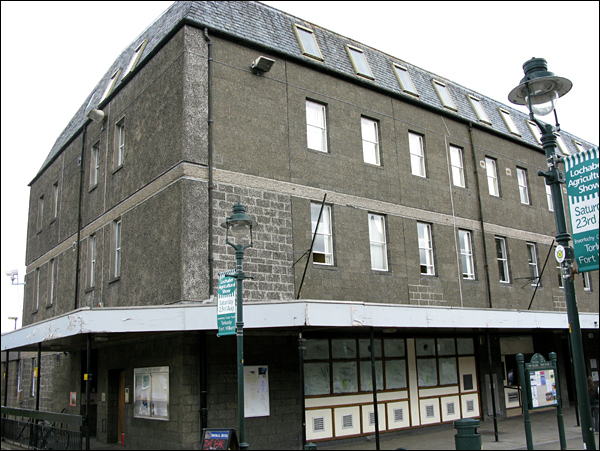
I walked down past Lochaber House and took a photograph of it. It looks to me like another product of the 1960’s wave of modernisation in these parts. The simple virtues of concrete must have been very seductive in those days. The building now lacks any discernible architectural grace, resembling a giant breeze block, hollowed out so that termites can labour perpetually within its dank grey carcase. Surely no-one could have designed or constructed such a building with the idea that it might endure and be regarded as in some way beautiful. It’s as if it was constructed on the functional principle that it will never be loved and therefore no-one will cry a tear over its inevitable demolition in the relatively near future. It’s a version of modernity that seems crude and ugly to us now, which is not to say of course that it may not have represented political aims a good deal more progressive and egalitarian than those that drive the current relentless rise of the shopping mall, the foundation hospital and the academy school.
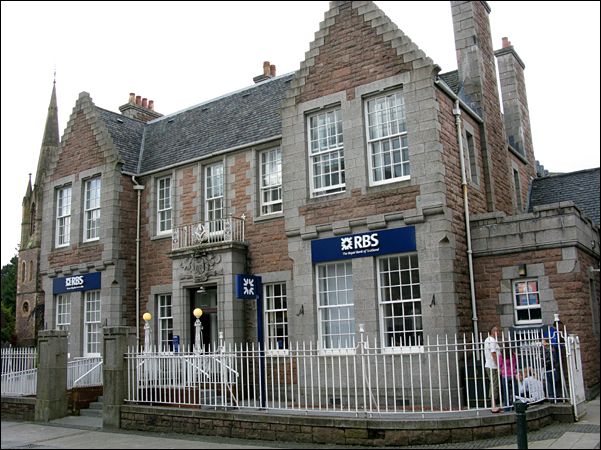
We are accomplices in the promotion of a pernicious Panglossian delusion. Appearance is everything. Facebook, facelifts and facades. The good is what looks good. Over the road from Lochaber House stands the building that houses the Royal Bank of Scotland, a solid construction of grey and pink stone, built in 1911. It reminded me of a seashell in its deceptively delicate intricacy. It embodies a sense of concern about beauty and design. Inside it I imagined bankers and cashiers and clerks would be going about their business like a scrupulous community of hermit crabs. Here we have modernity deploying the traditional to give a sense of something enduring and secure, the sort of place you’d be convinced your money is safe and will be put to work in the pursuit of decency, fairness and a responsible society. The sort of place you can trust. Here, we imagine, is a brand which is taking Scotland and the values it represents to the rest of the world. We somehow allow ourselves to be convinced that by becoming the customers of such a company we are investing in a world that is stable, solid and beautiful. This appearance is more or less the polar opposite of the reality, of course. The Royal Bank of Scotland identifies itself as The Oil & Gas Bank. Globally they finance projects that have in total more carbon emissions that Scotland itself. They are up to their sporrans in dirty work from the Amazon to Angola. Modernity occupies tradition in the way that some wasps occupy the living bodies of caterpillars by laying eggs in them; tradition is a paralysed, helpless host. I photographed the RBS building too, and then the Tesco Express building not far from it, another uninspiring concrete block.
As I was putting my camera back in my rucksack Alice came by. I told her about my day. We agreed that Glenfinnan station was very quaint and interesting. Alice was on her way to work. I told her I was leaving in the morning but I hoped to be back before too long. I asked her how her mother was and she told me she was fine. We walked together up the High Street. The cockney guy was near the tourist information centre. He was selling The Big Issue with another bloke who was also from the south of England.
Later that evening I walked alone down to the shore of Loch Linnhe and for a while watched the oyster catchers, herring gulls and hooded crows foraging on the shore. A common seal occasionally popped its head up out of the water as it went about the business of finding fish to eat. The following morning I drove south, through Glen Coe, past Loch Lomond and Glasgow and down the motorway to Carlisle. I listened to the radio for a while. I followed the A69 east for a while and then took the military road along Hadrian’s Wall. It was supposed to rain. It didn’t though. I was looking forward to seeing De Kooning and hoped that he was well. And as it turned out he was.
.
a case of mistaken identity
There were many suspected sightings of Flinty last weekend. By Monday morning a pattern had emerged to support a widespread belief that he had now settled on a consistent disguise: an Arab. The Arab is a man of about Flinty’s age and build. He wears a white dishdasha, a keffiya and Ray-Bans. He drives an old white Mercedes with a red leather interior. He has been seen on the estate parked across the street from Mandy’s on at least two occasions, and in the neighbourhood many more times. He was also been seen in Amble on Sunday afternoon, eating chips from the Harbour Chippy with no other than Elephant Carmichael. Standing with Elephant and the Arab were the Fisher boys, infamous as purveyors of dodgy amphetamines and benzos. By Monday morning the Arab had acquired a mythical identity around the estate: he was Flinty bin Laden.
While the evidence for a fixed identity seems compelling, it needs to be kept in mind that Batman was also spotted twice on the estate last weekend, on both occasions driving a pearly blue P-reg Peugeot 306. There were also a couple of other curious single sightings of note: on Saturday a Rastafarian in a bronze Citroen BX Estate and on Sunday morning Michael Jackson in a white Fiesta with a black offside wing and a cracked headlight. There was also an unconfirmed sighting of Robin Hood in a Honda Civic at around teatime on Sunday, although the source of this report is Cheryl Amstrong, a notoriously unreliable witness. It is generally agreed though that none of these individuals was Flinty, but that doesn’t explain the rash of exotic visitors to the estate. There are three plausible explanations for this:
- Chance. Despite the statistical odds being long these simultaneous rare visitors are no more than an unlikely coincidence.
- Copycat disguising. Flinty has started a craze. Already people are talking about ‘doing a Flinty’, but so far as anyone knows no-one actually has.
- Decoys. Flinty has got his mates to dress up to confuse and mislead people. If they can’t all be him maybe none of them is.
The smart money is on the third option. The presence of Flinty bin Laden is now considered an established fact. And while dressing as an Arab doesn’t seem like the most obvious way to avoid drawing attention to himself, remarkably enough he’s never once been pulled over by the police. Perhaps the decoys are doing their job. Or perhaps they’re mistaking him for Dekka Douglas.
On Wednesday morning Flinty rang Debs to ask about Mandy and the kids. He said he hadn’t heard from her since he came out and was a bit worried. He was just ringing to make sure everything was okay. He was Mr Charm himself, a nicer guy you couldn’t hope to meet. But Debs wasn’t going to let him go without a challenge.
‘People say you’ve been seen hanging around the estate near Mandy’s house.’ she said.
‘People? Which people? Tell me their names.’ Flinty replied.
‘Lots of people, Flinty. I don’t think they’d want me to tell you who they are.’
‘Because they know what would happen if I found out they’d been saying things about me.’
‘A couple of people have said you were across on Saturday afternoon. They say you were disguised as an Arab.’
‘It couldn’t have been me.’
‘Why not?’
‘Because I wasn’t there.’
‘Other people say you were there on Monday as well, around teatime.’
‘Do they? So what was I dressed as on that occasion – the Last of the Mohicans?!’
‘No, as an Arab again.’
‘Oh, come on, Debs, do I look like a bloody Arab to you? Tell me who’s saying these things and I’ll go and have a talk to them about it. I think you’ll find what we have here is a case of mistaken identity.’
‘How could you go and talk to them, Flinty? You’re not allowed to cross the Wansbeck.’
‘I’ll ring them, or maybe I’ll get the Elephant to drop in on them to clarify the matter.’
‘Mandy herself thinks you were there on Monday.’
‘Nah, Debs, it couldn’t have been me. I was somewhere else that day. And besides, if the person who was there was dressed as an Arab how would anyone know it was me in any case?!’
‘Because it was an Arab with your face, Flinty.’
‘Nah. It couldn’t have been me. I was with the Elephant in Seaton Delaval seeing a geezer about some DVD’s. Ask the Elephant. Any way, what kind of car did this Arab have, Debs?’
‘The Arab drives a white Mercedes.’
Flinty laughed, almost theatrically. Then, suddenly, the line fell completely silent.
‘You know I love the lass, Debs,’ he said, ‘and you know she loves me. The kids love me as well, you know they do. I’ve always treated them like my own. So why won’t you lot let us be together? It’s a breach of human rights not to let us be together.’
Debs began to wonder if Flinty had somehow forgotten that he tried to lop off Mandy’s ears with a pair of secateurs. ‘Mandy doesn’t want to be with you, Flinty,’ she said, very deliberately. ‘You know that. She’s moved on and you need to let her go.’
‘Who says she doesn’t want to be with me? Does she say that? I bet she doesn’t. Nah, it’s just you and the other busy bodies who say that. If you tell her she can be with me she’ll be back in a shot. Tell you what, Debs, you set up a meeting between me and Mandy – you can be there if you like – and let’s see what she really says. How about you do that?’
‘No, Flinty. Mandy has a right to get on with her life without having you scare the shit of her.’
‘You reckon? Yeah, well, time will tell, won’t it? Tell her I’m asking after her. You can also tell her I’ve seen my brief and my release conditions are going to be changed because they make it impossible for me to follow my usual employment.’
‘What’s your usual employment, Flinty? You’ve been on the dole as long as I can remember – except when you were locked up, of course.’
‘Scrap. I’ve always dealt in scrap, everybody knows that.’
‘Well, you’ve been convicted of stealing cable, Flinty, but I don’t think that makes you a legitimate businessman.’
‘Look, the law says I’ve got as much right as anybody else to be given a fair chance. That’s all I’m asking for, Debs. Just tell Mandy and the kids I love them. Tell them I’ll see them soon. Okay?’
Debs didn’t reply.
‘Okay. Well, whatever,’ Flinty said. ‘Salaam, Debs.’
Flinty hung up.
‘Cocky bastard,’ Debs said, and logged on to her computer to read her emails.
On Wednesday night it rained heavily. The telephone rang at about six in the morning, and I stumbled to the hall all groggy and tousled and answered it.
‘Hello,’ a quaky, panicky voice said.
‘’Oh, hello, Mrs Middlemiss,’ I said. It was The Widow Middlemiss, as I call her. She lives next door, on the other side from Hugo.
‘Is your garden flooded?’ she said, as if she was stranded. ‘Mine’s under a foot of water. Is yours?’
‘’I don’t know,’ I said. I was a bit bewildered and wondered what I was going to do if it was – mop it up with kitchen roll? ‘Er, I’ll go and check.’
‘It’s terrible,’ she said. ‘It’s run in from the Citadel.’
‘I’ll go and look Mrs Middlemiss. Thanks for ringing,’ I said.
I went into the conservatory, De Kooning traipsing along behind me. The garden was wet but not flooded. I looked out of the side window. Mrs Middlemiss’s garden was indeed under a foot of murky yellow water. Spindly pink lavetera teetered above the flood, like blighted ballerinas.
‘Oh dear,’ I said to myself, and went back to bed.
I went back to sleep and had a vivid, highly anxious dream. We were on an island and a yellow flood was rising all around us. It was gloomy and steam was rising from the water, which was lapping beneath almost luminous double-glazed kitchen and bedroom windows and seeping under white plastic doors. Crocodiles and giant snakes were slithering through the muddy flood and green frogs and brown toads were erupting suddenly out of the depths, like ferocious little missiles. A swan glided eerily across the scene. I was watching all this from the conservatory window. I ran upstairs and threw open the bedroom door. Gordon was there in the centre of a shabby assortment of characters, some of whom I knew but couldn’t identify. On his knee Gordon was nursing a spherical time bomb and gently stroking its smooth surface. Gathered around him were ruddy faced men and women, all gazing in wonderment at the baby in Gordon’s arms. A pale horse was running around; the Widow Middlemiss was its rider. I tried to scream but no sound came out of me. It struck me later that this terrifying bedroom tableau roughly resembled David Wilkie’s painting The Blind Fiddler. The fiddler in my dream version was Tristan, and the man in the red waistcoat was George Bush. For some reason there were a number of traffic cones in the dream too.
As I was sitting in the conservatory on Thursday morning having a cappuccino before I went to work the telephone rang again. I assumed it would be Mrs Middlemiss again and let Margaret answer it. I listened to the news on Radio 4 and ignored the conversation.
‘That was Geraldine,’ Margaret said, when she came back. ‘Edna was flooded last night! She rang Geraldine in the middle of the night, though God knows why. Geraldine did nothing. Typical Geraldine!’ Edna is the first name of the Widow Middlemiss, although not one I ever use since I have never felt I have achieved a sufficient level of intimacy with the woman.
‘She rang us too,’ I said. I forgot to tell you.
Margaret was annoyed. Geraldine had already presumed to ring Griff about the flood.
‘Why didn’t you wake me up?’ Margaret asked.
‘I couldn’t see the point,’ I said. ‘What were you going to do, paddle across and rescue her? The water wasn’t in her house. She wasn’t sitting on the roof with a cow.’ I could see that images from Oh Brother Where Art Thou? were seeping into my brain. I stopped there.
Margaret stomped away to ring Mrs Middlemiss. No doubt she was going to offer her better advice than Geraldine’s. The Widow Middlemiss is about eighty years old, lives alone and has arthritis. She is the kind of accidental victim who has the makings of a cause celebre.
‘You can swim, can’t you?’ I said to De Kooning. He looked at me and then licked his paw and began cleaning his face. He can, but he’d prefer it if he didn’t have to.
On Friday Debs visited Mandy to see how things were going. Mandy told her that Flinty was dressing as an Arab and driving around in an old Mercedes.
‘They call him Flinty bin Laden,’ she said.
Debs said yes, she already knew. Mandy said she hadn’t seen him herself but Mr Zee thinks he saw the white Mercedes on Station Road one afternoon. Mandy said they weren’t going out much and she felt like a prisoner in her own home. She said that on Thursday morning there was a small pile of sand on the step in front of her door when she got up. It had appeared there during the night. She thought it was a message from Flinty.
‘Has he rung you any more?’ Debs asked.
Mandy shrugged.
‘We had Yvonne Fair a couple of times last night,’ Mr Zee said. He was sitting on the settee with Sparky, who had a pair of toy binoculars around his neck and a plastic rifle in his arms. As usual Mr Zee was in his full regalia and looking very well turned out.
‘Is that a new mask?’ Debs asked him.
‘Yes, it is,’ he said. ‘I got it over the internet from ZorrStore.com. My old one was getting worn at the edges.’
‘It’s nice,’ Debs said. ‘It’s really, really black.’
‘Thanks,’ Mr Zee said.
Debs was thinking how young and naïve he seemed. She didn’t know how long a young man like him would be able to cope with the situation like this. She didn’t like to think what might happen if Flinty ever got his hands on him.
‘You both need to be careful,’ Debs said. ‘The police say they’re going to keep a look-out for him. They’ll arrest him as soon as they see him.’
Mandy and Mr Zee looked blankly at her and nodded their heads.
‘Has he rung you, Debs?’ Mandy asked.
Debs nodded. ‘Yes. Yes, he has. He rang me to ask if I’d seen you. I told him I had.’
‘So is that all he said?’ Mandy said, frowning.
‘Yes, more or less. Yeah, it was. He said he was living with Elephant. Just chit chat really.’
Debs gave Mr Zee a lift up to the Job Centre. She asked him how he was coping. He said he was fine but he was worried about Mandy and the kids. Sometimes he thinks Mandy is cracking up. He said she was hardly sleeping and she’d been to the doctor’s to get something for her nerves.
‘Do you think he’ll eventually just go away?’ he asked.
Debs shook her head. ‘No, that’s not his style,’ she replied. ‘He won’t go away until they lock him up again. He’s a dangerous bloke, Mr Zee. You need to keep your eyes open.’
Mr Zee in his best brown cape and new black mask thanked Debs for the lift and told her not to worry. He promised her he’d make sure Mandy and the kids would come to no harm.
When Debs got back to the office Jen Larkin from the police rang her. She had some intelligence to share with her.
‘We think Flinty might be dressing up in disguises to cross the Wansbeck,’ Jen said.
‘Never?’ Debs said.
‘Yes, we think so. But we’re not a hundred percent on this one, Debs,’ Jen said. ‘Some lads on patrol thought they had him on Monday when they pulled up a punter dressed as Batman on the Pegswood road, but he turned out to be a bloke from Guidepost on his way to a fancy dress do.’
‘Was he driving a pearly blue Peugeot 306?’ Debs asked.
‘Yes, he was. Do you know him?’
‘No, not really,’ Debs replied. ‘Just a lucky guess.’
This morning Maureen and the Whelp passed our house. They didn’t knock, though. I was disappointed. I had wanted to ask her about the passage in the Book of Revelation which says that three unclean spirits like frogs come out of the mouth of the dragon, and out of the mouth of the beast, and out of the mouth of the false prophet.
I let De Kooning out into the garden and cut back a few unruly brambles and pulled up a few weeds. Margaret was going off to Brenda’s to pack some orders for despatch tomorrow. It was fine day and forecast to stay dry.
When I went out Mrs Middlemiss was in her front garden, pottering about with her petunias and French marigolds.
‘Hi, Miss Middlemiss,’ I said. ‘Is you back garden okay now?’
‘Oh, wasn’t that just terrible?’ she said. ‘I didn’t know what to do. You must thank Margaret for being so kind to me.’
I will,’ I said. Mrs Middlemiss looked as I imagined Mrs Noah must have looked sometimes. Oddly enough her husband was a stevedore, I believe.
I drove up to Amble and walked up through Warkworth. Amble was bustling with market goers, as usual on a Sunday, but it was quiet along the Coquet. Eider ducks paddled to and fro towing nurseries of little brown chicks. A flock of lapwings swirled overhead at one point, like locusts. Along the river bank the dog roses are becoming ragged, their pale petals falling. The blue vetch is beautiful when it’s in flower, as it is now. I love its weird curling tendrils. They remind me of lyres and millipedes. There were quite a few cars at the castle at Warkworth. I wandered down the hill behind the Sun Inn past the little housing estate they’ve jammed on to the river bank. I saw a heron roosting in a tree on the other side of the river and I sat on a riverside seat eating an apple and watching it for a while.
When I got back into Amble I walked through the path past the marina with a well-spoken man who was on his way to the Co-op. He told me that the big Co-op shop near the church square was closed now and that the building was going to be taken over by Tesco, who were also going to build a superstore with a big car park on another piece of land away from the town centre.
‘Bloody hell,’ I said. ‘What do people think about that?’
‘Most people support it,’ the man said. ‘It’s the car park, you see.’
‘Yes,’ I said. ‘I see.’
I walked around the pier and back past the Harbour Chippy, which as usual had a queue right out the door and around the corner. I was on the lookout for an Arab in a white Mercedes. I didn’t find one, and I saw no sign of the Fisher boys either.
.
 yammering