Archive for the ‘jack verdi’ Category
the skies in nature aren’t made out of paint

At teatime last Friday I noticed a pair of glass earrings and a big green bottle of Becherovka on the table in the conservatory.
‘Have you seen Brenda?’ I asked Margaret, who was in the kitchen topping and tailing parsnips.
‘Yes,’ she said. ‘She brought me those crystal earrings back from Prague. Aren’t they lovely?’
‘Some of the old Czech herbal paint stripper too, I see. So how are things with her and Tristran?’
‘Oh they’re fine,’ Margaret replied, in an I don’t know what all the fuss was about sort of way. ‘They’re all loved up and happy again. They had an absolutely wonderful time. They bought each other amber amulets and they’ve both vowed to wear them forevermore. Brenda bought some really beautiful lace for herself too and a wooden marionette for her consulting room.’
I nodded. ‘That’s good,’ I said. ‘Tristan’s okay.’
I sat down to drink my cappuccino. De Kooning came in and jumped up beside me. I’m reading a book of poetry called ‘Beasts for the Chase’ by an American poet called Monica Ferrell. A friend in New Jersey sent me the book. Ferrell wasn’t a poet I’d heard of till then. She turns out to be a bit old-fashioned and prophetic in her tone at times, quite earnest, although quite good at her craft. She strikes me as one of those poets who imagine a poet is a seer, someone with special access to a world behind and beyond this one. Such a vision (!) always entails a belief in the supernatural, often under the guise of the primal. Such poets often invoke animals as their metaphorical selves or equivalents, their spiritual alter egos and agents in the other world. Such poetry always pretends to show us what we really are, what our essence is, and to show us the eternal world our souls inhabit, the world behind the veil of perception. It’s all seductive nonsense, of course. Poetry certainly somehow plugs fairly directly into the way we make the world and the ways in which we make it make sense. But it’s an exercise done with words, just as music is an exercise done with sound and painting an exercise done with pigment, canvas and brushes. I like Tam Lin as much as the next person, but anyone who thinks that at Halloween he was turned into an adder and a bear and a burning gleed really is away with the faeries. That sort of stuff doesn’t even happen in Glasgow. Poetry and truth have a much more oblique and complex relationship than some poets imagine. We need a poetics that is rigorously non-dualist. I’m sure there must be critics out there who’ve tried to formulate something to rescue us from the mire of misty-brained mythologies. I must go on to Amazon some time and see what I can find.
‘So, De Kooning’ I said. ‘What do we make of this stuff?’
He put his front paws on to my leg and looked up at me. His right ear flicked a couple of times.
‘Yes, you’re right, we prefer Ted Hughes, don’t we?’ I said. ‘We Brits like mumbo jumbo with a bit more muscle.’
It’s been much warmer for the past few days. On Sunday it was dry and almost spring-like. I went out for a bike ride to make the most of it. I rode across to Bebside and up the Heathery Lonnen to the Three Horse Shoes. I freewheeled down the hill from High Horton Farm and over the Horton Bridge and then went up through the new housing estates towards the Nelson Industrial Estate. There was a noticeable north westerly breeze. I took the road past the Snowy Owl towards Blagdon. I glanced over at the new opencast site. It’s on the estate of those famous stewards of the landscape, the illustrious Ridleys. Matthew Ridley was a prominent figure in the development of Northern Rock and not a man to let concern or consideration for the needs or feelings of other human beings get in the way of personal profit. In fact Matt can’t get his head around the idea that anyone can actually do such a thing, because surely it’s not human nature to think of anyone but yourself. The planning application was rejected by the County Council but overturned by the government on appeal. It’s another shameful mess. I turned left at Blagdon went south past the Holiday Inn to the Seaton Burn Roundabout. The wind was finally behind me. It’s about ten miles home from there. I went via Arcot Lane, High Pit and Shankhouse.
When I got home I did a bit of gardening. I took the secateurs to last year’s withered stragglers from the catmint, lopped some branches of some of the shrubs and cut back the fuschia almost to the ground. New growth is already beginning to appear from the earth and the snowdrops are already flowering. Winter’s on its way out.
I’d finished the painting I was doing of Seaton Sluice. During the week a pack of five Loxley 16″x16″ canvases had been delivered. I decided I’d do another painting of Seaton Sluice on one of those, using the first one as my source. I underpainted the canvas in cadmium yellow and read The Observer while that dried. Then with a big flat brush I scribbled, scrawled and slapped on a sky in titanium white, burnt sienna and burnt umber. It was dramatic and swirly and turbulent and as I let myself get into it I was aware that it was very Turneresque and that it was Turner I was stealing this sky from. It was probably the influence of the burnt sienna, a colour I have only recently added to my palette, used with white on a yellow ground. I think I was somehow remembering The Fighting Temeraire – there was a print of this painting on the wall at my old school, I now recall – and The Slave Ship, I think. Turner is hard to emulate in acrylic paint though because the paint dries too quickly and doesn’t allow you to use glazes very well or to achieve those beautiful subtle gradations and colour shifts. When I’m a better painter I’m sure I’ll want to use oils a lot more. The sky I produced was of course nothing like a sky you’ll ever see in nature. I don’t think that ever bothered Turner much, and it certainly doesn’t much bother me either. After all, the skies in nature aren’t made out of paint.
On Tuesday morning I had a meeting at the Blyth office. It was another nice morning and after the meeting I decided to have a walk over to the quayside to look at the river for a few minutes before I went back to Ashington. I spotted Tristan’s white PermaPlumba van parked on the quayside close to Eddie Ferguson House. Tristan was sitting alone on one of the benches at the other side of the fence.
‘Hi, Tristan,’ I said. ‘What brings you to these parts?’
‘Just killing time, mate,’ he said. ‘Nothing better to do, I guess.’
‘Still no work, eh?’
‘Dead as a door nail, my fweind. Dead as a door nail. I’m telling you, this wecession will close Bwitain down if Bwown doesn’t sort it out soon.’
‘Do you think he can do that?’
‘No, I know he bloody well can’t. But let’s not pwetend he had nothing to do with getting us into this mess. He should pay the pwice.’
‘So how was Prague?’ I said. ‘Margaret tells me it was the business.’
‘Did she?’ Tristan said, and turned to look me in the eye, as if to see if I was joking. ‘Well, Pwague’s a fine city, sure enough, a place worth seeing.’
‘But you wouldn’t go back?’
He shrugged and gazed out over the river towards the bauxite silos on the far bank. A couple of kids were fishing on the jetty just downstream from there. The first wind turbine loomed above them. ‘Can I ask you something off the wecord?’ he said. ‘Just between me and you?’
‘Sure,’ I said. ‘Anything you like.’
‘Have you heard of a bloke called Elvis Devlin? Wuns a bus company called Mephisto Twavel?’
‘Listen, I know about it, Tristan,’ I said. ‘Margaret told me.’
‘Yeah,’ he said. ‘Yeah, I thought you might know.’
‘It’s no big thing,’ I said. ‘It’ll go no further than me.’
‘Oh no, no,’ he said. ‘That’s fine. That’s fine.’
‘I thought you and Brenda had sorted that out. I thought things were cool between you again.’
‘Bwenda’s vewy needy, you know. She’s vewy insecure. She’s got twust issues, weally big twust issues.’
‘But this isn’t about anything you’ve done, is it?’
‘The thing about Bwenda is you’ve always got to do something to pwove you love her. That’s what the Pwague twip was about. All the fuss she made about her Chwistmas pwesents. Bwenda doesn’t know what the weal thing is. If I was the wichest man in the world and gave her evewything money could buy, it wouldn’t be enough. Tomowwow she’d want something else. Bwenda thinks that if you don’t give her pwesents you don’t love her. The thing is, she’s almost got me bwoke – but I daren’t tell her. I’m wunning our welationship on my cwedit card now. The cwunch is bound to come!’ He laughed a little.
‘Now you know how Gordon feels,’ I said, laughing too, trying to keep the thing in the air. ‘So what you’re saying is that the only way to make sure Brenda doesn’t believe you’re not about to go off with some other woman is to keep on giving her things, and that if you don’t she won’t trust you anymore?’
‘Yes, exactly. You know how matewialistic she is. But it’s weally about twust, not gweed.’
‘But surely there’s no way you can give her things indefinitely? You’re not Richard Branson!’
‘No, you’re damn wight, I’m not Wichard Bwanson. I’ve told her that. I said “Bwenda this is about twust. For you pwesents are pwoof that someone loves you.” That’s why she’s attwacted to wich men, like this Elvis bloke. It’s because they can give her an endless supply of expensive pwesents. You know, that’s why I think she pwobably went for me now. Because when we met I was doing well. I was wolling in it. She’s so insecure she needs you to give, give, give. I asked her: “Bwenda,” I said, “Would you still think I loved you if I couldn’t buy you things?” “Of course I would,” she said. “What on earth do you take me for?!” But she wouldn’t, I know for sure she wouldn’t.”
‘So what’s the answer?’ I said. ‘Maybe she needs to life coach herself a bit.’
‘Oh, yes, I’ve pointed out the iwonies of this situation, believe you me I have. Maybe there is no answer. But the cwunch is going to come before long, that’s for sure. I’m spent up and there’s no work coming in. You can’t wun a welationship on cwedit. Pretty soon I’ll be bankwupt.’
‘Maybe things’ll take a turn for the better soon,’ I said. ‘Gordon’s green shoots might be springing up all around us any day now.’
‘Fat chance of that!’ Tristan said. ‘And besides that would only pwolong the agony. It wouldn’t solve the pwoblem. Bwenda needs to learn to twust. The thing is of course that it isn’t weally men she doesn’t twust – it’s herself she doesn’t twust. And evewy time she cwaves for another pwesent she knows she can’t be twusted. People who can’t be twusted don’t twust others, isn’t that twue? Because they think evewybody’s just like them. Bwenda can’t see that anyone could ever love her for what she is. It’s a self-worth thing with her. It’s as if she thinks only expensive things will ever make her good enough. But of course they never will.’
We sat quietly for a minute or two watching the river. A seal popped up and I pointed it out to Tristan. He said it had been there all morning.
‘He’s cute, isn’t he?’ I said.
‘Yeah,’ Tristan said. ‘He’s really beautiful.’
‘Anyhow,’ I said, ‘I need to be making my way back to work. I hope things work out okay for you and Brenda.’
‘Thanks, mate. Me too. Oh, and by the way, do me a favour, don’t tell Margawet you’ve seen me. I don’t want it getting back to Bwenda where I spend my days.’
‘Brenda thinks you’re working?’
Tristan nodded. ‘Yeah, and I need to keep it that way. God knows what she’d do if she knew I wasn’t’
‘Your secret’s safe with me,’ I said.
I drove past Ridley Park and along Wensleydale Terrace, past the site of the demolished Wellesley School which now stands deserted waiting for the economy to turn to make it worth building houses there. I reached the South Shore estate and glanced over at the sea. At the roundabout I went up South Newsham Road. It struck me that Blyth no longer has outskirts. It has a settlement boundary which marks the point where fields will turn into housing estates. The transition is sudden, in no way gradual. You can’t really say you’re coming into Blyth these days. You’re either in or you’re out. You’ve arrived or you haven’t. I turned on the CD player and listened to The Killers’ Sam’s Town album. I played it loudly. I crossed the railway at South Newsham and cruised up the Laverock and on to the Spine Road.
I parked in the public car park at the bottom of the street. As I was walking up to the office I met Owen Vardy coming down the hill. He was wearing a loose wrinkly oatmeal-coloured linen jacket – it was at least a size too big for him – and pale baggy Chinos. He had a stripey brown and pink scarf wrapped around his neck, Dr Who style. He was leaning into every step, each of which appeared cautious and measured. Owen walks like a man on a treadmill, a treadmill he thinks might at any moment either stop completely or speed up dramatically. He was carrying an Asda ‘Bag for Life’.
‘Hi, Owen,’ I said. ‘Have you been shopping?’
‘No,’ he said. ‘Well, not really. I’ve been to a meeting about the Collingwood children. I carry my files in this bag. It’s the perfect size, you see. Actually, between you and I, I did take a quick toddle over to the high street to pick up a few vitamins.’
‘Oh, so what vitamins do you take?’
‘Oh, you know – zinc, vitamin C, B complex, vitamin A, vitamin D, vitamin E, selenium, folic acid, echinacea, evening primrose oil, flax oil, omega-3 and omega-6, saw palmetto, feverfew, calcium, magnesium, potassium, ginkgo biloba, ginseng, garlic, CoQ10 . . . you know, just the usual stuff.’
What, no Becherovka? I thought to myself.
‘So are you ever ill, Owen?’ I asked.
‘Oh yes, of course. I’m just the same as everyone else, you know, I catch colds and what have you. But there’s no point in taking unnecessary chances, is there? Oh, by the way, did you hear the latest about Jack?’
‘No,’ I said. ‘I don’t think so. Don’t tell me he’s been dressing up again?’
‘No, no. He’s got rid of his Skoda and bought a motorbike. A big shiny black one. I think it might be a Kawasaki. It’s a very dangerous machine, a very dangerous machine. I think he’s being very foolish, actually.’
‘It’s his life, Owen,’ I said. ‘Or death, as the case might be.’
‘Exactly. Do you know he’s the same age as me? In fact we were born on exactly the same day. You’d never catch me on a motor bike.’
‘I don’t think I’d bother trying,’ I said. ‘I wouldn’t stand a chance.’
For a moment Owen missed the joke. He looked at me quizzically, his head slightly to one side, a half smile frozen on his face. What was he listening for, I wondered. Then he got it.
‘Ho ho,’ he laughed. ‘Very good. Yes, very good.’ And then he slid straight back into parson-like caution and prudence. He put his fingertips on my sleeve. He leaned in close to me.
‘And you’ll not have heard what he said to Tallulah either, have you?’ he said. ‘He offered to buy her a full set of leathers – a red leather bodysuit. He offered to take her out on his pillion.’
I laughed. ‘Oh my God, he’s shameless, isn’t he?’ I said.
‘Exactly,’ Owen said. ‘He is shameless, and lacking in any sort of dignity too, I think.’ Just for a moment I fancied I caught the elusive vinegary whiff of piety and prurience.
‘Any how,’ he said, looking at his watch, ‘I really must be getting along now or I’ll miss my bus.’
Owen always travels by bus, for road safety and environmental reasons, he says, although given how much he must spend on vitamins I wonder if he could afford a car in any case. As we parted I was thinking I must read George Herbert again.
When I went into the office Mandy Potts was in reception with Apple and Sparky. She looked like she’d been crying.
‘Hi, Mandy,’ I said. ‘Are you all right?’
She shook her head slowly. She wasn’t. When I went through to the team room I asked Angie what Mandy wanted.
‘She wants to go to a refuge.’
‘Again?’ I said. ‘Why? Surely Mr Zee hasn’t turned nasty?’
‘No,’ Angie said. ‘Anything but. No, it’s not that. Elephant Carmichael called to see her last night. He gave her a message. He told the Arab said not to forget that what’s his is his forever. He told her the Arab said to say hello. When they got up this morning there were four piles of sand on the step. She said they looked like four little graves. ‘
.
the nightingale’s cage and the prince of pipers
When I arrived at the office on Tuesday Jack Verdi and his colleague Owen Vardy were in reception. They had come for meetings about different families. These two men have a strange affinity with one another, something their appearance belies. It’s believed they even have the same birthday. Jack – who has now taken to wearing skinny leg black jeans and trainers – is increasing rock-Gothic black and motorcycle dangerous, a man in shades, a refugee from the crypt. Owen by contrast is David Livingstone without the pith helmet. He has about him something of the demeanour of a country parson, gentle and reed-like, with a rather tentative and deferential style. Unlike Jack, Owen seems not to want to rage against the dying of the light, not even to seek to challenge it subversively. Of course, the word on Owen is that he may not be quite as meek as he seems and that somewhere inside that parson-like persona there burns a still unquenchable fire. What these two men share, besides their birthday, is that they are from the same generation, that they both were once professional musicians – Owen was part of a quite successful folk-rock outfit called Proudlute – and that both have known fame. Both are trying to get their bearings in an obscure post-celebrity netherworld. Both also share an enduring fixation with John Keats. When I arrived they were discussing Keats’ epitaph, and appeared to be disagreeing about whether it would be an appropriate epitaph for us all today.
‘Ah ha,’ I said as I approached them, ‘Verdi and Vardy, the undertakers, I presume.’
Keats is buried in a grave in Italy. Famously, he did not want his name put on his gravestone. He wanted it only to contain his epitaph, the line he told his painter friend Severn he wanted: “Here lies one whose name was writ in water”. This phrase deploys an image taken from the play Love Lies Ableeding, written by Beaumont and Fletcher some two hundred years earlier. The image is generally taken as speaking of our transience, the brevity and impermanency of life and fame and renown, and how we are all destined to die and to be forgotten. It says the world will not remember who we were. In Keats’ case you might also argue that his identification and involvement with the sensuous, sensual substances of the world is also represented in the image, that it suggests that who he was is written in the concrete stuff of nature, the things he let himself somehow unite with and become. A good example of negative capability, perhaps. But either way, a name written in water will not endure, at least not at the level of individual identity, of being discernible as anyone in particular. No-one’s name will long survive their passing. It is a tad ironic, of course, that the anonymity of Keats’ gravestone and the pessimism of his epitaph have enhanced its fame and made it more likely to be remembered.
Owen was saying that he wanted the same epitaph on his grave. Jack was arguing that times had changed and that the epitaph needed to be updated accordingly
‘It’s a new age, man,’ Jack said. ‘If Keats had been around now he wouldn’t have accepted death so easily. Life expectancy has increased dramatically since those days. People are no longer resigned to an early death. Hey, one day soon people might not even need to die! The epitaph needs to reflect that change. “Here lies one whose name was writ in rock,” that’s what my epitaph’s going to be, man!’ Jack chuckled, at his own felicitous ambiguity, no doubt.
‘That can’t be right,’ Owen said. ‘The whole point of the epitaph is its universality. It’s our transience and the temporary nature of our existence that binds us together as human beings. It’s the very thing that makes us human, Jack.’
‘No, man,’ Jack said. ‘That’s bollocks. It might have been that way once, but not now, man, not now. If Keats was around now he wouldn’t be moping around with this romantic despair and dissolution mullarkey. He wouldn’t be even one percent in love with easeful death. He’d be saying grab the future and strangle it, dude! Carve your name into the stars, man! The spirit of Keats is transformative, man, and we’ve got to pay the cat his dues. If Keats was around today he wouldn’t slip so quietly into his grave – they’d have to drag him off the stage, man, crowbar the axe from his hand.’
Owen looked pensive, like a man looking into an empty bird cage. Someone told me that Owen in fact did once keep a pet nightingale. Jack says the only pet he ever had was a flea. He said he found it on himself after he had spent an afternoon in a room in the Chelsea Hotel with Janis Joplin. He says he just couldn’t bring himself to crush a creature that had been on Janis’s body, that may have tasted her blood and felt the warm throb of her skin. He tells how he put the fortunate flea in a jam jar and kept it with him on the tour bus for weeks. He named it Jimi. One day the band was on Route 66, driving through the night on their way to a gig in St Louis. A roadie who had been drinking a lot of beer was desperate to relieve himself. It is generally believed that Jimi probably died by drowning, although some like to think he escaped into the night when the jam jar was hurled from the bus and shattered on the pavement of a small unknown town somewhere in middle America. Some will tell you Jimi’s still out there, living the good life in a motel east of Albuquerque. This tale may be apocryphal, of course. In true rock tradition, Jack’s not the sort of man who would let factual accuracy stand in the way of the construction of his personal myth.
‘No, man,’ Jack said, ‘it’s the desire to cheat death, to defy it, to overcome it, to transcend it – that’s what makes us human, that’s what binds us together. Not the willingness to surrender demurely to the Reaper.’ I wondered if he was alluding to Tallulah at this point. Surely not.
Owen shook his head gently. ‘I really, really don’t agree,’ he said. Jack was leaning against the wall, wiry and spectre-thin in his skinny leg jeans, inscrutable behind his Aviators. What struck me was the way he was more and more deploying the vocabulary of a rock musician again. If I’d closed my eyes when I was listening to this conversation I might have thought it was Keith Richards speaking.
As I walked along the corridor I thought that one of the differences between Jack and Owen is that Jack has no children. I wondered if he had whether he’d have a different attitude to death, a different attitude to life. It’s surprising how much difference that can make, at least for some people.
When I went into the team room Michelle collared me to talk about baby Davina. After a short spell in foster care Davina was returned to her mother, Tania, and both had gone to live with her dad. Unfortunately Tania has on several occasions gone awol for two or three nights on end, leaving the baby with her dad. She was away again and her dad was at the end of his tether.
‘There’s just no attachment,’ Michelle said. ‘It’s never going to work. I think it’s time to call it day with Tania. Grandad is prepared to go for Residence and I think that’s the way we need to go now.’
Attachment is the new love for some social workers and other professionals. Some of them seem to think that if attachment is good then parenting will be good. Attachment theory is on its way to becoming a theory of everything for some professionals, the only real construct they’ll ever need. Things are not that simple, of course, and some day soon someone’s going to have to write the book Attachment is Not Enough. But what is true is that if a parent has a poor attachment to his or her child, the child’s needs are not likely to be fully met and the child is far more likely to suffer harm. A child to whom no responsible adult is attached is a child a wolf will soon devour.
‘So where’s Tania gone this time?’ I asked.
‘Her mother’s, she’ll say. But she hasn’t. I’ve been there. My guess is she’s lying in bed with Joe again, not answering the door and having a merry old time while grandad feeds the baby and changes the nappies.’
‘Yeah, okay,’ I said. ‘Talk to grandad and pull a planning meeting together.’
Angie had been hovering nearby and wanted to talk about her new client, Naomi Bell.
‘Are there attachment problems there too?’ I asked.
‘Probably,’ Angie said. ‘The place is a pig sty and the kids are running amok. But the main problem is she’s barking. I asked her about what support she had and she told me she was close to her mother, who gave her lots of advice and kept her right. The trouble is her mother’s been dead for years.’
‘So maybe she was speaking historically.’
‘No. She was speaking to her mother while I was there! “Mother,” she calls out. “Mother, are you there?” Spooky, or what?!’
‘And was she – there, I mean?’
‘Yes, it seems she was. She told Naomi to feed the bairns bananas and porridge and everything would be fine.’
‘Hmmm, tasty suggestion. Does she have a CPN?’
‘Nope.’
‘A psychiatrist?’
‘No.’
‘A sympathetic GP?’
‘No, none of those. What she’s got is a medium.’
‘A medium?’
‘A medium, and a spirit guide called Fatima.’
‘You’re thinking of a referral the mental health and a strategy meeting, right?’
‘Right.’
‘Okay, let’s do it. Invite the medium, invite Fatima – mother too if she’s available. Let’s remember the spirit of Working Together.’
I’ve been reading a book that my dad discovered in the library called ‘The Clough Family of Newsham’. It’s published by the Northumbrian Pipers Society. Some members of the Clough family were important and celebrated Northumbrian smallpipes players, particularly Tom Clough. My dad knew they were pipers but hadn’t realised how famous a Northumbrian piper Tom had been. Tom, a pitman, is said by the book to have been known as The Prince of Pipers. I had never even heard of the family and the name meant nothing to me. But it turns out that my dad actually knew Tom and his son, Tom junior, another well known piper. My dad remembers that sometimes in the summer Tom would play his smallpipes in the backyard of his house in Brick Row at Newsham, which is demolished now but stood in the area opposite the Willow Tree that is now grassed over, just before you get to the railway crossing. When my dad was a kid he and his friends would hear Tom playing in the yard and sometimes throw things over the wall as a prank.
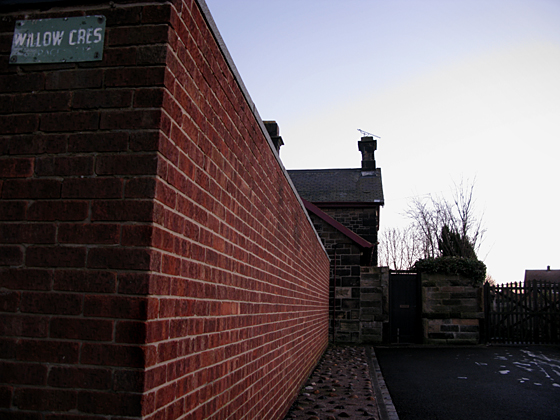
On Thursday night I walked up Plessey Road to the Willow Tree to look at the space where Brick Row had stood. I had never heard of this street and it must have been demolished decades ago. It was called Brick Row because it was the only row built of bricks. My dad lived in Stone Row – you can guess why it was called that – which ran at right angles to Brick Row along the eastern side of railway line to the Stationmaster’s house. That row has gone too, but the Stationmaster’s house remains, black and redundant at the far reaches of a somewhat anonymous estate of social housing – maisonettes and small semis. I listened for and tried to imagine the “amazing, hypnotising runs of notes”, the “startlingly clear and inspirational” playing and “masterly rendition of old airs” described by the authors of the book. I listened hard but I’m not sure I heard any tune I knew, only the sound of the wind whining through the railings in the darkness and the grumble of the traffic across the line over on Newcastle Road.
The book says Tom senior suffered from an increasing loss of his hearing in the late 1940’s. It’s suggested by some that this may have been because in September 1940, during the war, a bomb destroyed their house. Others suggest that he had been almost deaf for years before that because of a mining explosion. We don’t really know why, but there’s no doubt Tom’s hearing went. He had a poetic streak and in the 1950’s wrote this:
My hearing now is not so keen, As what it was or might have been. In whispers soft the old pipes say, ‘Just fill the bag. We know the way.’
It sounds a bit like he might have been the Beethoven of the smallpipes. In one of his notebooks he wrote “Music is some Divine Essence that clarify’s the Soul enabling it to take momentary glimpses into heaven.” This phrase might have made a good epitaph for him, I guess. He died in 1964 and is buried up on the hill in Horton churchyard. I’ve no idea what his epitaph is, but I might stop by there one day on my way to work to visit his grave and find out. Maybe I’ll hear the plaintive lilt of his smallpipes in the wind. But then again, there’s every chance I won’t..
.
the broken troubadour
I am walking in a perfect place. I am with Brenda, who I take to be my guide.
‘Where am I?’ I ask. ‘What is this place?’
All around us and across our path soft snow is gently falling. Across the meadow there is wide expanse of grey water, a lake. The dim shapes of mountains rise up beyond it. It is twilight. Candles are flickering in the windows of the little stone cottages we pass from time to time.
Brenda is dressed in what I later come to believe is a Munchkin outfit. On her head she is wearing a big soft deep red pancake hat. It reminds me of the hat Rembrandt wears in his late self-portraits, especially the one of 1660. It is vague and amorphous, unnecessarily substantial. Snowflakes sit on it like butterflies on velvet. Her dark hair tumbles out of it like a frozen black waterfall.
‘Why aren’t we leaving any footprints?’ I ask, as I glance back over my shoulder down the path we have walked.
‘The paths in heaven leave no trace of those that walk on them,’ Brenda replies.
‘Where are we going?’ I ask.
‘Heaven knows,’ she replies.
As we approach another cottage I hear the strumming of a gypsy guitar. Brenda leads me to the little window. Inside I see Jack Verdi. He is dressed like an Elizabethan courtier, in a bottle green jerkin, a white ruff and a tall silk hat. He is wearing French hose.
‘It’s Sir Philip Sidney,’ I whisper. He is sitting on a low stool, playing to Tallulah, who is dressed in a black t-shirt and black skinny leg jeans and has her red hair tied up in bunches.
‘He is The Broken Troubadour,’ Brenda says.
Tallulah begins to tap random rhythms on a tambourine and to dance to the music of the guitar. Her dance is wild, precarious and full of flamboyant contortions.
‘She is a drunken giraffe,’ Brenda says. I watch the show, mesmerised.
‘Why do human beings leave no footprints when they walk across the snows of heaven?’ I ask.
‘Because heaven can never change,’ Brenda replies.
Inside the cottage Tallulah is now spoon feeding her troubadour a large bowl of warm English apple pie and hot vanilla custard.
‘How did they get here?’ I ask.
‘They had the right tickets,’ Brenda replies.
‘What are the right tickets?’ I ask.
‘Grace and kindness and laughing eyes.’ she answers.
‘Grace and kindness and laughing eyes?’ I say. ‘Is that how I got here too?’
‘No,’ Brenda replies. ‘You stole your ticket from someone you once knew.’
I opened my eyes. It was almost morning. De Kooning was softly tapping my nose with his paw.
‘What’s wrong?’ I said. ‘Have the clocks all started ticking again?’
.
tallulah and the good catastrophe
It looks like Debs will be off sick for a few months. Earlier this week I held an emergency meeting with the whole team to talk about redistributing her cases.
‘How do you want to do this?’ I said. ‘Do you want me to decide who gets what or should I just throw all the names into a hat and let you take turns picking one? Or do you want to discuss them one by one and see who’s interested?’
They decided that I should decide. I divided the couple of dozen most serious cases on Debs’ caseload between the five workers left standing. Angie copped for Mandy Potts, who as it happened turned up just as the meeting ended. She had Apple and Sparky with her. Mr Zee wasn’t with her. Mandy was upset.
‘Seems like a good time to introduce yourself,’ I said to Angie.
‘Oh, isn’t her weird boyfriend with her?’ Angie said. ‘I was looking forward to meeting him. I like young men in uniforms.’
‘A Zorro outfit’s hardly a uniform, Ange,’ Lily said.
‘Isn’t it?’ Angie pulled her pondering face, and wandered off to meet Mandy and the kids.
‘What’s up?’ Lily asked, when Angie came back along.
‘They’re going to make Mr Zee get a job. The dole’s on his back. Mandy doesn’t want him to because she’s scared that if she’s on her own Flinty will come to her door.’
‘She has a point,’ Lily said. ‘But it’s not a point the dole will take.’
‘No, they won’t,’ Angie said. ‘He’s down there now and he thinks they’re going to send him for an interview.’
‘He should go,’ Lily said. ‘No-one’s going to give a job to a man dressed as Zorro, are they?’
‘Well, that’s the other thing,’ Angie said. ‘Mr Zee isn’t prepared to not dress the way he does. He thinks he has a human right to do so, like Christians wearing crucifixes and Muslims wearing the veil.’
‘Another good point,’ Lily said. ‘But again, not one the dole will buy.’
‘No, they won’t,’ Angie said. ‘They’ve suggested he may need to take work at MacDonald’s.’
‘Oh my God,’ Michelle said. ‘Can you image that, Zorro appearing in the drive-thru window! Imagine asking Zorro for a couple of Happy Meals and a regular Coke!’
‘It could bring them business!’ Lily said, chuckling to herself as she tried to get on with inputting stuff on to the computer. ‘It’s a shame MacDonald’s aren’t likely to think the same.’
‘Mandy thinks that Mr Zee will leave her and return to Newcastle if they force him to take a job where he can’t continue to dress the way he does.’
‘That surprises me,’ Lily said. ‘I always had the impression from Debs that he’s really committed to Mandy and the kids. Things will fall apart if he does leave, that’s a certainty. Mandy will never cope without him.’
‘Bloody men!’ Angie said. ‘Is there a single one out there that isn’t a complete waste of space?!’
It snowed on Thursday. I sat in the team room for a while first thing going through the post and listening to the team talking about the BBC documentary on the Shannon Matthews case which had been on the previous night. Fairy tale explanations are the bedrock of the world according to the popular media, and on this occasion the police seem especially ready to give the story the right slant by stating that this girl’s mother was ‘pure evil’. Here we have The Cruel Mother. ‘I thought that police officer was about the tell us the story of Hansel and Gretel or something,’ I heard Angie say. The police are hardly more self-aware or enlightening as social narrators than The Sun or The Daily Mail. It is within the terms of the crude and narrow narratives the popular media constructs that the identities and aspirations of their audience will to a significant extent arise. Karen Matthews, who no doubt is a person who came to see herself in the terms of those narratives, was and is stupid, dysfunctional, misguided, and inadequate. But this description could equally as well be applied to the police themselves who had four hundred officers in the area for almost a month and failed to find a child who all the time was under their very noses. The same could also be said for the troops of journalists who traipsed around the area 24 hours a day for the same period. And now they’re blaming social workers for not seeing this coming two years earlier. Lily wondered when we would get our crystal balls.
‘It’s a pity Shannon didn’t think of dropping pieces of bread as a trail to her wicked uncle’s house, isn’t it?’ Angie said. ‘That’s always the thing to look for in a case like this.’
I went upstairs. About mid morning I was sitting up in my office looking out over the car park watching the white stuff falling hypnotically, like a weird quiet currency being repaid to the world. Nature has a fascinating economy. A pale blue Favorit slithered into the car park. It was Jack Verdi. He got out and pulled the collar of his black reefer jacket up around his face. He was wearing his Ray-Bans. His long grey hair was tied back in a pony tail by what looked like a red elastic band. In his pale desert boots he gingerly made his way across the snow into the office. He brought to mind something vaguely Russian, maybe someone from a Gogol story. He’d come for a meeting with Debs and forgotten she was off. He asked if I was free and came upstairs for a chat.
‘Hi, Jack,’ I said when he came into my room. ‘How’s tricks?’ He shook my hand. As he leant forward to do so I briefly caught sight of his pale blue eyes peering out over his sunglasses.
‘Hey, I’m not so bad, mate. Bloody awful weather though.’
I looked out of the window and nodded.
‘Actually I like the snow,’ I said.
‘Aye,’ Jack said, ‘to look at, but not to drive in!’
I made him a cup of tea and for a while we talked about music, as we always do. He always asks me who I’m listening to as a preamble to him telling me what I might want to try instead. On this occasion I swapped him Teddy Thompson and Josh Ritter for a classic album from Jefferson Airplane and Neil Young’s Live at Canterbury House 1968, Sugar Mountain album.
‘Hey, that was quite a performance you gave at Rosie’s leaving do,’ I said, finally mentioning the elephant in the room. ‘Man, you certainly blew them away that night!’
Jack shook his head and looked down into his lap. ‘Yeah, well, maybe. I just wish I’d stuck to bloody well playing the piano, as I was supposed to do.’
‘Yeah, me too,’ I said. ‘Banging out Chas and Dave numbers in a room so thick with the reek of HRT isn’t exactly my bag either.’
He laughed. But he had something more on his mind, and I thought I knew what it was.
‘Hey, Jack,’ I said, ‘I’d just let it go if I were you. Most people will already have forgotten about it, you know how they are. You’re the only person who’s thinking about now.’
‘Oh yeah, yeah, I know that,’ he said. ‘No, it’s not that, it’s what it’s telling me about me that bothers me. I’m becoming desperate. I can’t seem to let myself ever be anything but young. You know why I did that? Because I’m scared to death of getting old. I’ve seen this happen to other guys, guys who I was once in bands with. I’m starting to do what they’ve done and make a bloody fool of myself.’
‘Well, as they say, if you recognise a problem you’re half way there to solving it.’
‘Yeah, but how do you solve the problems of decrepitude and death?’
I laughed. I wanted this conversation to remain light. ‘Euthanasia’s good,’ I said. ‘I’ve already booked myself a one-way ticket to Switzerland.’
‘I don’t want to go,’ Jack said, shaking his head.
‘You don’t want to go to Switzerland, Jack? Compact land-locked mid European country? Bankers, watchmakers, Toblerone, Heidi, St Moritz, lots of big snowy mountains? It’s the sort of place where there’s never any litter and they don’t ever have to think about Asbo’s. Switzerland’s not such a bad place, Jack.’
‘I don’t mean I don’t want to go to Switzerland, man. No, I mean I don’t want a die. At least not yet. I’ve still got some good times left in me. The problem really is that the rest of the world is starting to disregard me. It’s as if as you get older there’s a quiet conspiracy to exclude you from things. It starts when you’re about thirty. The world begins to tell you that you can’t do that. And do you know why it says that? It says it because it embarrasses them if you do. They just don’t want you around. They discard you, like you’re an old-fashioned appliance of some sort. I don’t buy it, mate. There’s some stuff I’m just not ready to say goodbye to.’
‘Like good old rock and roll, eh?’
‘Well, yeah, but not just that.’ His Aviators looked straight at me and for a moment or two he paused. ‘You read poetry, right?’ he said.
I said I did sometimes, yes.
‘You know I’m into Keats, don’t you? Yeah? Okay, can I show you something? It’s like a modern take on something he wrote. I’d be interested to know what your response to it is.’
He bent over and unbuckled his brown leather satchel bag. He took out a couple of sheets of A4 and handed them to me
‘You’ll know the original,’ he said. ‘It’s La Belle Dame Sans Merci.’
I.
O what’s bothering you now, my bonny lad, Alone and palely loitering? Has thy assessment slithered into the sink?Are you waiting for the telephone to ring?
II. O what can ail thee, fostering man!
So flushed and so woe-begone?
The question from the Chair was crass,
The Police Checks were never done.
III. I see a cloud across thy face
Your reviews are all long over due,
And in thy diary a fading date
When your anxious manager last hounded you.
IV. I met a damsel in the tearoom,
Full beautiful-an Ashington child,
Her hair was red, her foot was light,
And her laughter was quite wild.
V. I bought a cosy for her napper
And sent her a text from my mobile phone;
She texted me back and asked me to sing
‘Will you give this little dog a bone.’
VI. I sat her in my Skoda’s front seat
And put Crosby, Stills and Nash on,
I whizzed her around the slippery bends
Till all her lingering doubts were gone.
VII. She bought me bags of morish sweets,
And Honey Tunes and herbal tea,
And then in an accent strange she said-
“Bonny lad, aa’ve got the hots for ye.”
VIII. She took me to her terraced grotto,
And swept the sawdust from her floor,
And I gazed into her wild wild eyes
Until my heart could take no more.
IX.
And with a tambourine she lulled me asleep,
And I dreamt I heard a terrible din
‘Twas the scariest dream I ever did dream,
I dreamt I was trapped inside her bin.
X.
I saw pale ploughmen, businessmen too, Old heartthrobs, death-pale as if without feelings; They cried-“The Bonny Lass Without Pity Has dumped us amang her peelings!”XI.
I saw their starved lips in the garbage With horrid warnings gaping wide, And I awoke and found me dumped, With another old scratter at my side.XII.
And this is why I sojourn here, Alone and palely loitering, My assessments all soggy in the sink, And my mobile phone not ringing.
After I’d finished reading it I said nothing for maybe a minute or so. Nor did Jack.
‘Okay,’ I said. ‘This is, er, interesting.’
Jack looked at me. He wanted more than just, er, interesting.
‘Hey, Jack,’ I said. ‘What do you want me to say here? How I’d feel if I was the woman you wrote this for?’
‘It shows, then?’
‘Yeah, Jack, it shows. It’s about Tallulah, right?’
He nodded slowly.
‘So,’ I said, tentatively, ‘have you and her got a thing going on, or what?’
‘No,’ he said. ‘That’s just tittle tattle. Emma Pope started that rumour as a put down to me.’
‘But you would like to have something going on with her, yeah?’
He nodded, safe behind his sunglasses. ‘Yeah.’
‘And? . . .And? . . . And what? You think she’s too young for you?’
‘No,’ he said. ‘Not at all. What bothers me is that she’ll think I’m too old for her.’
‘She’s not a kid, Jack. She must be well into her thirties now. What are you saying, that she’s shallow?’
‘No, she’s definitely not shallow,’ Jack said, almost indignantly. ‘She’s a woman with deceptive subtlety and depth. She’s like a great river and her complexion is forever changing as she makes her course through her days. Sometimes she’s wild and tempestuous, sometimes she trickles and gurgles, but sometimes she’s quiet and still and just so damned profound. No, she’s not shallow, man, but I’ve got twenty years on her, and she knows it.’
I nodded. I almost smiled. I looked at the poem again.
‘This dustbin metaphor,’ I said. ‘That’s serious, right, a deep concern hidden behind a daft joke?’
‘Yeah,’ he said. ‘Exactly. What bothers me is that even if I got something off the ground with Tallulah she’d pretty soon dump me for a younger model. She has a bit of a reputation for chewing guys up and spitting them out.’
‘And the bin, that’s the bin of decrepitude, yeah? It’s a bin you fear that once she dumps you in you’ll be in for the rest of your days?’
‘It’s more than that,’ Jack said. ‘It’s a bin I fear I’m already in. Not because I want to be there or because I’m really need to be. It’s just the bin the rest of the world has put me in. It ‘s like that Yeats line, isn’t it, the one about old age being tied to you like a tin can to a dog’s tail. It stinks, man!’
‘And the bonny lass without pity, that’s not just Tallulah, is it? She’s society too, isn’t she, and young mistress Time herself. This bonny lass is The Reaper.’ A picture of Tallulah Hudspith wielding a giant scythe crossed my mind. It was an image from a Tarot card.
‘Yeah, something like that, I guess,’ Jack said.
‘You know what I’d do if I were you, Jack? I’d go for it. What’s the worst that can happen – you don’t get the gig. Or if you do you don’t get booked for a second night. But hey, Jack, for you this might just be the gig to end all gigs. One night with Tallulah might be your Madison Square Garden moment, the one gig you’ll never forget!’
Jack stood up. He very deliberately buttoned up his black reefer jacket. He smiled quietly and flicked his pony tail back over his collar. It was indeed a red elastic band holding it together.
‘Carpe diem, eh, man? I kinda knew that would be your take on it. Thanks, man. It helped.’
Jack picked up his brown satchel and slung it over his shoulder. ‘Hey, and one more thing, eh? This conversation we’ve had, strictly between me and you, right?’
‘Yeah, of course, Jack,’ I said. ‘Between me, you and the gatepost.’
He smiled and shook my hand again. I walked along the landing with him. As he was making his way down the stairs he turned and asked me if I knew Warren Zevon’s stuff.
‘Yeah,’ I said. ‘He’s good.’
‘He wrote a song called I’ll Sleep When I’m Dead,’ Jack said. ‘Give it a listen some time.’
‘I will’ I said. ‘But isn’t poor old Warren now fast asleep himself?’
‘He is, man. But what a way to hit the mattress, eh?!’
I laughed. Jack left. The snow had turned to rain.
When I got home I had a quick pizza and then put my boots on to go for a walk. It was turning cold and the slushy snow was beginning to freeze into crusty waves. I walked along Broadway and then on as far as the Thoroton Hotel. I went up Marlow Street and cut through past the sports centre and over on to Newsham Road. I walked up into Newsham and down Winship Street past the site of the Big Club, which is still fenced off but now completely razed. At the roundabout I stood for a moment or two and looked at the strings of Christmas lights slung above the road. I then made my way back down Plessey Road. In the last few days a lot more Christmas lights have appeared on houses and a lot more Christmas trees in their windows, but Christmas still seems slightly reluctant to appear this year, even though the Angel Alistair and the Good St Gordon from every television in the land sing, ‘Spend, Spend, Spend!’
‘Spend what?!’ the world sings back.
When I got back home Brenda was there again, gathering more slippers into boxes to take away for dispatch.
‘Hi, Brenda,’ I said. ‘How’s business?’
‘Brisk!’ she replied. ‘Surprisingly so. Things have really picked up in the past few days.’
‘Well, you can never go far wrong with slippers at Christmas, can you?’
‘Yes, I think you’re right. Folks may not have much money this year, but everyone can afford a good old fashioned pair of slippers, can’t they?’
Brenda didn’t have her Auguries of Innocence cardie on that day. She had a sort of long very expensive looking camel-coloured wrap around coat. She was also wearing green knee high leather boots with big shiny silver buckles on them, and out of the collar of her coat the leafy frills of a spring green blouse of some sort erupted. She also wore a coffee-coloured knitted hat of some kind, a one with a peak and a small chocolate brown button on the crown, the sort of hat that reminds me vaguely of Barbra Streisand. For a moment it crossed my mind that Brenda looked rather like a tortilla wrap.
‘So what’s Tristan getting you for Christmas?’ I asked.
‘Oh I don’t know that!’ she replied. ‘That would take all the fun out of it. I like surprises.’
‘But there must be something you hope he gets you.’
‘Oh well, yes, of course. What I’m hoping for is a Matthew Williams Chapelle weave coat and some Jimmy Choo Erica ankle boots, as well as some lovely smellies and maybe some nice stocking fillers, such as earrings and brooches and choccies and things. Just lots of lovely lovely delicious surprises really. I’ve pointed Tristan in the direction of net-a-porter.com and I know for certain that he’s looked. I’m quite excited really. But what about you? What do you want for Christmas?’
I paused for a moment, as if taking thought. ‘The emancipation of the working class, I think,’ I said, very calmly and seriously. ‘Yes, that definitely. That and world peace.’
Brenda nodded her head approvingly. ‘That’s just such a beautiful wish,’ she said. ‘Yes, of course, you’re absolutely right. It is the spiritual aspect of Christmas that really matters, not all the shopping and materialism. And in any case it really is better to give than to receive. You know, I don’t really care what anyone gets me actually. Christmas is just such a special time of year. Just be close to someone you care about and to know they’re there, that’s all any of us really needs.’
So I’ll tell Tristan to just send you a note and prod you from time to time then, I thought. I know what great joy and cheer that will bring.
‘So what are you getting Tristan?’ I asked.
‘An electric screwdriver set.’ Brenda replied. ‘I saw one at B & Q. It was such a good buy and it will be all he’ll ever need. He’s always saying how much he wished he had one.’
‘That’s nice, Brenda,’ I said. ‘If you’ve got to spend then a practical gift is always the way to go, I think.’
Lucky Tristan, I thought. But of course I’m sure Brenda will get a huge amount of pleasure from giving Tristan his electric screwdriver set.
‘Oh, but what do presents matter?’ Brenda said. ‘Christmas really is first and foremost a spiritual time, a time to think of others. As you said, a time for peace and love. Material things are such a terrible distraction sometimes, aren’t they?’
For a moment I wanted to ask her what the word ‘spiritual’ meant. But I thought better of it. In any case I think I already know how spiritual Brenda is: she’s about as spiritual as a checkout till. She has exactly the sort of spirituality the Angel Alistair wishes we all had this year.
‘Do you know anything about the Tarot, Brenda?’ I said, changing the subject. It was like asking a seagull if it knew about fish heads.
‘Yes, of course,’ she replied, becoming animated. ‘Do you want me to do a reading for you?’
‘No, not really,’ I said. ‘But thank you for the offer. No, I was wondering about one of the cards and what it means.’
‘Which one?’ Brenda said, always ready to share her esoteric knowledge with the curious.
‘The one with the reaper on’ I said. ‘Is it called the Tallulah?’
‘The Tallulah?’ Brenda said, screwing up her face. ‘The Tallulah? The Tallulah’s not a Tarot card. No, no. No, the card you’re describing is the Death card.’
‘Oh,’ I said. ‘The Death card. So there’s not an expression which is like “turning the Tallulah” or something like that?’
‘No,’ Brenda said, a little sharply. ‘No, there isn’t. The reaper is on the Death card.’
‘And if that card turned up for you it would be bad news, right?’
‘No, not necessarily,’ Brenda said. ‘That’s a common misconception. The Death card does not necessarily signify death. But it does signify that major change will occur in your life. Catastrophic change, in fact, but not necessarily for the worse.’
So, I thought to myself, turning the Tallulah foretells catastrophe. But not necessarily a bad catastrophe. The idea of a good catastrophe appealed to me. This was an idea it would be good for Jack to know about.
‘So have you ever done a reading for anyone when the Death card has turned up?’
‘Oh, yes, of course,’ Brenda replied. ‘Many times.’
‘And are any of those people still alive?’ I asked.
‘Yes, so far as I know, they all are.’
‘But they will have all encountered a catastrophe by now, yes?’
Brenda had rumbled my game a while ago of course. She was prepared to play along no longer.
‘You should stop taking the mick,’ she said. ‘You know, many people have been helped to make important decisions in their lives through the Tarot. Just because you think it’s nonsense, doesn’t mean it is nonsense, you know.’
I nodded. She was right of course. I began to wonder about making a catastrophic decision, or rather, making a decision to have a catastrophe in your life. It seemed to me that since the future can’t really be foretold, this must be the way the Tarot works. The cards suggest that decisions of a certain kind should be made. It sets an agenda in someone’s mind. Decisions are then made according to the cards’ suggestions and hey presto – the cards appear to have done what cards never can and to have foretold the future. The classic self-fulfilling prophecy. Perhaps most divination works in exactly the same way. The effect is that you take active responsibility for your own future but that by some sleight of hand you can always say that whatever happens was bound to be, that it was written in the cards.
I wandered through to the conservatory. De Kooning was sitting on the windowsill, looking out into the dark where the snow had fallen among the gaping spaces of the Citadel. Sometimes I think I’m too passive about the future. It’s not something I get a hold of and try to make for myself. Maybe it’s that working class thing. Maybe it’s something else. I just seem to be happy to sit and watch the river flow by. I could dip my foot in, I know that. Maybe I fear a catastrophe if I do. Maybe I think I might turn the Tallulah if I get my feet wet.
I wondered if I should get a Tarot pack and do a reading for De Kooning. I know of course that this sort of stuff doesn’t work for cats. Cats sit on life’s windowsill and sing Que Sera Sera. They sing it nine times over.
.
exodus and a last hand of whist
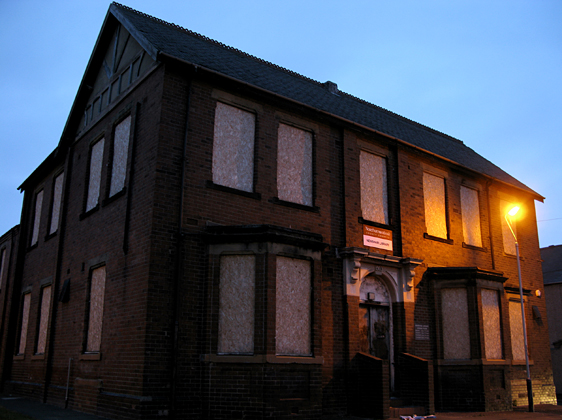
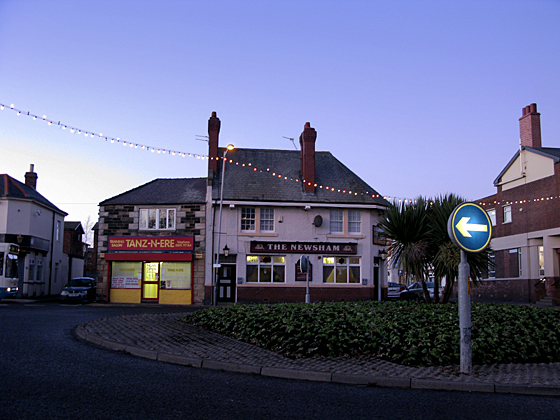
They’ve been demolishing Newsham Library this week. I noticed as I drove through Newsham on Friday that it is now almost all down. A gaping space has opened up between the shops and the flats, a sort of scandalous vacuum. I caught glimpses of it down Elliot Street and the back lane between the Black Diamond and Tanz-N-Ere. I could see the giant crooked metal arm of a demolition machine poised above the rubble. It reminded me that things are disappearing so quickly. I really must hurry and photograph all those buildings and places that will be gone any day now. This is a matter of urgency to me. Time moves on inexorably, flattening the old world to make a place for the new. It worries me that some places might be destroyed before I’ve made a record of them. I want my inventory to be as complete as it can be. I know of course that the photograph will never really bring them back. But it may bring back memories. Things do need to be remembered. My granddad spent the last years of his life in sheltered housing in Newsham. He probably toddled down Winship Street to this building every week a few years ago to find himself a book to read, probably a political biography, or maybe a travel book or a whodunit, or maybe The Ragged Trousered Philanthropists. The truth is I don’t really know what my granddad’s taste in books was.
In 1984 I was a student. During the miners’ strike I was a member of the Labour Party. My monthly ward branch meetings took place in a room in Newsham Library, which at that time may have been a community centre of sorts, I think, or maybe it was still a working men’s club. Bundles of canny old ladies from another age would faithfully attend to make tea and provide a sort of amiable Socialist ballast. They had votes they gave away in the same good-hearted spirit that they gave away the cakes and biscuits they brought along. The rest of the branch comprised a bunch of men of various ages, dispositions and motivations – Arthur Hancock, Ronnie Milburn, Bill Brookes were among them, as I recall – who would debate or mull over or grumble or chunter on about the heroic tragedy or stupidity of the strike, flying pickets, the difficult or duplicitous position of the railwaymen, Kinnock’s devious cowardice, Scargill’s reckless leadership, or whatever. The branch chairman was Peter Mortakis, an insignificant Machiavellian sort of man with the political and moral integrity of a blowfly. He was in cahoots with the MP at the time, a useless, self-serving, Rumpolian, persistently absent carpetbagger. A lawyer. The sort of man who could have been Tony Blair’s favourite uncle.
The room where the meetings took place was dark, maroon and brown, full of deep shadows and dim yellow lights that glinted on the glasses and bottles behind the bar. A sense of history seemed to stain the place, like blood on an old carpet. I never felt comfortable there, but it was a place where I somehow had to think I belonged. It was like needing to stand for a while in a painting by Norman Cornish or Tom McGuinness. Here was a world of ordinary people bound together by adversity. Here was the security of a mythical universe. Of course I can see now that the writing was already on the wall. Thatcher had already lined up the machines that would one day come and demolish this place. This week that day arrived. You can be pretty sure that a block of affordable first-time buyer apartments is already on its way.
Things have been hectic at work in the last two weeks. A tsunami of referrals has hit us after a period of inexplicable calm. This is always the way in social work. It’s unlikely that some mysterious force is at work in society that from time to time casts a curse over a particular place and makes a lot of children there suddenly begin to suffer harm at the same time, a sort of evil spirit that randomly visits a part of the population. It’s more likely that these waves are to some degree chance occurrences and a consequence of fluctuations in levels of responsiveness and concern among professionals. But maybe it is all down to chance. And a sighting of Snow White’s stepmother in Ashington would hardly come as much of a surprise these days.
Thursday was a particularly bad day. Kids scared to go home from school, kids with bruises, kids with fractures, kids with burns, kids home alone, babies losing weight, babies in cold houses, tiny babies that no-one could find. Drunken mothers, drunken dads, dads throwing plates at walls, mothers throwing shoes, depressed mothers, dads doing drugs.
Late that afternoon everyone in the team was out on something or other. Michelle had spent half an hour with the police trying to get into the house of a twenty five year old mother called Tania who seemed to have lost all interest in her three week old baby. The flat was in darkness but the key was visible on the inside of the door, so there was obviously someone in the house. Eventually Tania came downstairs and answered the door. She was with her new sixteen year old boyfriend, Joe, the same boy who a few days earlier had bitten her on the face during an argument. She’d dumped him, she said. Joe and Tania had been in bed when Michelle and the police disturbed them. But where was baby Davina? Tania wasn’t telling. Tania wouldn’t take Michelle and the police to see her, not even under the threat of arrest. Michelle rang me up: what should we do? Baby P was on all our minds; the moorings of rationality were coming loose. All we could hear was the footfall of the beast slouching towards Bethlehem.
‘Have you tried torture?’ I said. ‘Pull her fingernails out. Offer her money. Tania needs to be persuaded to tell us where her baby is. If she doesn’t do so she’s got no chance of keeping it when we find it. But for God’s sake don’t make her any promises. We’re not going to be able to leave the baby there tonight now in any case, are we?’
Fifteen minutes later Tania told them where the baby was and they all set off in the police car to find her. She turned out to be with Tania’s sister. She’d been there all day. She was fit and well. On another day we might have decided to just leave her there and look at it again in the morning. But Baby P was on the minds of the police officers too. Baby Davina was made subject to Police Protection. Michelle arrived back at the office with the baby in her arms at about half past five. I told her who the foster carer was going to be.
‘Oh, is Debs around?’ she said. ‘I’ve just seen a police car chasing a white Mercedes down Milburn Road. I’m sure it was being driven by an Arab.’
‘Debs is at the hospital,’ I said. ‘Kid with a broken arm.’
On my way home that night I went to Tesco’s at North Shields. I was looking for a DVD of The Wizard of Oz. They didn’t have one, but I did pick up a copy of Todd Haynes film about Bob Dylan, I’m Not There. I didn’t see it when it came out, although I’d wanted to. At about seven o’clock I was driving back through Whitley Bay. My mobile rang. It was Debs.
‘The paediatrician says the injury could have been accidental. She’s not prepared to say it wasn’t.’
‘And the kid and mother are sticking to their story that he fell off a wall?’
‘Yep.’
‘And there have been no previous concerns about this kid?’
‘Nope.’
‘Then the kid goes home and we do an assessment, I guess.’
‘Should we have a strategy meeting?’
‘Oh, I don’t know, Debs. Maybe. Let’s talk about it tomorrow.’
I turned on the car radio and listened to Bob Harris’s country show on Radio 2. He played a song by George Strait called ‘I Saw God Today’.
On Friday morning Debs’ husband phoned in to say she was sick. She’d been taken ill during the night. It sounded serious and she was probably going to have to go into hospital.
‘Tell her to take it easy and that we hope she gets well soon,’ I said, and began to wonder what I could do with her caseload.
‘Anyone fancy doing an assessment on a kid with a broken arm?’ I said to the rest of the team. Daft question. They all looked at me as if I needed treatment. At that point reception rang to say that Jack Verdi had arrived for a meeting with Debs. I went along to see him.
‘Hi, Jack,’ I said. ‘Hey, hey, rock and roll! What’s with the shades, dude?’ He was wearing a pair of Ray-Ban Aviators.
Jack laughed, but he didn’t explain. I told him Debs was poorly and that the meeting couldn’t go ahead. He was fine about that and immediately went on to talk to me about the genius of Keats. Jack sees himself as in some way Keats last real disciple, which is odd for a man who’s prepared to prance around in little more than his boots to impress a few dozen middle aged women. There’s only so much mellow fruitfulness such women can take. But autumn is always a peak activity time for the disciples of Keats, of course, so Jack’s digression wasn’t really that unexpected.
Today it was breezy but bright and fairly mild for November. In the morning I walked down Plessey Road and bought The Guardian at the newsagents. I then continued on down to Park Road corner and along Beaconsfield Street towards the town centre, before turning to cross Croft Road and go up Marine Terrace and back across Broadway Circle. A few leaves still cling to the trees but most are assigned to the gutters in drifts of yellow and brown or stuck on the roads like squashed butterflies.
This afternoon I rode along to my dad’s on my bike. The refurbishment of his house is still not complete. It’s becoming pretty obvious that a lot of the tradesmen recruited by the private contractor doing the refurbishments – Frank Haslam – don’t know what they’re doing. Some of them have admitted this to my dad. Some of them also seem to be canvassing for the redecoration work off their own backs. My dad’s cheesed off, but there’s not much he can do to get the work finished any quicker.
My dad was born and brought up in Newsham. I told him about the library building now being knocked down. I asked him what he could remember about this building.
‘We called it the Big Club,’ he said. ‘Your grandfather used to often go down there at one time to play cards. He was very friendly with Bob Oxley, who was the steward at the time.’
He went on to tell me that what is now the Victory Club used to be the Wooden Club, because it was a wood building. There were also a couple of other pubs in Newsham in those days, neither of them more than a stone’s throw away from the three that still survive. They were the Miner’s Arms and the Turk’s Head. Newsham Coop used to be close to the Miner’s Arms and close to the Big Club, During the 1926 General Strike the Sunshine Fund or some such charity used to provide meals for the kids upstairs in the Coop building. The thing my granddad always remembered was the smell of the gingerbread pudding drifting down the stairs and into the street.
The local doctor had a room in the house opposite the Big Club. I think my dad said he was called Dr Gordon, although this could be a Freudian slip: it might have been Gardener. Either way, he was known as ‘The Butcher’. He was the doctor employed by Cowpen Coal Company for their compensation scheme. He had a reputation for sending men back to work at the pit when they were still unfit to be there.
It was getting dark as I rode back. The light was enchanting. The sky had those hard clear gradations from black-blues into orangey-greens and tobacco that you only get in winter. The sea was a pale and steely blue. There were quite a few people on the beach with dogs.
I got back before dark. The washed-up computer desk has disappeared from Hugo’s front garden and the gates to his drive are open. It looks like the Alligator is at long last ready for the road. I went inside and negotiated my way through to the kitchen over the assorted assemblies of slippers. I gave De Kooning a sachet of Felix and made myself a cappuccino. I sat in the conservatory reading The Guardian for a while. The headline said that eight out of ten children who are seriously harmed are ‘missed’ by agencies, whatever ‘missed’ means. This sort of stuff scares senior managers to death, of course. ‘Whither goes Sharon Shoesmith, there go I,’ they think. It’s a situation you can be sure will soon mean a lot of work for the rest of us.
I picked up De Kooning and we peered together out into the darkness beyond the garden fence. The glimmer of strange lights was appearing again in the Citadel. Margaret was on the phone talking to Geraldine.
‘Have you seen any sign of rats out there?’ I whispered to De Kooning. ‘No? No, I thought not.’
Margaret came through and said that she and Geraldine were going to ring Griff on Monday and give him an ultimatum: get rid of the rats or they call in Environmental Health and go to the press.
‘What if there aren’t any rats there?’ I said. ‘How can anyone prove they’ve got rid of something which isn’t really there to begin with?’
‘How could they not be there?!’ Margaret said. ‘Trevor’s seen them again twice this week!’
I began to think that the mythical rats of the Citadel might be refugees from the Big Club building at Newsham. Maybe they are an exiled tribe of working class rodents displaced by modernity, looking for a new set of premises under which to continue their way of life. On their exodus they probably crossed Winship Street and made their way through the allotments and across the old railway line and then followed a route through the back gardens down Twentieth Avenue. I can see them now, scurrying bravely along carrying everything they own, all with their little knapsacks on their backs. Suddenly after forty days of dodging cats and kids with airguns their long walk brought them to the Citadel. The bare girders loomed above them.
‘This must be our new home!’ their weary little hearts exclaimed.
Which seems fair enough to me, but it isn’t exactly the future Margaret and Geraldine have in mind for them.
I was going to watch my new DVD tonight, but Margaret cancelled her plans to go out. I sat in the conservatory reading for a while and then logged on to Amazon. I ordered The Wizard of Oz. I went out and walked up to Newsham. It’s a cool, clear sort of night. The wind has dropped. I walked up Elliot Street. The lights from the pizza and chip shop, the Chinese and the Indian take-away flooded out across the dry pavement. The smell of curry and onions floated in the air. The rubble of the Big Club is fenced off. The big Cat machine stands among it, it’s demolition arm resting its heavy nose on the ground. I stood on the other side of the road.
‘Okay, granddad,’ I said. ‘German whist. Your deal.’
.
if rats are made out of nothingness

New Labour won the Glenrothes by-election. Gordon will be gloating. He sits at night in his new primrose yellow room full of broken cogs and scattered springs and cannot believe his luck. He sniggers. He chortles. He laughs like a Kirkcaldy drain. How many dark nights did he sit over-winding his beloved timebomb, praying to the mythical deity that the bloody thing wouldn’t blow up in his face? But blow up it does and guess what: he’s off the hook! You’d almost think Gordon had done this deliberately, wouldn’t you? I gather he’s now asked Sarah to get him a wrecking ball for Christmas. He’s told her he’s come up with an ingenious solution to the recession in the construction industry.
I spoke to Talullah Hudspith a few days ago. I hadn’t seen her since Rosie’s leaving do. She asked me what I thought of Jack’s performance.
‘Quite remarkable,’ I said. ‘And brave. The man rocks, doesn’t he?’
Talullah and Jack have an odd relationship. Some say she has a thing about him; others say the exact opposite is true. I personally remain agnostic on the Talullah and Jack issue.
‘Do you think so?’ Talullah said, with more than a hint of a sneer. ‘I thought he was bloody ridiculous, actually. I mean, what on earth would possess a man of his age to prance around like that in front of all those poor women? He’s got no shame.’
In the light of this response you too will now no doubt be hypothesising about Talullah and Jack. I certainly was. But a tactical evasion seemed the order of the day.
‘So is he back at work?’ I asked.
Talullah chuckled, or perhaps snortled. ‘Oh ho, he’s back all right!’ she said. ‘The dirty hound’s always skulking around in the shadows somewhere. He’s never yet spoken to me about his antics, of course. He’s quite ridiculous, really. Do you know he’s now wearing dark glasses for work? He never takes them off. Who the hell does he think he is, Elvis Presley?!’
‘Yeah, I would be too if I’d done what he did!’ I said. ‘The guy’s probably just a bit embarrassed.’
‘Embarrassed?! Him?! That’s a laugh. You couldn’t knock him back with a shitty stick, man. No, he’s a star reborn, that’s what our Jack is. I wish he’d do us all a favour and just retire.’
‘So,’ I said. ‘How’s the delightful Mrs Gormley? Did she enjoy the night?’
‘Oh, Betty loved it! She’d do it again tomorrow if she could.’
‘Maybe Jack’ll play for her if she asks him nicely,’ I said. ‘If he really is a star reborn, he’ll have no problem with that. Nor will she, I suspect. Just as long as he keeps his pants on next time.’
Talullah’s from a theatrical blackground. She’s naturally dramatic. She’s the kind of woman who likes to start a riot. Maybe it just gets up her nose that Jack upstaged her.
Mandy has been into the office a couple of times this week. There have been almost daily sightings of the Arab in the white Mercedes and she’s getting very stressed. On Friday she and Mr Zee were waiting to see Debs when I arrived at the office. Mr Zee looked very smart, as always. His rich brown cape was almost shimmering in the morning sun.
‘How you doing?’ I said to him.
‘I’m okay,’ he replied. ‘You know.’
‘Yeah,’ I said, ‘I know. So are you still reading Bukowski?’
‘No,’ he replied. ‘I decided he wasn’t my cup of tea. I’m reading Neruda at the minute. They’ve got lots of his stuff at ZorrStore.com. I’m trying to get into Rumi too.’
Mandy then told me that the phone had rung seven times during the night for each of the last three nights, and each and every time it was the same old tune.
‘Is Flinty still with Molly?’ I asked.
Mandy shrugged and looked at Mr Zee.
‘We don’t know,’ he said.
‘Have you told the police?’
‘Yeah. Nothing they can do. The caller’s using a stolen mobile.’
When I got home that night there were three more big boxes of slippers in the hall. De Kooning was sitting on top of them playing king of the castle. Geraldine was talking to Margaret about the latest curse of the Citadel: rats. They were first spotted by Big Trevor while I was in Glasgow it seems, scuttling around beneath his railings.
‘They weren’t there until the builders came,’ Geraldine said.
I wondered if she thought the builders had imported them as a sort of alien species, or simply because no building site is complete without a good infestation of rodents.
‘So how did they get there?’ I asked, already allowing my mind to toy with the notion of their ex nihilo creation.
‘Well, it can only be the building site, can’t it?’ Margaret said. ‘They weren’t there until they started building that monstrosity.’
Okay, I thought, but how did they get here? Did Griff dress himself as the Pied Piper and lead them here from their old haunts along the quayside? Did they hear along the grapevine about the Citadel site and make their way here, like the Israelites to the Promised Land, like Americans to California? My guess was that they’ve always been here or that perhaps the sightings are apocryphal, a plague of the Citizens’ collective imagination.
‘We need to visit the site en masse and register our protest,’ Geraldine said. ‘Rats are dangerous. Did you know that they sometimes curl up on your pillow beside your face as you sleep! Imagine that. It’s horrific!’
‘Will we be safe?’ Margaret asked.
‘As long as we wear sensible footwear we will be!’ Geraldine said, obviously recalling the mass trespass during the summer when she fell off her high heeled boots. It’s not often Geraldine makes a joke about herself.
‘I’ll wear my Timberlands,’ Margaret said. ‘They’ll never get me in them.’
I went through to the conservatory to drink a cappuccino. There were a dozen or so pairs of slippers lined up across the floor. They were obviously part of the Christmas stock. Slippers with owls and guitars and ducks on them. Camper van slippers, cows and gingerbread men slippers. There were also a couple of pairs of fake fur leopard skin bootie slippers. I stepped over them and stood at the window. The sky was almost dark. There were vague lights flickering somewhere deep in the carcase of the Citadel. It looms over us like Kafka’s Castle. I began again to wonder where Hugo had put his little giraffe.
‘Edna will never come home now,’ Margaret said, after Geraldine had left. ‘She’ll never cope with the idea that she might wake up and find a rat sleeping next to her face. It’s an absolute crying shame.’
I stared out at the Castle. I wondered about the rats that are made out of nothingness.
‘I’m going to Brenda’s tonight,’ Margaret said. ‘Her friend who’s an astrologer is coming to her house. She’s going to do my horoscope.’
I nodded. I said nothing for a minute or so.
‘Are you taking some of these slippers with you?’ I eventually asked.
‘No,’ Margaret said. ‘But I am taking the boxes in the hall.’
When she left I had another cappuccino and sat for a while reading my book on Scottish art. Some of W G Gillies’ paintings are stunning. I love his border landscapes and they sort of feel like home to me too. It takes a lot of confidence to paint as freely as he does in those paintings. But I was particularly taken on Friday night by his 1973 painting The Garden in Winter. We sometimes fail to see the beauty that lies in the ordinary things, the things we can see from our windows. We sometimes fail to see how much those things really matter. I gave De Kooning his prawns and painted a new square canvas over with a Prussian blue ground.
I watched it dry and listened to Meg Baird’s album. I decided I would have to go up to Temple soon to see the house where Gillies lived and where he did all those late paintings.
I watched Newsnight. I went to bed.
.
the return of the muslim vampires
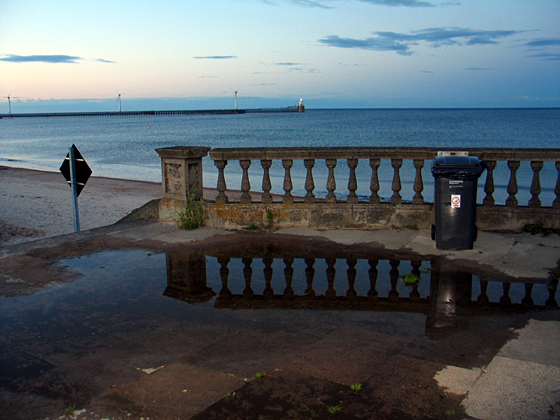
Yesterday morning I went to a meeting in Shiremoor. On my way back I decided to call and see my dad in Seaton Sluice. He’s getting his house refurbished – rewired, new kitchen and all that palaver – and I was wondering how things were going. When I got to the Sluice I saw Tristan’s white PermaPlumma van parked just around the corner of the Collywell Bay Road, more or less opposite the social club. I spotted Tristan himself in his white boilersuit and blue jacket, leaning against the fence looking out over into the harbour. It was sunny and cold, quite suddenly like winter. The white buildings on Rocky Island were gleaming in the sun and the whole scene looking north had a picture postcard quality about it. I parked up and went over.
‘Hey, Tristan, what’s happening?’ I said. ‘Have you got as job up this way to do?’
‘No, mate,’ Tristan said. ‘No job. Work’s dwied up a bit, I’m afwaid.’
He looked just a little despondent, a little stoical.
‘So what you doing in the Sluice?’ I asked.
‘I’m just getting out of Bwenda’s way,’ he replied. ‘She’s got clients all morning. I didn’t want to be under her feet.’
I nodded and shared the view with him for a few seconds.
‘Hey, so what do you think of the response of the Left of the credit crunch, Tristan?’ I said.
‘What wesponse?’ he replied, suddenly becoming more animated. ‘The so-called Left squats like a bullfwog on a log and cwoaks and cwoaks but never jumps.’
‘So what’s it waiting for?’
‘I dunno, mate! A sign, maybe, or a call from heaven.’
‘So what should it do, Tristan? What would it look like if the bullfrog jumped?’
‘You know something, mate, I don’t think this bullfrog knows how to jump. I don’t think it’s actually got the legs for it anymore. It isn’t organised, that’s the problem. Who are the Left? Who’s leading them? Without organisation, mate, this fwog ain’t jumping anywhere.’
I laughed and said that maybe this was true, but surely that it just begged the question of why there was no organised Left in the first place, why we had a frog that couldn’t jump.
‘Maybe it’s because it can’t see anywhere to jump to?’ I suggested. ‘Maybe that one smug log in the backwater is the only one this frog can sit on these days. There’s no other log for the socialist frog to swim towards, is there?’
‘This is a chicken and egg situation,’ Tristan said. ‘Pwaxis, mate, that’s the way to deal with this kind of pawadox. You’ve always got to be weady to jump. Jumping’s what changes the world. Jump and the future weveals itself! Wemember what Marx said: in the past it was the job of philosophers to understand the world, the job now is to change it. The fwog needs to get on with jumping, I say, and stop gazing at its navel and cwoaking. A fwog that loves the sound of its own cwoak is a fwog that will soon be dwowned in the tide of histowy.’
‘You make this frog sound a bit like Hamlet, Tristan,’ I joked. ‘To jump or not to jump, that is the question. A frog with its head up its own backside.’
I told Tristan I needed to be on my way. I found his position frankly a little undisciplined for a Trotskyist, somewhat lacking in theoretical rigour. But he is right, the Left’s response to the current global financial crisis has been remarkably passive, and you can only surmise that this is because they either don’t know how to respond or no longer have the capacity to do so. These two things are probably inextricably linked, of course. Marxists can gloat over their man’s acumen about capitalism, but which of them can tell us where to go from here? The Left seems to have lost the belief it once had that it can make history, and that it can even do so in circumstances not of its own choosing. The Left seems to be mostly comprised of Lutherans nowadays. They don’t need to be organised. All that’s needed is that each individual believes in the God of history. If everyone sits quietly in their soon to be repossessed homes praying to this God the revolution will inevitably occur. Capitalism will magically wither and die while they dream.
As I walked back to my car I mused on Tristan’s brave and perhaps slightly incoherent analysis, that the Left is a frog with no legs and nowhere to jump but somehow ought to jump anyway. Basho’s famous haiku came to my mind.
The old pond,
A frog jumps in:
Plop!
This poem has been translated by just about everyone, of course. The version I always recall is Alan Watts’ translation. I wasn’t sure how enlightening it was in terms of the Left and the global crisis in Capitalism, but it’s a fine little poem, isn’t it?
I called across to see my dad. His flat is upside down, polythene covering every floor surface, workmen coming and going, the door permanently open. My dad had his coat on and was obviously very cold. He offered me a sandwich; I declined. I told him I needed to get back to work and left. As I drove back down past the social club I could see Tristan. He was still looking out over the bay.
The schools are on holiday this week and it’s Halloween on Friday. Some of the kids in Ashington are using their cast off pillowcases as spook outfits and wandering from house to house knocking on doors. Just after I got back from the Sluice Gilmour rang me about this phenomenon.
‘We don’t have a resurgence of the Flinties, do we?’ he asked. ‘Tell me how worried we should be about this.’
‘Not at all,’ I suggested. ‘They are just kids trick or treating. They’re also wearing witches hats, Frankenstein masks and carrying pumpkin lanterns from Asda. Some of them have luminous plastic vampire teeth and fake knives through their heads. Do they sound like a bunch of Muslim terrorists to you?’
Gilmour agreed, they didn’t, although not without observing that stranger things have happened. And by chance he’d listened to Alan Robson on Night Owls last night and there had been some alarming calls from worried listeners in the Ashington area.
‘A lady called Hettie from Bomarsund rang up,’ Gilmour said. ‘This lady sounded quite agitated. She said to the presenter something like “It’s all happening again, Alan.” He tried to reassure her, but she was having none of it. He asked her if these children were throwing paper aeroplanes at windows again and then as a sort of Halloween joke he said, “Or is it bats this time, Hettie?” Hettie was not at all amused. “Alan, with all due respect,” she said, “this is not funny.” Alan apologised. Oh, Hettie wasn’t a happy bunny. Later a bloke called John from Westerhope came on. This guy was obviously some kind of conspiracy theorist. He seemed to think Ashington police were in cahoots with the Flinties to destroy the British way of life. The next caller was a drunken woman from Ashington.’
‘Oh, Cheryl!’ I said.’ Ha ha. Yes, we know Cheryl. She’d be complaining that the authorities weren’t taking her seriously, was she?’
‘Yes, that’s right. She said she’d seen someone dressed as – ‘
I interrupted him: ‘Robin Hood! Yes, she says that all the time!’
‘No,’ Gilmour said. ‘Not Robin Hood. The Lone Ranger.’
‘Oh,’ I said.
‘Anyhoo, my boy,’ Gilmour said, ‘It sounds like we don’t have to get ourselves into a lather about any of this, do we? So, tell me, how’s your dad doing? Is he okay?’
‘Yeah,’ I replied. ‘He’s fine. Still mending fuses in the factory and what have you. How’s yours?’
‘Oh, father’s absolutely chipper. He’s a bit worried that the demand for meat might drop off a bit if there’s a recession, and of course like anyone else he’s getting a bit nervous about property values and his investments. But all in all he’s very well, thank you. Oh, by the way, did I tell you my lad’s driving the quad now?’
‘Is he? The quad, eh? Hey, that’s great. He’s really coming on, isn’t he? By the way, how’s your daughter’s horse doing?’
Gilmour told me the horse and his daughter were both doing remarkably well. I then asked him why he didn’t turn up at Rosie Lake’s leaving do last Friday.
‘Oh, it clashed with something my wife had arranged,’ he said. ‘How did it go? Did they give her a good send off?’
‘Well, Jack Verdi did,’ I said.
‘Jack finally performed?!’ Gilmour said. ‘My goodness, miracles will never cease, eh? What did he do, the old hits from his back catalogue?’
‘Yeah, well, his back catalogue was certainly involved. Nobody’s told you about, have they?’
‘No. No-one’s mentioned it. Hey, it sounds like I missed a good night? I really wish I could have been there. I’ve got a couple of Jack’s old albums, you know. I like his stuff. Is his voice still as good as it was?’
I chuckled. Gilmour asked me why I was laughing. ‘Oh, I guess you just had to be there,’ I said. ‘I’m sure Freddy will give you the full low down when you see him.’
I think our call ended with Gilmour in much better fettle than when our conversation began. It certainly cheered me up.
Debs came up and told me that Mandy was in the office. She was thinking of trying to get a private tenancy outside of Ashington, maybe in Morpeth or Seaton Delaval. She wanted to live somewhere where Flinty might not find her.
‘If she found somewhere could we help her out with a bond?’ Debs asked.
‘Is running away from him the answer, Debs?’ I said.
‘Oh, come on,’ she said. ‘What else is she going to do? The man’s a nutcase. He’s never going to leave her alone.’
I looked at her and shook my head. ‘Aye, all right,’ I said. ‘It’s only money, I guess.’
It was another cold afternoon. As I drove down Alexandra Road at dusk the sky was icy blues, violets and orange. The streetlights had just come on. An old white Mercedes passed me going in the other direction. The driver was dressed like an Arab. I turned on the radio. On the five o’clock news I heard that Gordon had stepped into the furore about Jonathan Ross and Russell Brand acting like a couple of prats on Brand’s late night radio programme a week or so ago. Gordon’s the man with his finger on the pulse of the nation.
It was dark before I got home.
.
on the day the clocks went back
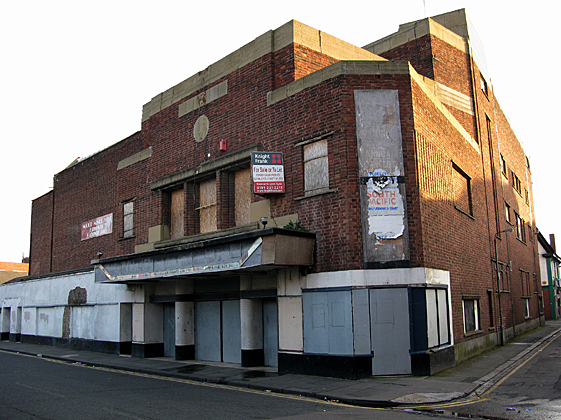
The clocks went back last night. British Summer Time is over, the dark nights are here. It was a sunny morning, cool and windy. As I left the house to go for a walk and get the newspapers, Hugo was getting out of his car. He had a small plastic giraffe under his arm.
‘Here, mate, that tree of yours has suddenly gone yellow, hasn’t it?’ he shouted.
‘Happens every autumn, Fletch,’ I said, laughing.
Maureen and the Whelp were knocking on the Widow’s door.
‘She’s gone away,’ I said.
‘Oh?’ Maureen said. The Whelp gawped superciliously over her shoulder.
‘No, no,’ I said, seeing that my remark had an ambiguity which those who were religiously minded might find especially confusing. ‘I mean she’s gone to stay with her brother in Derbyshire. We’re not sure when she’ll be back.’
‘Oh,’ Maureen said again, but this time with a relieved smile. She got out her note book and wrote something in it. Perhaps she was noting that the Widow hadn’t escaped doing business with them by grabbing an early flight to heaven with the Methodists.
Boz went completely off the rails last week. He came to the office several times with one query after another about his children and his rights and the stupidity of the law. On Wednesday he was arrested for stealing seed from a bird-feeder in a garden on the Fallowfield estate. It appears that he had been reliably informed that commercial bird seed contains cannabis seeds.
Boz had estimated that there are probably about five hundred bird feeders in Ashington, mostly hanging from trees and bird tables in the new private estates. He reckoned that there would be on average a pound of seed in each feeder. If ten percent of that was cannabis seed that would be fifty pounds of the stuff. Boz reckoned a shrewd dealer would surely pay a tidy sum for fifty pounds of cannabis seed. All he had to do was to break the town into manageable harvesting districts – each district being about the right size for one night’s work – and systematically gather the seed from the gardens. He couldn’t fail.
On Wednesday night he found himself with his back against a six foot lattice fence in a garden in Magnolia Drive, cornered behind the garden pond by a Rottweiller called Dexter Dan. Dexter Dan’s owner, Geoffrey Harrison, a retired seaman and Chief Storekeeper by trade, shone his high-powered torch into Boz’s face and told him the police were on there way. Rather uncharacteristically Boz said nothing and instead began eating the seed from his pocket. He later explained that he’d calculated that trespass was a less serious offence than possession of more of a Class C drug than he could reasonably argue was for personal use only.
Boz was released the following morning and came in to see Lily at about lunchtime. He told her of the idea he’d had and how he’d been apprehended on his very first seed gathering expedition.
‘They kept me in a cell all night, Lil,’ he said. ‘The police have no right to do the things they do, you know. Do I look like a criminal to you, Lil? Do I?’
Lily shook her head ambiguously. ‘So did they charge you with anything?’ she asked.
‘They’re complete numpties, complete bloody wassocks.’
‘So you were charged with something?’
‘They charged me with criminal damage to a bird feeder.’ Boz looked Lily straight in the eyes. He was very serious. He was saying loud and clear that this was no laughing matter.
‘Well, that’s not serious, Boz,’ she said. ‘I mean, it might never get to court.’
‘They also charged me with the theft of ten ounces of birdseed with an estimated value of two pounds fifty.’ He paused.
Lily put his hand on his shoulder.
‘I’ll be a laughing stock, Lil,’ he said. ‘The numpties from Newbiggin will call me Birdseed or Pecker or something else just as stupid that they’ll think is absolutely bloody hilarious. I’ll never be able to hold my head up in Ashington again. Never.’
‘Forget about it,’ Lily said. ‘Listen, no-one will ever know about it in any case if it doesn’t get to court. And I’m sure it won’t, Boz. It’d be a waste of public money.’
‘Can I have the kids this weekend, Lil?’ Boz asked, very calmly. ‘I need them with me right now. You can come and inspect the caravan if you want.’
Lily shook her head. ‘I’m sorry, Boz’, she said. ‘You know that can’t happen. It’s just not the right thing for the kids.’
Boz shook his head slowly. But he didn’t get angry at all. In fact, Lily felt he accepted this very easily. He looked very composed, as if he’d finally gained control of himself. As if, as Lily put it, the penny had finally dropped. ‘I know,’ he said. ‘I just needed to ask you. You understand that, right?’
‘Yes,’ Lily said. ‘I do understand.’
What happened in the next few hours is somewhat unclear. However, at about eight thirty on Thursday evening the police were called to Bubbles where Boz was being restrained by the doorman and a couple of lads from North Seaton. Boz had gone into Bubbles and announced to everyone there that he was a suicide bomber and that he was about to blow the place up. He pulled open his jacket and revealed a belt which he claimed was packed with explosives. The doorman sauntered over, head-butted him and threw him to the ground. The lads from North Seaton then helped out by putting in the boot. They removed the belt and found it was packed with Rowntree’s Table Jelly.
The police arrested Boz and initially considered holding him under Schedule 8 of the Terrorism Act 2000. However, it struck the duty Sergeant that a man who had just one day earlier been arrested for stealing birdseed from a garden feeder and who at the time of arrest had nothing more dangerous on his person than some unopened packets of Rowntree’s Table Jelly, probably wasn’t a member of Al Qaeda. In fact, he probably wasn’t at all well. Later that night Boz was sectioned. He is now in St George’s Hospital.
On Friday night I went to a working men’s club in Cramlington for the retirement do for Rosie Lake, who has managed long-term placements for children since time began. I don’t like these sort of does and, while I like and respect Rosie, I would normally have given it a very wide berth. Unfortunately I was roped into being a late replacement for Jack Verdi, who was going to play the piano for some of Rosie’s colleagues who wanted to sing a few songs for her. Jack rang me up and told me that for personal reasons he wouldn’t now be able to play. He asked me to stand in for him. I reluctantly agreed. I said I was surprised that he wasn’t able to go as he and Rosie had once been rivals for the same post and had been through a lot together. He said he genuinely regretted not being able to play for her.
Jack Verdi used to be a professional musician before he gave it all up to become a social worker and raise a family. Jack was in a band that made one or two chart-topping singles. He lived the rock and roll lifestyle to the hilt and in his younger days had quite a reputation as a hell-raiser. The story of how he once threw the ironing board out of the window of the Chelsea Hotel is still recounted in music circles to this day. Jack was hot tempered and quite notorious for getting into fights with other musicians about apparently insignificant issues. One story relates how he once threw a pint of cider over a sound engineer who’d suggested that B-flat was a better key than G for a particular song. This propensity for fighting led to Jack acquiring the nickname of ‘Scrapper’, and again even now from time to time in Q or Mojo or Rolling Stone you will see Scrapper Verdi invoked as the paradigm for the wild man of British rock.
On more than one occasion in recent years Jack has been expected to play at departmental leaving does, but for one reason or another he has never yet done so. Some people believe this is because Jack very much prefers the electric organ to the piano, and because he cannot bear to play anything but a top class instrument. It’s said he has a really wonderful organ, but that it’s far too big to bring along to a do. Someone once told me it’s a Hammond organ – complete with bass pedalboard and every other bell and whistle – and that it once belonged to Billy Preston. What people say is that Jack’s reputation depends upon his organ and that without it he’d be very ordinary. They say this is the reason he never plays in public nowadays.
I think that may be a little harsh. Jack has in fact sometimes turned up at a do but when he has he has always done something other than play the piano. It is true of course that he has sometimes chosen to do something unexpected and slightly eccentric. When Sally Chaudry left the Adoption Unit, Jack went along to her leaving do, stepped up to the microphone and read aloud for her selected passages from Moby Dick. Then, completely unaccompanied, he sang in their entirety two long Greenland whaling songs. The urge to perform really is irrepressible in some people.
I went along to Rosie’s do at about seven. I checked out what songs we were doing with Betty Gormley, who was the main singer for the evening. Betty – known to her colleagues as “Butterbeans” – is a bluff sort of woman from Rotherham. As a young woman she worked in a textile mill and used to sing in local pubs at nights to make some extra money. Like Jack she got a taste for the limelight and even though she moved on in her life – she married a man who ran a betting shop and got herself an education – she too is still drawn back there sometimes.
There was a reasonable turn out for Rosie’s do, including one or two notable faces from the past. There were also some notable absentees, of course, not least among them Gilmour, who had told Rosie he’d be there for sure.
Once everyone had arrived Freddy Fotheringay, Rosie’s senior manager, made an amusing if somewhat predictable speech about the great service she has given the Department. He then presented her with her leaving present. Rosie took to the mike and did her bit, paying warm and generous tributes to colleagues past and present. She also took a few well-aimed shots at the pernicious effects that managerialism is having on the services provided for vulnerable children. Freddy smiled and took it on the chin. The Inspectors will be back soon and there’s not a blind thing he can do about it. It occurred to me at that point how Rosie suddenly looked older than she did just a week or so ago, and somehow much smaller. When someone’s working life comes to an end does something physical suddenly happen to them?
I took to the piano and Betty along with one or two of her colleagues took to the mike, most notably Talullah Hudspith, the youngest woman in the room, who has a strange penchant for feathers and platform shoes. We banged out three or four numbers from the Chas and Dave Songbook, which always goes down well this kind of audience. We then did one or two of Betty’s personal favourites – ‘When I’m Cleaning Windows’ and ‘Pedro the Fisherman’ – before ending with a rousing version of ‘Wish Me Luck (As You Wave Me Goodbye)’. Betty knew her audience well; it all went down perfectly.
Performance over, I sat at the back of the room with a plate full of crisps, the only guaranteed vegetarian option from the buffet table. I was sitting musing on the meaning of retirement and the loss of purpose that it sometimes brings. I was also musing about how suddenly it can alter our perception of a person, especially if that person has been powerful at work. That loss of power seemed to me perhaps the thing that stripped the person of their aura, that made them suddenly seem physically different. I was wondering if that is why my dad sometimes seems so small to me nowadays. He never did when I was a kid. Do we always instinctively equate size with power and does this affect our perception? Do we imagine a big person is powerful and therefore imagine a powerful person is big?
I was pondering how I might make my getaway when Butterbeans Gormley got back on to the stage and called for everyone’s attention. There had been a complaint made to the police and they were on their way over now. They wanted to interview Rosie, she believed, and possibly some others. No-one should leave the room. Rosie shook her head. She was genuinely aghast at this prospect. Everyone present was stunned into silence.
And then the policeman entered the room. He had his hat on and a truncheon at his side and walked purposefully into the middle of the darkened room. And at that point Butterbeans must have pressed play on the CD player. ‘You Sexy Thing’ by Hot Chocolate began blaring out. The policeman looked up and threw his helmet across the room.
It was Jack Verdi. One or two gasped, one or two covered their faces, one or two cheered. Most pinched themselves to see if they were awake and tried desperately to get their hands to make a clapping motion. Jack began gyrating sinuously in front of Rosie.
Jack looked flushed to me, but he was clearly still in remarkable condition, the result no doubt of the obsession with jogging he has had in recent years. He ripped of his Velcroed on jacket. We all know where he got this routine from, and it wasn’t Herman Melville. He ripped off his shirt, ripped off his policeman’s trousers. He writhed around shamelessly to the relentless music, dressed only in shiny black boots, black socks and a black leather thong. Jack was giving it his all, turning back the clock to give Rosie a send-off she’d never forget. There was only one question now: were we about to see the Full Monty Verdi?
Jack’s a friend, so let me spare his blushes. But I will say this: sometimes there’s a lot to be said for a Greenland whaling song. There’s a lot to be said for the Hammond Organ too.
Yesterday I finished my painting of Corby’s Crag. It has a certain roughness to it that I like, and the palette is wider than I’ve been using in the last year or so. I’ve got too many paintings lying around the house now. Perhaps I should try to sell some of them.
This afternoon I went out on the bike for an hour or so. I rode out across the reclaimed land from the old Isabella Colliery and then on up to Bebside and up the Heathery Lonnen to the Three Horse Shoes. It was hard work riding into the strong westerly wind, but it was a beautiful autumnal day. In places the roads were laminated with brown and yellow leaves and blowing down all around me. I rode up into Cramlington. It began to rain lightly and for a few minutes I stopped in a subway, where I read the graffiti and reflected again on Jack’s performance on Friday night. Once a rock star, always a rock star, I thought.
When the rain stopped I decided to head for home. With the wind at my back I flew down the Laverock Hall Road, past the bruised blackberry bushes and the tattered hawthorns. I came down Plessey Road with the late afternoon sun at my back and could see my long shadow pedalling ahead of me. In the pale blue sky over the sea there were a few ragged dark grey clouds. One of them was shaped like a West Highland Terrier.
I sat with De Kooning in the conservatory as I ate my rice and broccoli. I was trying to reset my watch, to turn it back an hour. It’s a complicated multi-function digital device and I still hadn’t discovered how to do it when Margaret came into the room. She was waiting for a pan of onions and turnip to cook.
‘What are you doing?’ she asked.
‘Trying to set my watch,’ I replied.
‘Oh, of course,’ she said. ‘The clock’s have gone back.’
‘So are you going to reset all the stopped ones?’ I asked. ‘Make then quarter past two instead of quarter past three? You should really.’
‘Why?’ she said. ‘The time on a stopped clock is meaningless.’
‘I don’t know about that,’ I said. ‘It seems to me that you’ve now got twenty two clocks that are all an hour fast.’
Margaret shook her head and tutted.
‘Well, what about the Napoleon in your room?’ I said. ‘Are you going to put that back to the same time as the others again?’
‘No,’ she said. ‘I don’t think so. Some things are best left alone.’
Which reminds me, I must go out and see where Hugo’s put the small plastic giraffe.
.
 yammering