Archive for the ‘margaret’ Category
as good will stalks the fairy-lit earth
It would have been a miracle if all the slippers had gone when I returned from Ambleside. They hadn’t. Over the weekend one after another, like Magi logging on to LastMinuteMyrrh.com, Citizens came to collect their orders. Big Trevor had ordered no fewer than six pairs. For his mother he’d ordered some lambswool moccasins in dusky pink. For his mother-in-law the same, but in a more restrained natural light tan. His two sisters and sister-in-law all got shiny silk sequined mules with a low heel in silver, black and red. His daughter got a pair of Winnie the Poohs, which Margaret says have been one of the best sellers over Christmas. Interestingly Trevor didn’t order any slippers for himself and nor did anyone else order any for him. Perhaps Trevor’s a barefoot sort of man at home, I thought. Or perhaps he’s hoping to get a pair for himself in the Slipper Sisters eBay shop sale, which was starting on Christmas Day (because that’s when Marks and Sparks start theirs, Margaret explained).
While I was away the Widow Middlemiss returned home. Her brother and sister-in-law are staying with her until the New Year. It seems she had been quite anxious about returning and had feared that when she got back she would find her house overrun with a plague of frogs. Fortunately this was not the case, although it did occur to me that as was it was winter now and the heating in the house hadn’t been on for months there could be any number of them hibernating behind her settee or under her bed. She sent Margaret a glittery white Christmas card with a picture of an angel on it. Inside the card she thanked Margaret for all her help at the time of the flood. She also gave Margaret a similar card to pass on the Brenda. On Sunday morning Maureen and the Whelp turned up at the Widow’s door. How do they do that? How did they know she had returned? Do doorstep evangelists have some sort of special radar which enables them to detect the presence of people like the Widow? Are they for instance like sharks, which are said to be able detect a single drop of blood in the ocean from more than five miles away and without fail to always find their way to its source within a matter of seconds? How do they do that?
At work most of the toys from the Salvation Army and other charities were delivered and distributed in my absence. We don’t get as many as we used too, though, and there are always a number of parents who turn up at our door in the days before Christmas asking if we can help. For the most part the answer is no. Whatever other Christmas bonuses he gives out there is no allowance for toys for the children of the poor, perhaps because that whole process would look a bit Dickensian and evoke images of the Poor House. The Poor House is not the sort of image New Labour is really looking for.
Lily took Boz’s kids through to the hospital to see him. He’s no longer on a secure ward and expects to be discharged early in the new year. Lily said he was very calm and ‘absolutely lovely’ with the kids. He had bought them presents and had a little Christmas party with them on the ward. They all wore Christmas hats and played pass the parcel and musical chairs with some of the other patients. Angie asked if the Mad Hatter had been there. Lily said he hadn’t. Apparently he’s on Prozac now and not half as much fun as he used to be. As I listened to this conversation I recalled that the Mad Hatter had been found guilty of murdering time and his stopped at teatime watch came to mind. I wondered if Margaret would be resetting the time on her twenty three clocks for 2009.
On Christmas Eve Angie visited Mandy, Apple and Sparky. Mr Zee was still there and the situation was calm and settled. Mr Zee’s job interview was cancelled because the company went into liquidation and so the possible crisis has been averted, as least for the time being. Angie asked Sparky what he was hoping to get from Santa, and he said a Zorro suit just like his ‘daddy’s’. Unfortunately Flinty has become aware of this development in the relationship between Mr Zee and the children. He rang Angie on Christmas Eve, ostensibly to ask again how he was supposed to get his presents to them. Angie reminded him that he’d already been told several times that if he got them delivered to the office they we would see to it they got to the children in time.
‘Aye, but how can I do that?’ Flinty said. ‘I’m not allowed to enter Ashington, am I? What are you saying, that I should break the conditions of my parole?!’
‘No, Mr Flintoff,’ Angie said. ‘I am not suggesting you do anything of the sort. I would suggest that it would be very irresponsible for you to ever do such a thing.’
‘Aye, exactly,’ Flinty replied. ‘So how are the kids going to get their presents?’
‘Last time we spoke you said you could get your sister to drop them off. I thought that’s what we agreed would happen.’
‘But what if she doesn’t want to do that?’
‘You said she wouldn’t have any problem doing that. Did you ask her?’
‘That’s not the point, though, is it? What if she’d said no?’
‘So she said yes? So she can drop them off and we’ll make sure they’re delivered.’
‘Any way there’s another thing I’m not happy about. Someone tells me that that freak is making my kids call him dad. Is that true?’ It better bloody well not be.’
‘So far as I am aware Mandy’s current partner is not making the children call him anything,’ Angie said.
‘Hey, listen, pet. Them’s my bairns and I’m telling you now that neither you nor anybody else in this world has the right to let them think some weirdo from a fancy dress parlour is their dad. Got it, pet? I’m their dad, not that freak.’
‘Mandy’s partner has a very good relationship with the children, Mr Flintoff,’ Angie said. ‘It would be quite wrong to judge anyone merely by the way they dress. But for your information I can assure you he does not dress the way he does as a form of fancy dress. He’s actually a very serious person.’
‘Serious person, my arse! What sort of serious person needs to dress up as some sort of fictional Mexican bandito?! Eh?! If it isn’t just fancy dress, what is it, eh? Is he in disguise or something? Is he being hunted down by the Federales or something?!’
Flinty had a point, of course. There is a big difference between dressing up and being in disguise. A man dressed as an Arab to evade the attention of the police is a good example of the latter, and his behaviour is obviously open to explanation by reference to his predicament (although the reasons for his choice of disguise might be less clear). The reason why someone would simply want to spend all his or her waking hours dressed as Count Dracula, Mickey Mouse, Snow White, Godzilla or Zorro is rather less obvious, and in any case if someone did the term ‘wearing fancy dress’ would probably not be an adequate account of their behaviour. But Angie wasn’t wanting to debate the complexities of this issue with him or to provoke him further by raising The Arab question with him, an identity which in any case he’d simply categorically deny he’d ever assumed.
‘I think you’ll find, Mr Flintoff, that we all have a right under Human Rights legislation to dress as we choose, just so long as it doesn’t offend public decency or break some other law.’
‘And you don’t think that a geezer dressed up in cowboy boots and a cape living in the same house as my kids offends me?! What planet are ye from, pet?’
‘Obviously not the same one as you, Mr Flintoff,’ Angie replied. ‘Can I suggest that this conversation is getting us nowhere. If you get your sister to bring the presents in I’ll make sure they are delivered in time for Christmas.’
‘Hey, don’t bother, pet. I’ll tell you what, I’ll deliver them myself!’ he said, and hung up. Flinty’s sister brought the presents in to the office an hour or so later.
Every morning on the days before Christmas I noticed there was a lot of sand around the photocopier, especially on Christmas Eve morning. ‘Morning, Frodo,’ I said as I passed him. ‘How’s tricks?’
‘Is Tom having any holiday this Christmas?’ I asked Jesse from admin when she came up with a letter for me to sign.
‘No, I think he’s in every day,’ she said. ‘I don’t think he’s very big on Christmas.’
‘Has he got any family?’
‘Actually, I’m not sure. Tom’s a very, very private person. He never talks about his home life at all. He’s a sort of international man of mystery.’
‘So he doesn’t have a partner?’
Jesse shrugged. ‘If he does it’s not one he’s ever told anybody about,’ she said.
‘Kids?’
Jesse shrugged again.
‘Parents? Grandparents?’
She shook her head.
‘A girlfriend, a boyfriend, a best friend, a confidante?’
Another shrug.
‘A cat? A budgie? A goldfish?’
Late that afternoon there was only a skeleton staff left in the building. Tom had let all the other admin workers finish early and was in the main office, manning the telephones. I wandered through and sat down at one of the desks.
‘You all ready for Christmas, Tom?’ I said.
‘Yes,’ he said. ‘I am. I’m looking forward to a few days off.’
‘So do you do anything special at Christmas? Are you a party animal or a stay at home kind of guy?’
‘Oh, I’m not one for parties.’ he said, and smiled.
‘No, me neither,’ I said. ‘And doesn’t all this present buying business drive you loopy?! There’s supposed to be a recession going on. I don’t know about you, but to me it still seemed like Bedlam again out there this year! Still, what’s the point of having money if you’re not going to spend it on anyone, eh?’
Tom smiled, meekly. I noticed a parcel lying on his bag. It was wrapped in fine silver paper with gold spots on it and tied up with a blue satin ribbon. From its size and shape I would have said it looked very much like a new toner cartridge for a Xerox M35. There was also a ream of Premium Ivory Bond and a brand new green extendable leash on the floor near him, as well as another big gift wrapped bundle which looked to me as if it probably contained a quilted stable rug coat for a small horse.
‘Do you want to get away?’ Tom said. ‘I’m happy to hang on here. We can always get you on your mobile, can’t we?’
‘Thanks, Tom. That’s very kind of you. Yeah, I might do that.’
I suspected Tom wanted everyone to go so he could take Frodo home for Christmas. I sat for a minute or so. I got up, leant over towards Tom and shook his hand.
‘All the best to you and yours, Tom,’ I said. ‘Have a really good Christmas.’ What I was wanting to do of course was to remind him that a Xerox is for life, not just for Christmas.
‘Yes,’ Tom said. ‘All the best to you too. Merry Christmas.’
When I got home the house was full of the smell of the sweet onions Margaret was cooking for Christmas Day. I fed De Kooning a plate of prawns and sat for a while flicking through Bill Smith’s book on D Y Cameron. Then I went out for a walk. I crossed Broadway Circle and went along to the top of Waterloo Road to look at the house with the Christmas lights and the inflatable Homer Simpson dressed as Santa. I walked down past the still unfinished market place refurbishment and the bus station and on down to the quayside. It’s easy to convince yourself on a night like this that all is well with the world and that good will really does stalk the earth.
When I got back home Margaret was wrapping up the last of her presents.
‘Did you get Brenda something?’ I asked.
‘Of course,’ she said. ‘I got her a pair of winter gloves and a matching muff in leopard skin faux fur and a sweet little Radley purse with a lime green dog. I also got her a Chanel Coco Mademoiselle Gift Set – perfume, body cream, body wash, everything. Coco‘s her favourite. She’ll really love it. Oh, and I got her some silver earrings from The Biscuit Factory, handmade ones with little birds dangling down.’
‘Did you get anything for Tristan?’
‘Of course. I wouldn’t leave him out, would I? I got him a three-pack of striped socks from Topman.’
‘Hmmm, good choice,’ I said. ‘Troskyists are really big on stripes this year.’
‘Oh, by the way, that’s your present from Brenda over there,’ Margaret said. ‘The one beneath the tree in the holly and mistletoe paper.’
I picked it up. It was a cube, each side being perhaps twelve inches in length. I shook it. It rattled a little and I fancied it might have slurped or gurgled too. I very much wanted it to be an electric screwdriver set, but its weight and sound told me it wasn’t. I wondered if I stared at it long enough and wished hard enough I could change the contents of my unopened gift into what I wanted it to be. I wondered if it was a Plaster of Paris Paint It Yourself horse’s head or an illuminated world globe showing the map of the British Empire at the end of the Nineteenth Century. It was probably not a good idea to entertain such thoughts though, just in case. Be careful what you wish for, as they say.
‘Do you know what it is?’ I asked Margaret.
‘No, of course not,’ she replied.
I decided to open it. It was a battery powered Zen-style Feng Shui Windchime Table Fountain. That’s what it said on the box. I took it out. It somehow reminded me of the whale’s jawbone arch at Whitby, although of course that isn’t made of silver plastic. The Table Fountain is obviously meant to be a therapeutic ornament, something to soothe me.
‘Oh, isn’t that lovely!’ Margaret said. ‘It’s so unusual, isn’t it? You must remember to thank her for it.’
‘Yes,’ I said. ‘I will. By the way, you did put my name on her present, didn’t you?’
‘Yes, of course. Why? You haven’t bought her something on your own, have you?’
‘No,’ I said. ‘I haven’t. Not this year. I only wish I had.’
.
kurt schwitters and the empty box of fate
I spent last week staying in a cottage at Under Loughrigg close to Ambleside. I usually have a week away walking in the hills in December, and last week was an especially good time to go this year as it meant I escaped the mayhem of Margaret and Brenda trying to post off all those slippers in time for Christmas. But last week wasn’t such a good week weather-wise. It rained almost every day and on a couple of days rained very hard. Some nights I could hear the Rothay running high and rushing by below my bedroom window.
Monday wasn’t a bad day. There was still quite a good covering of snow on the mountains. In the morning I left town by the old coffin road going north towards Grasmere. As I made my way up the hill toward Rydal Hall fugitive glimpses of sunlight were catching the snow high up on Fairfield, my destination. As I often do when walking where he lived, I tried to put myself in Wordsworth’s shoes and to imagine how walking this path must have felt to him. I often convince myself that this is a futile exercise: even my footwear and map militate against it. Wordsworth had a relationship with the weather and the place that I can hardly begin to imagine, I suspect.
It was cold on Fairfield and felt damp. I made my way down the snowy descent to Grisedale Tarn, which lay below me like a slab of grey pewter in its bowl of broken rock and white snow. From the tarn I followed the bridleway back down to Grasmere. I wandered around the village and had a cappuccino before making my way back by way of the paths to the south of Grasmere and Rydal Water. It turned out to be the best day of the week. After a frosty start on Tuesday the rain began.
Each morning I opened the curtains and looked out to see rain on Wansfell. Last Christmas I had a cottage over that way, not far below Jenkins Crag, close to where Kurt Schwitters lived when he first came to stay in Ambleside in 1945. The weather was better last year and I spent several good days up on Wansfell looking for Schwitters’ footprints and walking the paths he must have so often walked in the last years of his life.
Because it was raining much of the time last week I found myself spending more time than usual in the cottage. Sometimes I’d sketch, sometimes I’d read or listen to music. Sometimes I even watched daytime television. I saw programmes I’d heard people talk about but never seen before.
Late one rainy afternoon I sat watching the dusk closing in, descending like a dark amorphous cloak over Wansfell. I turned on the television and Deal or No Deal appeared, hosted by Noel Edmonds. Edmonds has bleached blond hair, oiled and slicked back, and a scraggy goatee beard. He reminded me of Richard Branson, who also has this cheesy swashbuckler look about him. I initially simultaneously recalled both Amundsen and the Aryan Nation. Putting those echoes aside, I noticed how much of the Barnum and Bailey Ringmeister Edmonds had about him. A small, middle-aged man, perhaps no taller than a vacuum cleaner, he was clad in seasonal browns and russets, perhaps with a little gold or scarlet trimming here and there. He was wearing a high shouldered sort of jacket with a collar of a different colour to the body. It may have been velvet and for all I could see may have had a fitted waist and tails. I think he was wearing a waistcoat and he was in a collar and tie. His look seemed to encode a sort of amiable if vaguely counterfeit authority and expertise. He reminded me of a medicine man of some sort, the sort of quack doctor who at one time in America travelled from town to town in a caravan selling hair restoring potions, wonder cures for warts, patented tonics, snake oils for every occasion, that sort of thing. Dr Swapshop, perhaps, or Dr Houseparty.
It’s easy to dismiss a programme like this as cynical, manipulative poppycock just because that’s what it happens to be. But maybe this programme actually shows us a lot about how we construct, imagine and deal with risk in our society. It appears to set desire and dream against reason, but the hero(ine) of the show is always the (relatively poor and needy) contestant, and we are quickly persuaded – as are the studio audience – to identify with the contestant’s wishes and fears and to believe in the dream. The Dream of course is the usual fairy tale that if you want something enough you will get it. The hapless viewer is sucked into a regressive world of magical thinking. We join the contestant and the audience in believing that wishing can alter the way things are. The scrupulous – and inscrutable – sealed boxes seem to suggest that as no-one can tamper with them a rational decision can be made knowing there can be no cheating. But the inscrutability of the boxes means that until they are opened they could potentially contain any amount of money, and magical thinking leads us to think that we have the power to change that amount – or rather that whatever amount is in there will be the direct consequence of our fears and wishes. The boxes are the property of providence and contain nothing until the future reveals them. It’s another version our old esse est percipi conundrum. The future is empty. It will only be filled by events that have yet to happen.
The other player in this game is the banker, whose money it is that we are to suppose the contestant is playing for. From time to time this inevitably somewhat metaphysical banker intervenes by telephone via the dapper little Dr Swap to make the contestant an offer for the box in front of him or her, the box that contains the amount of money the contestant will win if he or she chooses to go that far. The banker’s interventions are supposed to be cold, rational and driven by a calculation of self interest. But within the context of the game of course they are as dubious and manipulative as any other element. Our mistrust of bankers comes into play: how do we know this banker doesn’t know what’s in the box all the time? The banker’s offer can never be taken at face value, even if he (let’s assume he’s male!) appears to merely respond to the fortunes of the contestant. If he offers a large sum to someone who’s on a winning streak it might mean that he actually knows there’s a bigger sum in the box and he is trying to prevent the contestant winning it. The offer can therefore be seen as evidence that the contestant is indeed in for a big win; the offer should be rejected. On the other hand a small offer to a contestant on a losing streak might look like an attempt to make them think they’re bound to lose when the banker actually knows all along that there’s a lot of money in that final box. So this offer too, which in rational terms may also represent as much as the contestant is ever likely to win, is rejected. Similar self-deceptions occur if we assume the banker doesn’t know what’s in the box. A good offer in this case encourages the contestant and his or her audience to see this as evidence of the efficacy of magical thinking. It says the banker too knows that wishing hard enough really does change the future. A bad offer has a similar effect, because it too can be read as the banker attempting to discourage dreaming or encourage fear because he knows the power they have. In this world of fortune and fate every sign must let you believe that you can be a winner too.
Of course in this game the truism that the future has not yet happened and therefore no-one can know what it holds is entirely illusory. The inscrutable boxes that contain the future cannot be changed. Not unless you believe that wishes and fears do determine the future. If you believe this a swan will hatch from the duck’s egg that was irrevocably laid in the contestant’s box, or, if your fears are too strong and you don’t wish hard enough, your immutable treasure will dwindle to a trifle.
As the thick saturated mass of night fell on Wansfell that afternoon a young woman with a toothy smile had a run of good fortune: by chance she opened four boxes in a row that had only low amounts in them, thus increasing the probability – and belief – that her box contained one of the large sums. The banker responded by offering her £10,000. On a balance of probability basis this was more than the contestant was likely to win: most of the remaining boxes contained less than that, even though one did contain £250,000. But faced with the go for it, girl dream that drives these things, reason went to the wall. Encouraged by her boyfriend and the rest of the audience the young woman chose to open more boxes. She lost three of the remaining four large amounts in quick succession. The banker made another offer: £1,200. Again on a balance of probability calculation this was a reasonable offer, but as there was still a one in eight chance that she might win £35,000, she pressed on. She eventually opened the box in front of her and won £5. The offers the banker made were never enough to coax her out of her belief in the power of wishing, and that’s probably the only real calculation our make believe banker ever made. At the end the young woman with the toothy smile said sorry to her boyfriend for failing. Perhaps she felt that she hadn’t wished hard enough or that she had feared failure too much, although I imagine she later rationalised it all as a failure to make a rational choice based on probability when it became advantageous to do so. ‘I should have just taken the ten thousand, shouldn’t I?’ she’ll say.
The next contestant that afternoon was Gordon Brown. Gordon, like the young woman with the toothy smile, began well enough and had some early success in eliminating a better than chance number of low amount boxes. The telephone rang: the banker was offering Gordon £20 for his box. Little Dr Swap, standing on some books to enable him to see over the table top, rolled his eyes. Gordon smirked knowingly. He’s a man who knows all about bankers: when they act like this you can be sure they’re up to something, and that something is probably feathering their own nests.
‘I, er, owe it to the nation to honour our manifesto promise on this, er, issue. I am able to announce today that in respect of the, er, Honourable Gentleman’s offer our position is this: er, no deal,’ he said. He laid his hands on his inscrutable future, as if it was the dispatch box at question time. He had about him a smug certainty. If there was ever a man to defeat the banker, Gordon was that man. The audience cheered. Gordon winked at his wife Sarah, who was sitting in the front row of the audience with one of their children on her knee.
Gordon next opened box number seven, the one in the possession of The Man in a Cowboy Hat.
‘I’m prayin’ for you, pardner,’ The Man said.
‘Go for it, Gordon,’ someone from the audience called out.
The box was opened. It contained only £1.
The audience cheered. Gordon smiled bashfully, and turned to look at Sarah. He was visibly chuffed. He went over and shook The Cowboy’s hand, as if to thank him for his act of exceptional good will. The Cowboy smiled, as if he was a hero too. ‘I guess my prayers were answered,’ he said.
The phone rang. The banker upped his offer to £2,000. Gordon smirked again. He looked like a man who thought he had already all but vanquished the possibility of defeat.
‘It is my, er, responsibility to manage the nations asset prudently. Through prudence and good management this government has established the healthiest set of unopened boxes in a generation. I am confident that we can withstand any, er, minor, er, mis, er, fortunes. We are therefore in a position to say again to the Honourable Gentleman: no deal, sir.’
The audience loved it. St Gordon could do no wrong. But then, just as it had with the young woman with the toothy smile, fortune took a turn for the worst. In what seemed like no time at all Gordon was reduced to only four unopened boxes. Three of these boxes contained amounts of £15 or less; the fourth contained £250,000. The telephone rang. Standing as tall and proud as a pepper mill Dr Swap lifted the handset slowly to his ear. He nodded and then nodded again.
‘He’s now offering you . . . ‘ Dr Swap paused and took a deep breath. For a moment he reminded me of a miniature Kirk Douglas. ‘£15,000. Deal or no deal?’
Gordon smirked and smiled knowingly.
‘No deal,’ Gordon said, without hesitation. Here was man who felt the hand of history on his shoulder. ‘I have not come here today to make a deal. I have come to restore pride to our nation. I have come in the can do spirit that has always characterised our nation. I can win the £250,000. I will win the £250,000. Anything less will be failure.’
The audience went bananas. The tension in the room was electric. Sarah had her hand over mouth.
‘Which box do you want to open next?’ Dr Swap asked.
Gordon looked at the three remaining choices. He chose to open box number nineteen, the box belonging to The Swiss Cheese Girl.
‘Good luck, Gordon,’ she said. ‘Vee all vont you to vin.’
The Swiss Cheese Girl opened box nineteen. The audience gasped and the studio fell into a dreadful silence: the £250,000 was lost.
Gordon hung his head. He suddenly looked ten years older. The phone didn’t ring. Gordon opened another box and the £15 was now also gone. There were now only two boxes remaining: £10 and 10p, and one of them was definitely his.
The telephone rang. Little Dr Swap listened attentively.
‘Oh, that was nasty,’ he said. With an expression that resembled a bewildered chicken he turned to Gordon. ‘He’s offering £7.50. Deal or no deal?’
Gordon looked back over his shoulder. Sarah was sitting with Alistair Darling. They both smiled half-heartedly, shook their heads and shrugged their shoulders. Gordon looked down at his unopened box. Surely all hope was now gone. But Gordon was not a man about to smile bravely at the cruel hand fate had dealt him. No, Sirree.
‘I have an offer to make the Honourable Gentleman,’ Gordon said.
‘You have?! That’s new!’ Dr Swap said, suddenly as upright and tall as a meerkat standing on its hind legs.
‘I want to ask the Honourable Banker to allow me to put half a million pounds into each of the two remaining boxes,’ Gordon said. ‘Deal or no deal?’
The audience gasped; the audience murmured.
‘Well, I never!’ Dr Swap exclaimed. He put Gordon’s offer to the banker.
‘He says it’s highly irregular. But he is prepared to consider it. But first he wants to know what happens to money in the box you don’t open,’ Dr Swap asked.
‘That money will be his,’ Gordon said. ‘I only get to keep my, er, winnings from the box I open, in accordance with the, er, rules of the game.’
The offer was put to the banker. The banker’s reply came back immediately.
‘He says it’s a deal!’ the dapper one said, with a gnome-like gleam on his face. He carefully placed the phone back into its cradle.
The audience clapped, stamped, whooped and cheered. Sarah and Alistair gazed at Gordon in what looked like a mixture of amazement and adoration. Little Dr Swap was again looking around the audience in much the same way as a meerkat might look across a desert. He was in new territory too. Gordon nodded to Alistair, who made a quick mobile phone call and confirmed that the money was now in the boxes. The game could go on.
‘Well,’ Dr Swap said. ‘I think I know what you’re going to do now.’
Gordon was just about to answer when the phone rang again. Our Little Swashbuckler assumed an expression of frozen disbelief. He slowly picked up the receiver. You could have heard a pin drop in the audience.
‘Okay. Yes, I see. Okay, I’ll put that to him.’ Dr Swap turned to Gordon and paused. ‘He wants to make you a final offer.’
Gordon smiled, almost smirked again. Self-satisfaction was returning to his face. He was truly back in the game.
‘The banker wants to offer you the amount you would have won originally had you been left with only the highest value box. He is offering you . . . £250,000. Deal or no deal?’
The audience emitted yet another collective gasp. This was a game like no other. The banker had never before offered that kind of money to anyone. Gordon nodded and again smirked just a little. He looked over his shoulder. Alistair and Sarah were nodding enthusiastically. They had manic grins all over their faces.
‘It has always been our hope to bring success to this country,’ Gordon said. ‘To act in the interests of all of the people, not just some of them. We have not achieved what we have by taking unnecessary risks or behaving in a reckless way. By following a policy of sound financial management we have become the envy of the world and restored this nation’s stature in the world. Now is no time to abandon the successful course we have set. Tell the banker I will accept his offer. Tell him he has a deal!’
The audience cheered enthusiastically. Sarah and Alistair sprang from their seats and ran across to Gordon and embraced him. Little Dr Swap shook his head and smiled. He sidled over and shook Gordon’s hand.
‘That was quite amazing, Gordon,’ he said. ‘I don’t think we’ll ever see a game like that again. Against all the odds you achieved your goal – you won the £250,000. Gordon, you are a winner!’
Later that evening the rain eased off. I walked into town and went to Zefferelli’s to eat. It’s always a very good place to go and for me the most comfortable and pleasant place to eat in Ambleside. I ordered garlic bread followed by vegetable chilli and rice. As I waited for my food I listened to the conversation the two couples on the table next to me were having. They were obviously well-educated and well off. I think one of them perhaps lectured at a university, perhaps in politics or sociology. He also seemed to speak fluent Italian and at times demonstrated this a little too loudly.
They were debating Gordon’s performance that afternoon. Three of the four took the view that it would increase his poll ratings significantly. The lecturer bloke wondered if a snap election early next year wasn’t now a possibility. The other man felt the Conservatives should be given a chance. The lecturer argued that both major parties would follow very similar policies and that winning an election at present would be a bit of a poisoned chalice. Things could only get worse.
After I’d eaten I wandered around Ambleside for a while. There were a few Christmas lights dangling above the street and strung across shop windows and their reflections shimmered darkly on the wet pavements. It looked very seasonal. As I walked I remembered that Schwitters is said to have sometimes gone to the cinema that now also houses Zefferelli’s restaurant. I began to wonder what films he might have seen there. I like to think he would have gone to see It’s a Wonderful Life and perhaps also The Big Sleep with Bogart and Bacall. I like both of those films and decided that when I got back I would see if I could get DVD’s of them both.
On Friday it rained very heavily. In the morning I wanted to visit Schwitters’ grave but it was chucking it down. I sat drinking a cappuccino and watched the Jeremy Kyle Show instead. Kyle appears to be the ratfaced scourge of the Chav Nation, television’s self-appointed grand inquisitor of the underclass, who appear to submit themselves to abuse and humiliation as if it is in some way their version of living the dream. If you worship the Great God Celebrity it seems to matter little how you get yourself to its altar. Kyle would never get away with talking the way he does to any other group in society, of course. The powerlessness of his victims is a key element in his show, although perhaps one we only become aware of if and when we reflect critically on the power Kyle himself appears to exercise, the way he mistreats his guests with impunity. Would he talk to Andrew Sach’s granddaughter like that, or Kate and Gerry McCann? Kyle’s programme is one of those that seems to enable the middle classes to feel superior but which in reality is fascinating and reassuring because it acts out the secret nightmare of their own lives, the dark shadows of what they really are. Kyle’s programme revolves around sexual intrigue and betrayal, infidelity, promiscuity, paternity and disordered family life. He deploys the DNA test and lie detector test with much the same cavalier brutality that a witchhunter might have deployed thumbscrews or the ducking stool. I think the grotesque enjoyment we might get from watching this programme is superficially sadistic, but ultimately secretly deeply masochistic. We may be the witchhunter, but we are always also the witch. On Friday Gordon Brown was on the programme. Remind me to tell you about that some time. It was really quite revealing.
Early on Friday evening the road south to Windermere and the road north to Keswick were both flooded for a while. The Rothay was running high behind the cottage and once or twice I went out with a torch to check that it wasn’t about to burst its banks. By midnight the level was beginning to fall again. I went to bed and listened to its rush. In the morning I left early. I needed to talk to De Kooning about the empty box of fate. I was hoping all the slippers had gone.
.
tallulah and the good catastrophe
It looks like Debs will be off sick for a few months. Earlier this week I held an emergency meeting with the whole team to talk about redistributing her cases.
‘How do you want to do this?’ I said. ‘Do you want me to decide who gets what or should I just throw all the names into a hat and let you take turns picking one? Or do you want to discuss them one by one and see who’s interested?’
They decided that I should decide. I divided the couple of dozen most serious cases on Debs’ caseload between the five workers left standing. Angie copped for Mandy Potts, who as it happened turned up just as the meeting ended. She had Apple and Sparky with her. Mr Zee wasn’t with her. Mandy was upset.
‘Seems like a good time to introduce yourself,’ I said to Angie.
‘Oh, isn’t her weird boyfriend with her?’ Angie said. ‘I was looking forward to meeting him. I like young men in uniforms.’
‘A Zorro outfit’s hardly a uniform, Ange,’ Lily said.
‘Isn’t it?’ Angie pulled her pondering face, and wandered off to meet Mandy and the kids.
‘What’s up?’ Lily asked, when Angie came back along.
‘They’re going to make Mr Zee get a job. The dole’s on his back. Mandy doesn’t want him to because she’s scared that if she’s on her own Flinty will come to her door.’
‘She has a point,’ Lily said. ‘But it’s not a point the dole will take.’
‘No, they won’t,’ Angie said. ‘He’s down there now and he thinks they’re going to send him for an interview.’
‘He should go,’ Lily said. ‘No-one’s going to give a job to a man dressed as Zorro, are they?’
‘Well, that’s the other thing,’ Angie said. ‘Mr Zee isn’t prepared to not dress the way he does. He thinks he has a human right to do so, like Christians wearing crucifixes and Muslims wearing the veil.’
‘Another good point,’ Lily said. ‘But again, not one the dole will buy.’
‘No, they won’t,’ Angie said. ‘They’ve suggested he may need to take work at MacDonald’s.’
‘Oh my God,’ Michelle said. ‘Can you image that, Zorro appearing in the drive-thru window! Imagine asking Zorro for a couple of Happy Meals and a regular Coke!’
‘It could bring them business!’ Lily said, chuckling to herself as she tried to get on with inputting stuff on to the computer. ‘It’s a shame MacDonald’s aren’t likely to think the same.’
‘Mandy thinks that Mr Zee will leave her and return to Newcastle if they force him to take a job where he can’t continue to dress the way he does.’
‘That surprises me,’ Lily said. ‘I always had the impression from Debs that he’s really committed to Mandy and the kids. Things will fall apart if he does leave, that’s a certainty. Mandy will never cope without him.’
‘Bloody men!’ Angie said. ‘Is there a single one out there that isn’t a complete waste of space?!’
It snowed on Thursday. I sat in the team room for a while first thing going through the post and listening to the team talking about the BBC documentary on the Shannon Matthews case which had been on the previous night. Fairy tale explanations are the bedrock of the world according to the popular media, and on this occasion the police seem especially ready to give the story the right slant by stating that this girl’s mother was ‘pure evil’. Here we have The Cruel Mother. ‘I thought that police officer was about the tell us the story of Hansel and Gretel or something,’ I heard Angie say. The police are hardly more self-aware or enlightening as social narrators than The Sun or The Daily Mail. It is within the terms of the crude and narrow narratives the popular media constructs that the identities and aspirations of their audience will to a significant extent arise. Karen Matthews, who no doubt is a person who came to see herself in the terms of those narratives, was and is stupid, dysfunctional, misguided, and inadequate. But this description could equally as well be applied to the police themselves who had four hundred officers in the area for almost a month and failed to find a child who all the time was under their very noses. The same could also be said for the troops of journalists who traipsed around the area 24 hours a day for the same period. And now they’re blaming social workers for not seeing this coming two years earlier. Lily wondered when we would get our crystal balls.
‘It’s a pity Shannon didn’t think of dropping pieces of bread as a trail to her wicked uncle’s house, isn’t it?’ Angie said. ‘That’s always the thing to look for in a case like this.’
I went upstairs. About mid morning I was sitting up in my office looking out over the car park watching the white stuff falling hypnotically, like a weird quiet currency being repaid to the world. Nature has a fascinating economy. A pale blue Favorit slithered into the car park. It was Jack Verdi. He got out and pulled the collar of his black reefer jacket up around his face. He was wearing his Ray-Bans. His long grey hair was tied back in a pony tail by what looked like a red elastic band. In his pale desert boots he gingerly made his way across the snow into the office. He brought to mind something vaguely Russian, maybe someone from a Gogol story. He’d come for a meeting with Debs and forgotten she was off. He asked if I was free and came upstairs for a chat.
‘Hi, Jack,’ I said when he came into my room. ‘How’s tricks?’ He shook my hand. As he leant forward to do so I briefly caught sight of his pale blue eyes peering out over his sunglasses.
‘Hey, I’m not so bad, mate. Bloody awful weather though.’
I looked out of the window and nodded.
‘Actually I like the snow,’ I said.
‘Aye,’ Jack said, ‘to look at, but not to drive in!’
I made him a cup of tea and for a while we talked about music, as we always do. He always asks me who I’m listening to as a preamble to him telling me what I might want to try instead. On this occasion I swapped him Teddy Thompson and Josh Ritter for a classic album from Jefferson Airplane and Neil Young’s Live at Canterbury House 1968, Sugar Mountain album.
‘Hey, that was quite a performance you gave at Rosie’s leaving do,’ I said, finally mentioning the elephant in the room. ‘Man, you certainly blew them away that night!’
Jack shook his head and looked down into his lap. ‘Yeah, well, maybe. I just wish I’d stuck to bloody well playing the piano, as I was supposed to do.’
‘Yeah, me too,’ I said. ‘Banging out Chas and Dave numbers in a room so thick with the reek of HRT isn’t exactly my bag either.’
He laughed. But he had something more on his mind, and I thought I knew what it was.
‘Hey, Jack,’ I said, ‘I’d just let it go if I were you. Most people will already have forgotten about it, you know how they are. You’re the only person who’s thinking about now.’
‘Oh yeah, yeah, I know that,’ he said. ‘No, it’s not that, it’s what it’s telling me about me that bothers me. I’m becoming desperate. I can’t seem to let myself ever be anything but young. You know why I did that? Because I’m scared to death of getting old. I’ve seen this happen to other guys, guys who I was once in bands with. I’m starting to do what they’ve done and make a bloody fool of myself.’
‘Well, as they say, if you recognise a problem you’re half way there to solving it.’
‘Yeah, but how do you solve the problems of decrepitude and death?’
I laughed. I wanted this conversation to remain light. ‘Euthanasia’s good,’ I said. ‘I’ve already booked myself a one-way ticket to Switzerland.’
‘I don’t want to go,’ Jack said, shaking his head.
‘You don’t want to go to Switzerland, Jack? Compact land-locked mid European country? Bankers, watchmakers, Toblerone, Heidi, St Moritz, lots of big snowy mountains? It’s the sort of place where there’s never any litter and they don’t ever have to think about Asbo’s. Switzerland’s not such a bad place, Jack.’
‘I don’t mean I don’t want to go to Switzerland, man. No, I mean I don’t want a die. At least not yet. I’ve still got some good times left in me. The problem really is that the rest of the world is starting to disregard me. It’s as if as you get older there’s a quiet conspiracy to exclude you from things. It starts when you’re about thirty. The world begins to tell you that you can’t do that. And do you know why it says that? It says it because it embarrasses them if you do. They just don’t want you around. They discard you, like you’re an old-fashioned appliance of some sort. I don’t buy it, mate. There’s some stuff I’m just not ready to say goodbye to.’
‘Like good old rock and roll, eh?’
‘Well, yeah, but not just that.’ His Aviators looked straight at me and for a moment or two he paused. ‘You read poetry, right?’ he said.
I said I did sometimes, yes.
‘You know I’m into Keats, don’t you? Yeah? Okay, can I show you something? It’s like a modern take on something he wrote. I’d be interested to know what your response to it is.’
He bent over and unbuckled his brown leather satchel bag. He took out a couple of sheets of A4 and handed them to me
‘You’ll know the original,’ he said. ‘It’s La Belle Dame Sans Merci.’
I.
O what’s bothering you now, my bonny lad, Alone and palely loitering? Has thy assessment slithered into the sink?Are you waiting for the telephone to ring?
II. O what can ail thee, fostering man!
So flushed and so woe-begone?
The question from the Chair was crass,
The Police Checks were never done.
III. I see a cloud across thy face
Your reviews are all long over due,
And in thy diary a fading date
When your anxious manager last hounded you.
IV. I met a damsel in the tearoom,
Full beautiful-an Ashington child,
Her hair was red, her foot was light,
And her laughter was quite wild.
V. I bought a cosy for her napper
And sent her a text from my mobile phone;
She texted me back and asked me to sing
‘Will you give this little dog a bone.’
VI. I sat her in my Skoda’s front seat
And put Crosby, Stills and Nash on,
I whizzed her around the slippery bends
Till all her lingering doubts were gone.
VII. She bought me bags of morish sweets,
And Honey Tunes and herbal tea,
And then in an accent strange she said-
“Bonny lad, aa’ve got the hots for ye.”
VIII. She took me to her terraced grotto,
And swept the sawdust from her floor,
And I gazed into her wild wild eyes
Until my heart could take no more.
IX.
And with a tambourine she lulled me asleep,
And I dreamt I heard a terrible din
‘Twas the scariest dream I ever did dream,
I dreamt I was trapped inside her bin.
X.
I saw pale ploughmen, businessmen too, Old heartthrobs, death-pale as if without feelings; They cried-“The Bonny Lass Without Pity Has dumped us amang her peelings!”XI.
I saw their starved lips in the garbage With horrid warnings gaping wide, And I awoke and found me dumped, With another old scratter at my side.XII.
And this is why I sojourn here, Alone and palely loitering, My assessments all soggy in the sink, And my mobile phone not ringing.
After I’d finished reading it I said nothing for maybe a minute or so. Nor did Jack.
‘Okay,’ I said. ‘This is, er, interesting.’
Jack looked at me. He wanted more than just, er, interesting.
‘Hey, Jack,’ I said. ‘What do you want me to say here? How I’d feel if I was the woman you wrote this for?’
‘It shows, then?’
‘Yeah, Jack, it shows. It’s about Tallulah, right?’
He nodded slowly.
‘So,’ I said, tentatively, ‘have you and her got a thing going on, or what?’
‘No,’ he said. ‘That’s just tittle tattle. Emma Pope started that rumour as a put down to me.’
‘But you would like to have something going on with her, yeah?’
He nodded, safe behind his sunglasses. ‘Yeah.’
‘And? . . .And? . . . And what? You think she’s too young for you?’
‘No,’ he said. ‘Not at all. What bothers me is that she’ll think I’m too old for her.’
‘She’s not a kid, Jack. She must be well into her thirties now. What are you saying, that she’s shallow?’
‘No, she’s definitely not shallow,’ Jack said, almost indignantly. ‘She’s a woman with deceptive subtlety and depth. She’s like a great river and her complexion is forever changing as she makes her course through her days. Sometimes she’s wild and tempestuous, sometimes she trickles and gurgles, but sometimes she’s quiet and still and just so damned profound. No, she’s not shallow, man, but I’ve got twenty years on her, and she knows it.’
I nodded. I almost smiled. I looked at the poem again.
‘This dustbin metaphor,’ I said. ‘That’s serious, right, a deep concern hidden behind a daft joke?’
‘Yeah,’ he said. ‘Exactly. What bothers me is that even if I got something off the ground with Tallulah she’d pretty soon dump me for a younger model. She has a bit of a reputation for chewing guys up and spitting them out.’
‘And the bin, that’s the bin of decrepitude, yeah? It’s a bin you fear that once she dumps you in you’ll be in for the rest of your days?’
‘It’s more than that,’ Jack said. ‘It’s a bin I fear I’m already in. Not because I want to be there or because I’m really need to be. It’s just the bin the rest of the world has put me in. It ‘s like that Yeats line, isn’t it, the one about old age being tied to you like a tin can to a dog’s tail. It stinks, man!’
‘And the bonny lass without pity, that’s not just Tallulah, is it? She’s society too, isn’t she, and young mistress Time herself. This bonny lass is The Reaper.’ A picture of Tallulah Hudspith wielding a giant scythe crossed my mind. It was an image from a Tarot card.
‘Yeah, something like that, I guess,’ Jack said.
‘You know what I’d do if I were you, Jack? I’d go for it. What’s the worst that can happen – you don’t get the gig. Or if you do you don’t get booked for a second night. But hey, Jack, for you this might just be the gig to end all gigs. One night with Tallulah might be your Madison Square Garden moment, the one gig you’ll never forget!’
Jack stood up. He very deliberately buttoned up his black reefer jacket. He smiled quietly and flicked his pony tail back over his collar. It was indeed a red elastic band holding it together.
‘Carpe diem, eh, man? I kinda knew that would be your take on it. Thanks, man. It helped.’
Jack picked up his brown satchel and slung it over his shoulder. ‘Hey, and one more thing, eh? This conversation we’ve had, strictly between me and you, right?’
‘Yeah, of course, Jack,’ I said. ‘Between me, you and the gatepost.’
He smiled and shook my hand again. I walked along the landing with him. As he was making his way down the stairs he turned and asked me if I knew Warren Zevon’s stuff.
‘Yeah,’ I said. ‘He’s good.’
‘He wrote a song called I’ll Sleep When I’m Dead,’ Jack said. ‘Give it a listen some time.’
‘I will’ I said. ‘But isn’t poor old Warren now fast asleep himself?’
‘He is, man. But what a way to hit the mattress, eh?!’
I laughed. Jack left. The snow had turned to rain.
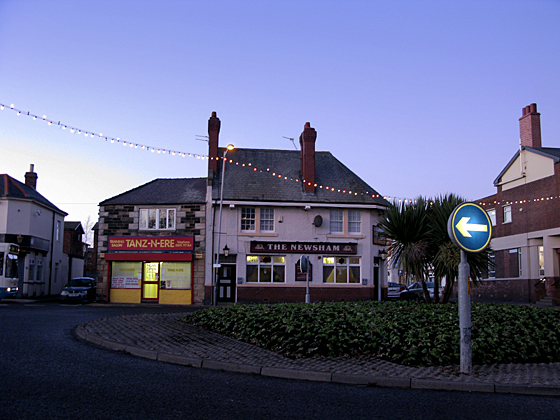
When I got home I had a quick pizza and then put my boots on to go for a walk. It was turning cold and the slushy snow was beginning to freeze into crusty waves. I walked along Broadway and then on as far as the Thoroton Hotel. I went up Marlow Street and cut through past the sports centre and over on to Newsham Road. I walked up into Newsham and down Winship Street past the site of the Big Club, which is still fenced off but now completely razed. At the roundabout I stood for a moment or two and looked at the strings of Christmas lights slung above the road. I then made my way back down Plessey Road. In the last few days a lot more Christmas lights have appeared on houses and a lot more Christmas trees in their windows, but Christmas still seems slightly reluctant to appear this year, even though the Angel Alistair and the Good St Gordon from every television in the land sing, ‘Spend, Spend, Spend!’
‘Spend what?!’ the world sings back.
When I got back home Brenda was there again, gathering more slippers into boxes to take away for dispatch.
‘Hi, Brenda,’ I said. ‘How’s business?’
‘Brisk!’ she replied. ‘Surprisingly so. Things have really picked up in the past few days.’
‘Well, you can never go far wrong with slippers at Christmas, can you?’
‘Yes, I think you’re right. Folks may not have much money this year, but everyone can afford a good old fashioned pair of slippers, can’t they?’
Brenda didn’t have her Auguries of Innocence cardie on that day. She had a sort of long very expensive looking camel-coloured wrap around coat. She was also wearing green knee high leather boots with big shiny silver buckles on them, and out of the collar of her coat the leafy frills of a spring green blouse of some sort erupted. She also wore a coffee-coloured knitted hat of some kind, a one with a peak and a small chocolate brown button on the crown, the sort of hat that reminds me vaguely of Barbra Streisand. For a moment it crossed my mind that Brenda looked rather like a tortilla wrap.
‘So what’s Tristan getting you for Christmas?’ I asked.
‘Oh I don’t know that!’ she replied. ‘That would take all the fun out of it. I like surprises.’
‘But there must be something you hope he gets you.’
‘Oh well, yes, of course. What I’m hoping for is a Matthew Williams Chapelle weave coat and some Jimmy Choo Erica ankle boots, as well as some lovely smellies and maybe some nice stocking fillers, such as earrings and brooches and choccies and things. Just lots of lovely lovely delicious surprises really. I’ve pointed Tristan in the direction of net-a-porter.com and I know for certain that he’s looked. I’m quite excited really. But what about you? What do you want for Christmas?’
I paused for a moment, as if taking thought. ‘The emancipation of the working class, I think,’ I said, very calmly and seriously. ‘Yes, that definitely. That and world peace.’
Brenda nodded her head approvingly. ‘That’s just such a beautiful wish,’ she said. ‘Yes, of course, you’re absolutely right. It is the spiritual aspect of Christmas that really matters, not all the shopping and materialism. And in any case it really is better to give than to receive. You know, I don’t really care what anyone gets me actually. Christmas is just such a special time of year. Just be close to someone you care about and to know they’re there, that’s all any of us really needs.’
So I’ll tell Tristan to just send you a note and prod you from time to time then, I thought. I know what great joy and cheer that will bring.
‘So what are you getting Tristan?’ I asked.
‘An electric screwdriver set.’ Brenda replied. ‘I saw one at B & Q. It was such a good buy and it will be all he’ll ever need. He’s always saying how much he wished he had one.’
‘That’s nice, Brenda,’ I said. ‘If you’ve got to spend then a practical gift is always the way to go, I think.’
Lucky Tristan, I thought. But of course I’m sure Brenda will get a huge amount of pleasure from giving Tristan his electric screwdriver set.
‘Oh, but what do presents matter?’ Brenda said. ‘Christmas really is first and foremost a spiritual time, a time to think of others. As you said, a time for peace and love. Material things are such a terrible distraction sometimes, aren’t they?’
For a moment I wanted to ask her what the word ‘spiritual’ meant. But I thought better of it. In any case I think I already know how spiritual Brenda is: she’s about as spiritual as a checkout till. She has exactly the sort of spirituality the Angel Alistair wishes we all had this year.
‘Do you know anything about the Tarot, Brenda?’ I said, changing the subject. It was like asking a seagull if it knew about fish heads.
‘Yes, of course,’ she replied, becoming animated. ‘Do you want me to do a reading for you?’
‘No, not really,’ I said. ‘But thank you for the offer. No, I was wondering about one of the cards and what it means.’
‘Which one?’ Brenda said, always ready to share her esoteric knowledge with the curious.
‘The one with the reaper on’ I said. ‘Is it called the Tallulah?’
‘The Tallulah?’ Brenda said, screwing up her face. ‘The Tallulah? The Tallulah’s not a Tarot card. No, no. No, the card you’re describing is the Death card.’
‘Oh,’ I said. ‘The Death card. So there’s not an expression which is like “turning the Tallulah” or something like that?’
‘No,’ Brenda said, a little sharply. ‘No, there isn’t. The reaper is on the Death card.’
‘And if that card turned up for you it would be bad news, right?’
‘No, not necessarily,’ Brenda said. ‘That’s a common misconception. The Death card does not necessarily signify death. But it does signify that major change will occur in your life. Catastrophic change, in fact, but not necessarily for the worse.’
So, I thought to myself, turning the Tallulah foretells catastrophe. But not necessarily a bad catastrophe. The idea of a good catastrophe appealed to me. This was an idea it would be good for Jack to know about.
‘So have you ever done a reading for anyone when the Death card has turned up?’
‘Oh, yes, of course,’ Brenda replied. ‘Many times.’
‘And are any of those people still alive?’ I asked.
‘Yes, so far as I know, they all are.’
‘But they will have all encountered a catastrophe by now, yes?’
Brenda had rumbled my game a while ago of course. She was prepared to play along no longer.
‘You should stop taking the mick,’ she said. ‘You know, many people have been helped to make important decisions in their lives through the Tarot. Just because you think it’s nonsense, doesn’t mean it is nonsense, you know.’
I nodded. She was right of course. I began to wonder about making a catastrophic decision, or rather, making a decision to have a catastrophe in your life. It seemed to me that since the future can’t really be foretold, this must be the way the Tarot works. The cards suggest that decisions of a certain kind should be made. It sets an agenda in someone’s mind. Decisions are then made according to the cards’ suggestions and hey presto – the cards appear to have done what cards never can and to have foretold the future. The classic self-fulfilling prophecy. Perhaps most divination works in exactly the same way. The effect is that you take active responsibility for your own future but that by some sleight of hand you can always say that whatever happens was bound to be, that it was written in the cards.
I wandered through to the conservatory. De Kooning was sitting on the windowsill, looking out into the dark where the snow had fallen among the gaping spaces of the Citadel. Sometimes I think I’m too passive about the future. It’s not something I get a hold of and try to make for myself. Maybe it’s that working class thing. Maybe it’s something else. I just seem to be happy to sit and watch the river flow by. I could dip my foot in, I know that. Maybe I fear a catastrophe if I do. Maybe I think I might turn the Tallulah if I get my feet wet.
I wondered if I should get a Tarot pack and do a reading for De Kooning. I know of course that this sort of stuff doesn’t work for cats. Cats sit on life’s windowsill and sing Que Sera Sera. They sing it nine times over.
.
a queer sort of petrified sphinx
I finally watched I’m Not There. Todd Haynes’ method was immediately clear to me. I was quite amused when the Richard Gere Dylan – a man who seemed to be looking for the part of an ordinary man in an extraordinary world – wandered into the town of Riddle on Halloween. Here we have the familiar conceit of the world as a riddle, perhaps in a modernist incarnation. Riddles have an answer, have a sense and a meaning even if they are elusive. Nietzsche’s ‘World Riddle’ came to mind, the Welträtsel, and Pope’s poem ‘The Riddle of the World’. The riddle is second cousin to the jigsaw and the scheme in cosmological terms. Dylan Gere is a clear contrast to Dylan Blanchett , the one who just a year or two earlier had looked out on the world as an apocalyptic junkyard.
While Dylan Gere is wandering pensively around this place of Riddle, the narrator says something like ‘nobody’s who they seem to be’. Ha ha, I thought. He should have been in Glasgow on that night!
I suppose that the question watching the film threw up for me was whether Dylan was just an ordinary man in an extraordinary world or whether he was an extraordinary man in an ordinary world. (For the sake of completeness the other possibilities are an ordinary man in an ordinary world or an extraordinary man in an extraordinary world). The modern world itself of course never settles long enough to be called ordinary, so we might say that extraordinariness is the normal condition of existence in a society like ours. Extraordinary is the ordinary condition of late modernity. And the sixties were an extraordinary time. America at war with itself, a tortured nation, a nation disintegrating. Assassinations, napalm, the space race, the arms race, the cold war, television, rock and roll, paranoia. These were apocalyptic times. But isn’t modernity in any case pretty much the normalisation of apocalypse?
The film presents the self as a fragmented, vulnerable and contested reality. If we accept this premise then perhaps we should recognise that as a person Dylan was both ordinary and extraordinary, and that this was perhaps key to his difficulties. And yet it is the idea that Dylan was arguably Everyman in the film that interests me most, the notion that in reality Dylan is much the same as you or I and that (increasingly?) our situations are becoming like his. Nowadays we all have to deal with shifting personae and shifting expectations. And with the lure of celebrity. We can no longer be satisfied with ordinary lives and in our world of greedy media an extraordinary life will make you famous; we are somehow fooled into thinking the corollary of this is that to be famous will make your life extraordinary and transform you into an extraordinary person. It won’t. But to be a celebrity is an almost normal goal now. The opportunities are many, from Big Brother to The Weakest Link. And yet how will being a celebrity even for a day change us? We will expect a transformation, a sudden coming into real being. And yet the opposite is likely to happen. The half-hearted realities of ordinariness will vanish from out hand; we will suddenly become no-one at all.
Of course Dylan’s burden as a celebrity was exceptional. But perhaps only different in scale, not in nature. We all want to ‘live the dream’. Haynes’ tale from this perspective is a cautionary one: the dream is only a dream and once you see that you will collapse into yourself. Anomie and dissociation will follow. You may want to refuse them. You will not be able to.
Haynes has his Dylans speak lines from various Dylan sources – sleeve notes, poems, Tarantula, interviews and so on. At one point one of them says a poem is a naked person. It’s interesting Dylan didn’t say self: a self and a person are not the same thing. A person is an outward reality, a social and political entity. The self is a supposed inner entity, a psychological item. People will say Dylan is a complex person. Did anyone ever suggest he had a complex self? The self is something we imagine we see when gaze into ourselves (ha ha – did you notice the tautology here?!) The self is like a soul. Like an essence. We imagine each self as having a unique simplicity. Can we imagine a person without a self? This seems almost like asking if we can imagine a person without a body.
Bob Dylan is a complex person and it is this complexity that Haynes film seems to want to unravel. And yet ironically I think the film falls into the trap of trying to show us Dylan’s soul, even though it takes its primary text from the song which says ‘I’m not there’. Maybe it needs to do this for dramatic reasons, since where would a western narrative be with a protagonist too elusive or transient for the audience to identify with? There is no narrative to chaos, and without a narrative there may be no space for a me. Maybe there is something to be said for the idea of the self as a centre of gravity for the narrative of a life. Maybe the self is a necessary fiction, the unavoidable consequence of giving chaos an order. I accept chaos, Dylan Blanchett says, but I don’t know if chaos accepts me.
In Haynes’ narrative we are presented with a succession of selves we are to suppose Dylan to have had. We like to imagine the self as an onion, and think perhaps some people have more layers than others. Dylan’s layers are peeled away, one after another. I think the film is structured so that the reflective persona of Dylan Gere perhaps represents Dylan’s curious soul, the simplicity that he finally is. Dylan Gere appears almost as if he’s the father of the others, the one from whom the seed of all the others came.
Maybe this is a stretch, but does it make sense? Was Dylan more than one person – one self – at any one time? Dylan’s selves were successive rather than simultaneous. One didn’t lie beneath the other; one lay next to the other, succeeded it. Each self was performed and the performances were repeated until they were succeeded by a different performance – a different self. Haynes is right to give these selves different names; the extent to which they can be said to be the same self is problematic. Dylan’s life is a succession of selves, none of which has any privileged or higher reality. His life, like all our lives, is a life caught between becoming and having been. The self is not there, only the performance that is what we are. Dylan Gere appears to perhaps be the real Dylan, the inner man, a meta-self, a self beyond performance. But even this is an illusion.
Dylan breathed in the chaos that is America and breathed out shapes that made sense, the shapes of a new America, brave new versions of traditional identities, hanging in the air, fragile and flickering, as vulnerable as ghosts in a hurricane, like projections on the screen of the nation. Dylan performed a succession of American selves. Or perhaps a succession of American personae. In the end Bob Dylan found he could not escape from Bob Dylan, because Bob Dylan was never really there at all. He sang America and America sang him. A song is anything that can walk alone, he said. A song falls short of selfhood. A song is not even a person, it seems. A song might be no more than a ghost.
The thing that I wonder about is whether Dylan in this film is Everyman. But the thing I remember about the film is the music, the way the songs seep from the scenes and haunt the images. The songs ambush you, taunt you, lure you into places you had forgotten about. The songs unsettle you and reassure you, sooth you and pierce you, empower you and terrify you. They do all these things at once. This is a film for Dylan freaks by a Dylan freak. In the end this is what the choice of songs says to me. These are legendary, hallowed songs, the songs from which the myth of Bob Dylan is woven.
I’m a bit worried about Tom Ridley. Tom is the admin manager for the area and works between three sites. I met him at the photocopier today. It’s a Xerox Workstation M35 model, a freestanding square box that’s about the size of chest freezer, or in animal terms, a small horse. Tom was talking quietly to it, promising it a ‘special treat’ if it was a ‘good boy’ and behaved itself for him.
‘Hi, Tom’ I said. ‘How you doing?’
‘Yes, fine,’ he replied. ‘Just trying to encourage Frodo to be a good boy for me.’
‘Frodo?’ I said. ‘The photocopier’s called Frodo?’
”Yes,’ Tom replied. ‘If he’s good all day I’ve promised him that I’ll take him out this afternoon.’
‘Out, eh? Anywhere special?’
‘The beach. He just loves the beach. Of course I’ve got to keep him on his lead in case he runs into the waves and gets washed out to sea. He’s still just a puppy really and very excitable.’
Tom leaned on Frodo’s stout ivory plastic frame as he spoke about him. I was wondering which end was which.
‘Of course the other thing about the beach,’ he went on, ‘ is that he gets to meet other photocopiers. That’s good for him because he needs to learn how to socialise with them and not to be aggressive or snappy.’
‘Yeah, that’s a good point,’ I said. I asked him if Frodo was almost finished his current job and could I perhaps copy a couple of reports.
‘Of course,’ Tom said. ‘You’re such a good boy, aren’t you? Now be nice for the man and copy his things carefully for him, do you hear?’
Tom patted his ivory friend affectionately on the shoulder, picked up his wad of documents and set off down the corridor towards his office.
About mid afternoon I went down to the photocopier to copy some documents. The photocopier was gone. I abandoned the idea and decided I’d go home early. I decided to drive down through Sleekburn and along through Cambois. I’d seen a television news item about E-on’s proposal to build a new coal fired power station there on the site of the old one and that local people were protesting about it. Quite understandably so too, because the government isn’t insisting that only so-called ‘clean’ coal fired power stations can be built. But did we really expect them to? Next thing you know the local MP’s will be telling us how this will be good for jobs, our own brave Socialist warrior foremost among them, no doubt.
It was dusk on the beach. As I drove south listening to Dengue Fever I saw a figure close to the shoreline making his way north. It was Tom. He was pulling along the Xerox M35 by a leash, like a man dragging a mule. Frodo seemed to me to be a rather more reluctant walker than Tom made him out to be. I was somehow reminded of Pozzo and Lucky in Waiting for Godot. For a moment I fancied I saw two small photocopiers run up to Frodo and sniff at him. Frodo set himself back on his haunches and his hackles went up. Tom is right, Frodo isn’t yet well socialised. I drove over the crossing and up through East Sleekburn, past the site of the old power station and Wilson Avenue. It was dark and there wasn’t a soul around. I wondered if I shouldn’t email Tom’s manager about his behaviour, but I decided it was really none of my business so long as he returned Frodo by morning and wiped the sand from his wheels before taking him back into the office. It’s certainly odd for a grown man to adopt a Xerox M35 as a pet and take him for walks on the beach, but it isn’t something which is very likely to harm children, at least not as long as Frodo is properly muzzled when they are around him.
When I got home that night Brenda was there. She had come to collect some more slippers to send out. She was wearing a knitted garment of many colours, a long wrap-around cardigan of sorts. It had multi-coloured words of some sort embroidered all over it.
‘Hi, Brenda,’ I said. ‘Nice cardie.’
‘Thank you, kind sir,’ she said. ‘It’s handmade. We bought it from a textile artist in Hawick a couple of weeks ago. It’s beautiful, isn’t it?’
‘It’s a doozy,’ I said. ‘What do the words say?’
‘You mean to say you don’t recognise them?!’ she said. She turned around to let me read her back. Entangled in meandering lines were phrases I struggled at first to recognise and disentangle. And then one of them became clear to me: a robin redbreast in a cage puts all heaven in a rage.
‘The Auguries of Innocence?’ I said. ‘Your cardie’s got lines from Blake embroidered all over it?’
‘Yes,’ Brenda said, swinging back around. ‘Isn’t it fab?! Tristan bought it for me on a day out. I just had to have it. I’m going to wear it when I go to my next poetry weekend. What do you think? I think they’ll just adore me in this!’
I tried to read Blake’s entangled utterances as they crept and crawled and snaked and snaggled over her shoulders and down her arms and across her torso and around her hips. If the sun and moon should doubt in mustard yellow criss-crossed by the poison of the snake and newt in dull maroon. In emerald green, the beggar’s dog and widow’s cat giving birth to the long divergent slate blue arc of the wanton boy that kills the fly.
‘I think it’s fantastic, Brenda,’ I said. ‘Does she also do the Proverbs of Hell?’
‘Yes, she does. Oh, that one’s really beautiful too. Oh, did Margaret tell you about her horoscope, by the way?’
‘Not really,’ I said, remembering how last night I’d noticed Orion again for the first time this winter. ‘What star sign are you again, Brenda?’ I asked.
‘Taurus, of course,’ she replied. ‘Loving, loyal, prosperous and patient, the creative type. Doesn’t it show?’
‘It shows in your cardie,’ I said.
‘What sign are you, again?’
‘I believe I was born under the sign of hammer and sickle,’ I said.
De Kooning wandered in. I picked him up.
‘Have you got your stock of sunglasses in yet?’ I asked.
‘No, not yet. Why? Are you after a pair.’
‘Yeah, I was thinking about getting a friend a pair of Ray-Bans for Christmas.’
‘Aviators?’
‘No, Wayfarers.’
‘I’ll see if I can get you some, if you like.’
‘Thanks, Brenda. Yes, that would be great.’
Margaret came through from the kitchen. She’d put on a big pan of onions to boil. I went through and put a pizza in the oven for tea. I gave De Kooning some prawns and sat in front of the television to watch the news. Later I went upstairs and rummaged among my books to find something William James wrote about the notion that the world might be a riddle to which there is a single answer.
All the great single-word answers to the world’s riddle, such as God, the One, Reason, Law, Spirit, Matter, Nature, Polarity, the Dialectic Process, the Idea, the Self, the Oversoul, draw the admiration that men have lavished on them from this oracular role. By amateurs in philosophy and professionals alike, the universe is represented as a queer sort of petrified sphinx whose appeal to man consists in a monotonous challenge to his divining powers. THE Truth: what a perfect idol of the rationalistic mind!
After I’d eaten I went out in the dark and walked through the town. Christmas is coming. The streets were remarkably quiet. I caught sight of my reflection in Woolworth’s window and for a moment thought it was a stranger. I was thinking about Nietzsche and Descartes and the Wizard of Oz.
.
exodus and a last hand of whist
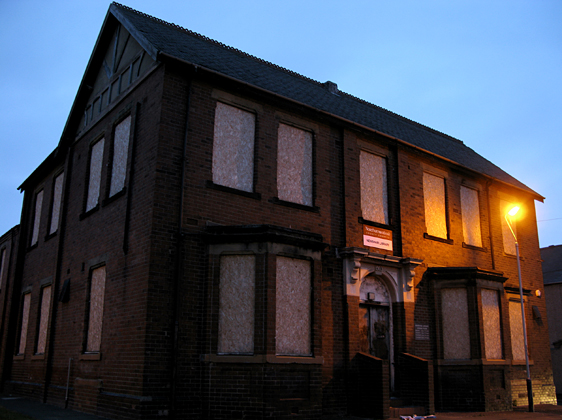
They’ve been demolishing Newsham Library this week. I noticed as I drove through Newsham on Friday that it is now almost all down. A gaping space has opened up between the shops and the flats, a sort of scandalous vacuum. I caught glimpses of it down Elliot Street and the back lane between the Black Diamond and Tanz-N-Ere. I could see the giant crooked metal arm of a demolition machine poised above the rubble. It reminded me that things are disappearing so quickly. I really must hurry and photograph all those buildings and places that will be gone any day now. This is a matter of urgency to me. Time moves on inexorably, flattening the old world to make a place for the new. It worries me that some places might be destroyed before I’ve made a record of them. I want my inventory to be as complete as it can be. I know of course that the photograph will never really bring them back. But it may bring back memories. Things do need to be remembered. My granddad spent the last years of his life in sheltered housing in Newsham. He probably toddled down Winship Street to this building every week a few years ago to find himself a book to read, probably a political biography, or maybe a travel book or a whodunit, or maybe The Ragged Trousered Philanthropists. The truth is I don’t really know what my granddad’s taste in books was.
In 1984 I was a student. During the miners’ strike I was a member of the Labour Party. My monthly ward branch meetings took place in a room in Newsham Library, which at that time may have been a community centre of sorts, I think, or maybe it was still a working men’s club. Bundles of canny old ladies from another age would faithfully attend to make tea and provide a sort of amiable Socialist ballast. They had votes they gave away in the same good-hearted spirit that they gave away the cakes and biscuits they brought along. The rest of the branch comprised a bunch of men of various ages, dispositions and motivations – Arthur Hancock, Ronnie Milburn, Bill Brookes were among them, as I recall – who would debate or mull over or grumble or chunter on about the heroic tragedy or stupidity of the strike, flying pickets, the difficult or duplicitous position of the railwaymen, Kinnock’s devious cowardice, Scargill’s reckless leadership, or whatever. The branch chairman was Peter Mortakis, an insignificant Machiavellian sort of man with the political and moral integrity of a blowfly. He was in cahoots with the MP at the time, a useless, self-serving, Rumpolian, persistently absent carpetbagger. A lawyer. The sort of man who could have been Tony Blair’s favourite uncle.
The room where the meetings took place was dark, maroon and brown, full of deep shadows and dim yellow lights that glinted on the glasses and bottles behind the bar. A sense of history seemed to stain the place, like blood on an old carpet. I never felt comfortable there, but it was a place where I somehow had to think I belonged. It was like needing to stand for a while in a painting by Norman Cornish or Tom McGuinness. Here was a world of ordinary people bound together by adversity. Here was the security of a mythical universe. Of course I can see now that the writing was already on the wall. Thatcher had already lined up the machines that would one day come and demolish this place. This week that day arrived. You can be pretty sure that a block of affordable first-time buyer apartments is already on its way.
Things have been hectic at work in the last two weeks. A tsunami of referrals has hit us after a period of inexplicable calm. This is always the way in social work. It’s unlikely that some mysterious force is at work in society that from time to time casts a curse over a particular place and makes a lot of children there suddenly begin to suffer harm at the same time, a sort of evil spirit that randomly visits a part of the population. It’s more likely that these waves are to some degree chance occurrences and a consequence of fluctuations in levels of responsiveness and concern among professionals. But maybe it is all down to chance. And a sighting of Snow White’s stepmother in Ashington would hardly come as much of a surprise these days.
Thursday was a particularly bad day. Kids scared to go home from school, kids with bruises, kids with fractures, kids with burns, kids home alone, babies losing weight, babies in cold houses, tiny babies that no-one could find. Drunken mothers, drunken dads, dads throwing plates at walls, mothers throwing shoes, depressed mothers, dads doing drugs.
Late that afternoon everyone in the team was out on something or other. Michelle had spent half an hour with the police trying to get into the house of a twenty five year old mother called Tania who seemed to have lost all interest in her three week old baby. The flat was in darkness but the key was visible on the inside of the door, so there was obviously someone in the house. Eventually Tania came downstairs and answered the door. She was with her new sixteen year old boyfriend, Joe, the same boy who a few days earlier had bitten her on the face during an argument. She’d dumped him, she said. Joe and Tania had been in bed when Michelle and the police disturbed them. But where was baby Davina? Tania wasn’t telling. Tania wouldn’t take Michelle and the police to see her, not even under the threat of arrest. Michelle rang me up: what should we do? Baby P was on all our minds; the moorings of rationality were coming loose. All we could hear was the footfall of the beast slouching towards Bethlehem.
‘Have you tried torture?’ I said. ‘Pull her fingernails out. Offer her money. Tania needs to be persuaded to tell us where her baby is. If she doesn’t do so she’s got no chance of keeping it when we find it. But for God’s sake don’t make her any promises. We’re not going to be able to leave the baby there tonight now in any case, are we?’
Fifteen minutes later Tania told them where the baby was and they all set off in the police car to find her. She turned out to be with Tania’s sister. She’d been there all day. She was fit and well. On another day we might have decided to just leave her there and look at it again in the morning. But Baby P was on the minds of the police officers too. Baby Davina was made subject to Police Protection. Michelle arrived back at the office with the baby in her arms at about half past five. I told her who the foster carer was going to be.
‘Oh, is Debs around?’ she said. ‘I’ve just seen a police car chasing a white Mercedes down Milburn Road. I’m sure it was being driven by an Arab.’
‘Debs is at the hospital,’ I said. ‘Kid with a broken arm.’
On my way home that night I went to Tesco’s at North Shields. I was looking for a DVD of The Wizard of Oz. They didn’t have one, but I did pick up a copy of Todd Haynes film about Bob Dylan, I’m Not There. I didn’t see it when it came out, although I’d wanted to. At about seven o’clock I was driving back through Whitley Bay. My mobile rang. It was Debs.
‘The paediatrician says the injury could have been accidental. She’s not prepared to say it wasn’t.’
‘And the kid and mother are sticking to their story that he fell off a wall?’
‘Yep.’
‘And there have been no previous concerns about this kid?’
‘Nope.’
‘Then the kid goes home and we do an assessment, I guess.’
‘Should we have a strategy meeting?’
‘Oh, I don’t know, Debs. Maybe. Let’s talk about it tomorrow.’
I turned on the car radio and listened to Bob Harris’s country show on Radio 2. He played a song by George Strait called ‘I Saw God Today’.
On Friday morning Debs’ husband phoned in to say she was sick. She’d been taken ill during the night. It sounded serious and she was probably going to have to go into hospital.
‘Tell her to take it easy and that we hope she gets well soon,’ I said, and began to wonder what I could do with her caseload.
‘Anyone fancy doing an assessment on a kid with a broken arm?’ I said to the rest of the team. Daft question. They all looked at me as if I needed treatment. At that point reception rang to say that Jack Verdi had arrived for a meeting with Debs. I went along to see him.
‘Hi, Jack,’ I said. ‘Hey, hey, rock and roll! What’s with the shades, dude?’ He was wearing a pair of Ray-Ban Aviators.
Jack laughed, but he didn’t explain. I told him Debs was poorly and that the meeting couldn’t go ahead. He was fine about that and immediately went on to talk to me about the genius of Keats. Jack sees himself as in some way Keats last real disciple, which is odd for a man who’s prepared to prance around in little more than his boots to impress a few dozen middle aged women. There’s only so much mellow fruitfulness such women can take. But autumn is always a peak activity time for the disciples of Keats, of course, so Jack’s digression wasn’t really that unexpected.
Today it was breezy but bright and fairly mild for November. In the morning I walked down Plessey Road and bought The Guardian at the newsagents. I then continued on down to Park Road corner and along Beaconsfield Street towards the town centre, before turning to cross Croft Road and go up Marine Terrace and back across Broadway Circle. A few leaves still cling to the trees but most are assigned to the gutters in drifts of yellow and brown or stuck on the roads like squashed butterflies.
This afternoon I rode along to my dad’s on my bike. The refurbishment of his house is still not complete. It’s becoming pretty obvious that a lot of the tradesmen recruited by the private contractor doing the refurbishments – Frank Haslam – don’t know what they’re doing. Some of them have admitted this to my dad. Some of them also seem to be canvassing for the redecoration work off their own backs. My dad’s cheesed off, but there’s not much he can do to get the work finished any quicker.
My dad was born and brought up in Newsham. I told him about the library building now being knocked down. I asked him what he could remember about this building.
‘We called it the Big Club,’ he said. ‘Your grandfather used to often go down there at one time to play cards. He was very friendly with Bob Oxley, who was the steward at the time.’
He went on to tell me that what is now the Victory Club used to be the Wooden Club, because it was a wood building. There were also a couple of other pubs in Newsham in those days, neither of them more than a stone’s throw away from the three that still survive. They were the Miner’s Arms and the Turk’s Head. Newsham Coop used to be close to the Miner’s Arms and close to the Big Club, During the 1926 General Strike the Sunshine Fund or some such charity used to provide meals for the kids upstairs in the Coop building. The thing my granddad always remembered was the smell of the gingerbread pudding drifting down the stairs and into the street.
The local doctor had a room in the house opposite the Big Club. I think my dad said he was called Dr Gordon, although this could be a Freudian slip: it might have been Gardener. Either way, he was known as ‘The Butcher’. He was the doctor employed by Cowpen Coal Company for their compensation scheme. He had a reputation for sending men back to work at the pit when they were still unfit to be there.
It was getting dark as I rode back. The light was enchanting. The sky had those hard clear gradations from black-blues into orangey-greens and tobacco that you only get in winter. The sea was a pale and steely blue. There were quite a few people on the beach with dogs.
I got back before dark. The washed-up computer desk has disappeared from Hugo’s front garden and the gates to his drive are open. It looks like the Alligator is at long last ready for the road. I went inside and negotiated my way through to the kitchen over the assorted assemblies of slippers. I gave De Kooning a sachet of Felix and made myself a cappuccino. I sat in the conservatory reading The Guardian for a while. The headline said that eight out of ten children who are seriously harmed are ‘missed’ by agencies, whatever ‘missed’ means. This sort of stuff scares senior managers to death, of course. ‘Whither goes Sharon Shoesmith, there go I,’ they think. It’s a situation you can be sure will soon mean a lot of work for the rest of us.
I picked up De Kooning and we peered together out into the darkness beyond the garden fence. The glimmer of strange lights was appearing again in the Citadel. Margaret was on the phone talking to Geraldine.
‘Have you seen any sign of rats out there?’ I whispered to De Kooning. ‘No? No, I thought not.’
Margaret came through and said that she and Geraldine were going to ring Griff on Monday and give him an ultimatum: get rid of the rats or they call in Environmental Health and go to the press.
‘What if there aren’t any rats there?’ I said. ‘How can anyone prove they’ve got rid of something which isn’t really there to begin with?’
‘How could they not be there?!’ Margaret said. ‘Trevor’s seen them again twice this week!’
I began to think that the mythical rats of the Citadel might be refugees from the Big Club building at Newsham. Maybe they are an exiled tribe of working class rodents displaced by modernity, looking for a new set of premises under which to continue their way of life. On their exodus they probably crossed Winship Street and made their way through the allotments and across the old railway line and then followed a route through the back gardens down Twentieth Avenue. I can see them now, scurrying bravely along carrying everything they own, all with their little knapsacks on their backs. Suddenly after forty days of dodging cats and kids with airguns their long walk brought them to the Citadel. The bare girders loomed above them.
‘This must be our new home!’ their weary little hearts exclaimed.
Which seems fair enough to me, but it isn’t exactly the future Margaret and Geraldine have in mind for them.
I was going to watch my new DVD tonight, but Margaret cancelled her plans to go out. I sat in the conservatory reading for a while and then logged on to Amazon. I ordered The Wizard of Oz. I went out and walked up to Newsham. It’s a cool, clear sort of night. The wind has dropped. I walked up Elliot Street. The lights from the pizza and chip shop, the Chinese and the Indian take-away flooded out across the dry pavement. The smell of curry and onions floated in the air. The rubble of the Big Club is fenced off. The big Cat machine stands among it, it’s demolition arm resting its heavy nose on the ground. I stood on the other side of the road.
‘Okay, granddad,’ I said. ‘German whist. Your deal.’
.
if rats are made out of nothingness

New Labour won the Glenrothes by-election. Gordon will be gloating. He sits at night in his new primrose yellow room full of broken cogs and scattered springs and cannot believe his luck. He sniggers. He chortles. He laughs like a Kirkcaldy drain. How many dark nights did he sit over-winding his beloved timebomb, praying to the mythical deity that the bloody thing wouldn’t blow up in his face? But blow up it does and guess what: he’s off the hook! You’d almost think Gordon had done this deliberately, wouldn’t you? I gather he’s now asked Sarah to get him a wrecking ball for Christmas. He’s told her he’s come up with an ingenious solution to the recession in the construction industry.
I spoke to Talullah Hudspith a few days ago. I hadn’t seen her since Rosie’s leaving do. She asked me what I thought of Jack’s performance.
‘Quite remarkable,’ I said. ‘And brave. The man rocks, doesn’t he?’
Talullah and Jack have an odd relationship. Some say she has a thing about him; others say the exact opposite is true. I personally remain agnostic on the Talullah and Jack issue.
‘Do you think so?’ Talullah said, with more than a hint of a sneer. ‘I thought he was bloody ridiculous, actually. I mean, what on earth would possess a man of his age to prance around like that in front of all those poor women? He’s got no shame.’
In the light of this response you too will now no doubt be hypothesising about Talullah and Jack. I certainly was. But a tactical evasion seemed the order of the day.
‘So is he back at work?’ I asked.
Talullah chuckled, or perhaps snortled. ‘Oh ho, he’s back all right!’ she said. ‘The dirty hound’s always skulking around in the shadows somewhere. He’s never yet spoken to me about his antics, of course. He’s quite ridiculous, really. Do you know he’s now wearing dark glasses for work? He never takes them off. Who the hell does he think he is, Elvis Presley?!’
‘Yeah, I would be too if I’d done what he did!’ I said. ‘The guy’s probably just a bit embarrassed.’
‘Embarrassed?! Him?! That’s a laugh. You couldn’t knock him back with a shitty stick, man. No, he’s a star reborn, that’s what our Jack is. I wish he’d do us all a favour and just retire.’
‘So,’ I said. ‘How’s the delightful Mrs Gormley? Did she enjoy the night?’
‘Oh, Betty loved it! She’d do it again tomorrow if she could.’
‘Maybe Jack’ll play for her if she asks him nicely,’ I said. ‘If he really is a star reborn, he’ll have no problem with that. Nor will she, I suspect. Just as long as he keeps his pants on next time.’
Talullah’s from a theatrical blackground. She’s naturally dramatic. She’s the kind of woman who likes to start a riot. Maybe it just gets up her nose that Jack upstaged her.
Mandy has been into the office a couple of times this week. There have been almost daily sightings of the Arab in the white Mercedes and she’s getting very stressed. On Friday she and Mr Zee were waiting to see Debs when I arrived at the office. Mr Zee looked very smart, as always. His rich brown cape was almost shimmering in the morning sun.
‘How you doing?’ I said to him.
‘I’m okay,’ he replied. ‘You know.’
‘Yeah,’ I said, ‘I know. So are you still reading Bukowski?’
‘No,’ he replied. ‘I decided he wasn’t my cup of tea. I’m reading Neruda at the minute. They’ve got lots of his stuff at ZorrStore.com. I’m trying to get into Rumi too.’
Mandy then told me that the phone had rung seven times during the night for each of the last three nights, and each and every time it was the same old tune.
‘Is Flinty still with Molly?’ I asked.
Mandy shrugged and looked at Mr Zee.
‘We don’t know,’ he said.
‘Have you told the police?’
‘Yeah. Nothing they can do. The caller’s using a stolen mobile.’
When I got home that night there were three more big boxes of slippers in the hall. De Kooning was sitting on top of them playing king of the castle. Geraldine was talking to Margaret about the latest curse of the Citadel: rats. They were first spotted by Big Trevor while I was in Glasgow it seems, scuttling around beneath his railings.
‘They weren’t there until the builders came,’ Geraldine said.
I wondered if she thought the builders had imported them as a sort of alien species, or simply because no building site is complete without a good infestation of rodents.
‘So how did they get there?’ I asked, already allowing my mind to toy with the notion of their ex nihilo creation.
‘Well, it can only be the building site, can’t it?’ Margaret said. ‘They weren’t there until they started building that monstrosity.’
Okay, I thought, but how did they get here? Did Griff dress himself as the Pied Piper and lead them here from their old haunts along the quayside? Did they hear along the grapevine about the Citadel site and make their way here, like the Israelites to the Promised Land, like Americans to California? My guess was that they’ve always been here or that perhaps the sightings are apocryphal, a plague of the Citizens’ collective imagination.
‘We need to visit the site en masse and register our protest,’ Geraldine said. ‘Rats are dangerous. Did you know that they sometimes curl up on your pillow beside your face as you sleep! Imagine that. It’s horrific!’
‘Will we be safe?’ Margaret asked.
‘As long as we wear sensible footwear we will be!’ Geraldine said, obviously recalling the mass trespass during the summer when she fell off her high heeled boots. It’s not often Geraldine makes a joke about herself.
‘I’ll wear my Timberlands,’ Margaret said. ‘They’ll never get me in them.’
I went through to the conservatory to drink a cappuccino. There were a dozen or so pairs of slippers lined up across the floor. They were obviously part of the Christmas stock. Slippers with owls and guitars and ducks on them. Camper van slippers, cows and gingerbread men slippers. There were also a couple of pairs of fake fur leopard skin bootie slippers. I stepped over them and stood at the window. The sky was almost dark. There were vague lights flickering somewhere deep in the carcase of the Citadel. It looms over us like Kafka’s Castle. I began again to wonder where Hugo had put his little giraffe.
‘Edna will never come home now,’ Margaret said, after Geraldine had left. ‘She’ll never cope with the idea that she might wake up and find a rat sleeping next to her face. It’s an absolute crying shame.’
I stared out at the Castle. I wondered about the rats that are made out of nothingness.
‘I’m going to Brenda’s tonight,’ Margaret said. ‘Her friend who’s an astrologer is coming to her house. She’s going to do my horoscope.’
I nodded. I said nothing for a minute or so.
‘Are you taking some of these slippers with you?’ I eventually asked.
‘No,’ Margaret said. ‘But I am taking the boxes in the hall.’
When she left I had another cappuccino and sat for a while reading my book on Scottish art. Some of W G Gillies’ paintings are stunning. I love his border landscapes and they sort of feel like home to me too. It takes a lot of confidence to paint as freely as he does in those paintings. But I was particularly taken on Friday night by his 1973 painting The Garden in Winter. We sometimes fail to see the beauty that lies in the ordinary things, the things we can see from our windows. We sometimes fail to see how much those things really matter. I gave De Kooning his prawns and painted a new square canvas over with a Prussian blue ground.
I watched it dry and listened to Meg Baird’s album. I decided I would have to go up to Temple soon to see the house where Gillies lived and where he did all those late paintings.
I watched Newsnight. I went to bed.
.
on the day the clocks went back
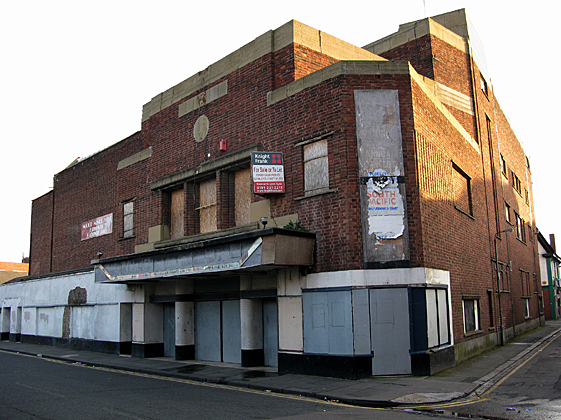
The clocks went back last night. British Summer Time is over, the dark nights are here. It was a sunny morning, cool and windy. As I left the house to go for a walk and get the newspapers, Hugo was getting out of his car. He had a small plastic giraffe under his arm.
‘Here, mate, that tree of yours has suddenly gone yellow, hasn’t it?’ he shouted.
‘Happens every autumn, Fletch,’ I said, laughing.
Maureen and the Whelp were knocking on the Widow’s door.
‘She’s gone away,’ I said.
‘Oh?’ Maureen said. The Whelp gawped superciliously over her shoulder.
‘No, no,’ I said, seeing that my remark had an ambiguity which those who were religiously minded might find especially confusing. ‘I mean she’s gone to stay with her brother in Derbyshire. We’re not sure when she’ll be back.’
‘Oh,’ Maureen said again, but this time with a relieved smile. She got out her note book and wrote something in it. Perhaps she was noting that the Widow hadn’t escaped doing business with them by grabbing an early flight to heaven with the Methodists.
Boz went completely off the rails last week. He came to the office several times with one query after another about his children and his rights and the stupidity of the law. On Wednesday he was arrested for stealing seed from a bird-feeder in a garden on the Fallowfield estate. It appears that he had been reliably informed that commercial bird seed contains cannabis seeds.
Boz had estimated that there are probably about five hundred bird feeders in Ashington, mostly hanging from trees and bird tables in the new private estates. He reckoned that there would be on average a pound of seed in each feeder. If ten percent of that was cannabis seed that would be fifty pounds of the stuff. Boz reckoned a shrewd dealer would surely pay a tidy sum for fifty pounds of cannabis seed. All he had to do was to break the town into manageable harvesting districts – each district being about the right size for one night’s work – and systematically gather the seed from the gardens. He couldn’t fail.
On Wednesday night he found himself with his back against a six foot lattice fence in a garden in Magnolia Drive, cornered behind the garden pond by a Rottweiller called Dexter Dan. Dexter Dan’s owner, Geoffrey Harrison, a retired seaman and Chief Storekeeper by trade, shone his high-powered torch into Boz’s face and told him the police were on there way. Rather uncharacteristically Boz said nothing and instead began eating the seed from his pocket. He later explained that he’d calculated that trespass was a less serious offence than possession of more of a Class C drug than he could reasonably argue was for personal use only.
Boz was released the following morning and came in to see Lily at about lunchtime. He told her of the idea he’d had and how he’d been apprehended on his very first seed gathering expedition.
‘They kept me in a cell all night, Lil,’ he said. ‘The police have no right to do the things they do, you know. Do I look like a criminal to you, Lil? Do I?’
Lily shook her head ambiguously. ‘So did they charge you with anything?’ she asked.
‘They’re complete numpties, complete bloody wassocks.’
‘So you were charged with something?’
‘They charged me with criminal damage to a bird feeder.’ Boz looked Lily straight in the eyes. He was very serious. He was saying loud and clear that this was no laughing matter.
‘Well, that’s not serious, Boz,’ she said. ‘I mean, it might never get to court.’
‘They also charged me with the theft of ten ounces of birdseed with an estimated value of two pounds fifty.’ He paused.
Lily put his hand on his shoulder.
‘I’ll be a laughing stock, Lil,’ he said. ‘The numpties from Newbiggin will call me Birdseed or Pecker or something else just as stupid that they’ll think is absolutely bloody hilarious. I’ll never be able to hold my head up in Ashington again. Never.’
‘Forget about it,’ Lily said. ‘Listen, no-one will ever know about it in any case if it doesn’t get to court. And I’m sure it won’t, Boz. It’d be a waste of public money.’
‘Can I have the kids this weekend, Lil?’ Boz asked, very calmly. ‘I need them with me right now. You can come and inspect the caravan if you want.’
Lily shook her head. ‘I’m sorry, Boz’, she said. ‘You know that can’t happen. It’s just not the right thing for the kids.’
Boz shook his head slowly. But he didn’t get angry at all. In fact, Lily felt he accepted this very easily. He looked very composed, as if he’d finally gained control of himself. As if, as Lily put it, the penny had finally dropped. ‘I know,’ he said. ‘I just needed to ask you. You understand that, right?’
‘Yes,’ Lily said. ‘I do understand.’
What happened in the next few hours is somewhat unclear. However, at about eight thirty on Thursday evening the police were called to Bubbles where Boz was being restrained by the doorman and a couple of lads from North Seaton. Boz had gone into Bubbles and announced to everyone there that he was a suicide bomber and that he was about to blow the place up. He pulled open his jacket and revealed a belt which he claimed was packed with explosives. The doorman sauntered over, head-butted him and threw him to the ground. The lads from North Seaton then helped out by putting in the boot. They removed the belt and found it was packed with Rowntree’s Table Jelly.
The police arrested Boz and initially considered holding him under Schedule 8 of the Terrorism Act 2000. However, it struck the duty Sergeant that a man who had just one day earlier been arrested for stealing birdseed from a garden feeder and who at the time of arrest had nothing more dangerous on his person than some unopened packets of Rowntree’s Table Jelly, probably wasn’t a member of Al Qaeda. In fact, he probably wasn’t at all well. Later that night Boz was sectioned. He is now in St George’s Hospital.
On Friday night I went to a working men’s club in Cramlington for the retirement do for Rosie Lake, who has managed long-term placements for children since time began. I don’t like these sort of does and, while I like and respect Rosie, I would normally have given it a very wide berth. Unfortunately I was roped into being a late replacement for Jack Verdi, who was going to play the piano for some of Rosie’s colleagues who wanted to sing a few songs for her. Jack rang me up and told me that for personal reasons he wouldn’t now be able to play. He asked me to stand in for him. I reluctantly agreed. I said I was surprised that he wasn’t able to go as he and Rosie had once been rivals for the same post and had been through a lot together. He said he genuinely regretted not being able to play for her.
Jack Verdi used to be a professional musician before he gave it all up to become a social worker and raise a family. Jack was in a band that made one or two chart-topping singles. He lived the rock and roll lifestyle to the hilt and in his younger days had quite a reputation as a hell-raiser. The story of how he once threw the ironing board out of the window of the Chelsea Hotel is still recounted in music circles to this day. Jack was hot tempered and quite notorious for getting into fights with other musicians about apparently insignificant issues. One story relates how he once threw a pint of cider over a sound engineer who’d suggested that B-flat was a better key than G for a particular song. This propensity for fighting led to Jack acquiring the nickname of ‘Scrapper’, and again even now from time to time in Q or Mojo or Rolling Stone you will see Scrapper Verdi invoked as the paradigm for the wild man of British rock.
On more than one occasion in recent years Jack has been expected to play at departmental leaving does, but for one reason or another he has never yet done so. Some people believe this is because Jack very much prefers the electric organ to the piano, and because he cannot bear to play anything but a top class instrument. It’s said he has a really wonderful organ, but that it’s far too big to bring along to a do. Someone once told me it’s a Hammond organ – complete with bass pedalboard and every other bell and whistle – and that it once belonged to Billy Preston. What people say is that Jack’s reputation depends upon his organ and that without it he’d be very ordinary. They say this is the reason he never plays in public nowadays.
I think that may be a little harsh. Jack has in fact sometimes turned up at a do but when he has he has always done something other than play the piano. It is true of course that he has sometimes chosen to do something unexpected and slightly eccentric. When Sally Chaudry left the Adoption Unit, Jack went along to her leaving do, stepped up to the microphone and read aloud for her selected passages from Moby Dick. Then, completely unaccompanied, he sang in their entirety two long Greenland whaling songs. The urge to perform really is irrepressible in some people.
I went along to Rosie’s do at about seven. I checked out what songs we were doing with Betty Gormley, who was the main singer for the evening. Betty – known to her colleagues as “Butterbeans” – is a bluff sort of woman from Rotherham. As a young woman she worked in a textile mill and used to sing in local pubs at nights to make some extra money. Like Jack she got a taste for the limelight and even though she moved on in her life – she married a man who ran a betting shop and got herself an education – she too is still drawn back there sometimes.
There was a reasonable turn out for Rosie’s do, including one or two notable faces from the past. There were also some notable absentees, of course, not least among them Gilmour, who had told Rosie he’d be there for sure.
Once everyone had arrived Freddy Fotheringay, Rosie’s senior manager, made an amusing if somewhat predictable speech about the great service she has given the Department. He then presented her with her leaving present. Rosie took to the mike and did her bit, paying warm and generous tributes to colleagues past and present. She also took a few well-aimed shots at the pernicious effects that managerialism is having on the services provided for vulnerable children. Freddy smiled and took it on the chin. The Inspectors will be back soon and there’s not a blind thing he can do about it. It occurred to me at that point how Rosie suddenly looked older than she did just a week or so ago, and somehow much smaller. When someone’s working life comes to an end does something physical suddenly happen to them?
I took to the piano and Betty along with one or two of her colleagues took to the mike, most notably Talullah Hudspith, the youngest woman in the room, who has a strange penchant for feathers and platform shoes. We banged out three or four numbers from the Chas and Dave Songbook, which always goes down well this kind of audience. We then did one or two of Betty’s personal favourites – ‘When I’m Cleaning Windows’ and ‘Pedro the Fisherman’ – before ending with a rousing version of ‘Wish Me Luck (As You Wave Me Goodbye)’. Betty knew her audience well; it all went down perfectly.
Performance over, I sat at the back of the room with a plate full of crisps, the only guaranteed vegetarian option from the buffet table. I was sitting musing on the meaning of retirement and the loss of purpose that it sometimes brings. I was also musing about how suddenly it can alter our perception of a person, especially if that person has been powerful at work. That loss of power seemed to me perhaps the thing that stripped the person of their aura, that made them suddenly seem physically different. I was wondering if that is why my dad sometimes seems so small to me nowadays. He never did when I was a kid. Do we always instinctively equate size with power and does this affect our perception? Do we imagine a big person is powerful and therefore imagine a powerful person is big?
I was pondering how I might make my getaway when Butterbeans Gormley got back on to the stage and called for everyone’s attention. There had been a complaint made to the police and they were on their way over now. They wanted to interview Rosie, she believed, and possibly some others. No-one should leave the room. Rosie shook her head. She was genuinely aghast at this prospect. Everyone present was stunned into silence.
And then the policeman entered the room. He had his hat on and a truncheon at his side and walked purposefully into the middle of the darkened room. And at that point Butterbeans must have pressed play on the CD player. ‘You Sexy Thing’ by Hot Chocolate began blaring out. The policeman looked up and threw his helmet across the room.
It was Jack Verdi. One or two gasped, one or two covered their faces, one or two cheered. Most pinched themselves to see if they were awake and tried desperately to get their hands to make a clapping motion. Jack began gyrating sinuously in front of Rosie.
Jack looked flushed to me, but he was clearly still in remarkable condition, the result no doubt of the obsession with jogging he has had in recent years. He ripped of his Velcroed on jacket. We all know where he got this routine from, and it wasn’t Herman Melville. He ripped off his shirt, ripped off his policeman’s trousers. He writhed around shamelessly to the relentless music, dressed only in shiny black boots, black socks and a black leather thong. Jack was giving it his all, turning back the clock to give Rosie a send-off she’d never forget. There was only one question now: were we about to see the Full Monty Verdi?
Jack’s a friend, so let me spare his blushes. But I will say this: sometimes there’s a lot to be said for a Greenland whaling song. There’s a lot to be said for the Hammond Organ too.
Yesterday I finished my painting of Corby’s Crag. It has a certain roughness to it that I like, and the palette is wider than I’ve been using in the last year or so. I’ve got too many paintings lying around the house now. Perhaps I should try to sell some of them.
This afternoon I went out on the bike for an hour or so. I rode out across the reclaimed land from the old Isabella Colliery and then on up to Bebside and up the Heathery Lonnen to the Three Horse Shoes. It was hard work riding into the strong westerly wind, but it was a beautiful autumnal day. In places the roads were laminated with brown and yellow leaves and blowing down all around me. I rode up into Cramlington. It began to rain lightly and for a few minutes I stopped in a subway, where I read the graffiti and reflected again on Jack’s performance on Friday night. Once a rock star, always a rock star, I thought.
When the rain stopped I decided to head for home. With the wind at my back I flew down the Laverock Hall Road, past the bruised blackberry bushes and the tattered hawthorns. I came down Plessey Road with the late afternoon sun at my back and could see my long shadow pedalling ahead of me. In the pale blue sky over the sea there were a few ragged dark grey clouds. One of them was shaped like a West Highland Terrier.
I sat with De Kooning in the conservatory as I ate my rice and broccoli. I was trying to reset my watch, to turn it back an hour. It’s a complicated multi-function digital device and I still hadn’t discovered how to do it when Margaret came into the room. She was waiting for a pan of onions and turnip to cook.
‘What are you doing?’ she asked.
‘Trying to set my watch,’ I replied.
‘Oh, of course,’ she said. ‘The clock’s have gone back.’
‘So are you going to reset all the stopped ones?’ I asked. ‘Make then quarter past two instead of quarter past three? You should really.’
‘Why?’ she said. ‘The time on a stopped clock is meaningless.’
‘I don’t know about that,’ I said. ‘It seems to me that you’ve now got twenty two clocks that are all an hour fast.’
Margaret shook her head and tutted.
‘Well, what about the Napoleon in your room?’ I said. ‘Are you going to put that back to the same time as the others again?’
‘No,’ she said. ‘I don’t think so. Some things are best left alone.’
Which reminds me, I must go out and see where Hugo’s put the small plastic giraffe.
.
waiting for the miracle

My computer’s been down. In a way it was if the world had stopped. A bit like not going to work. A bit like being without a television.
Last week Boz got himself locked up. At the beginning of the week he was in the office talking to Lily about abducting his children and hiding away with them in the caravan at Sandy Bay. Lily pointed out that he had already sabotaged his own plan by disclosing his secret whereabouts. Boz threw a wobbler and stormed out. He went into the car park and began methodically ripping the wing mirrors off cars. This is no easy task – a bit like pulling out a rhinocerous tooth, I thought. Once extracted he threw the detached mirrors over the wall into the street. He detached five in all, including both the driver’s and passenger’s side from Meg Bomberg’s BMW. At least no-one will notice the wiggly scratch now, as Lily said.
Boz then went and sat on the wall and had a cigarette. He was sitting there almost serenely when the police arrived in their Ford Focus panda car. They rolled down the window. The officer asked him if he knew anything about the five broken mirrors lying in the road.
Boz shook his head. ‘Me?’ he said. ‘Naw, nowt to do with me, mate. Do I look like a vandal? Naw, it must be the numpties from Newbiggin.’
Lily walked out into the car park at this point. Boz glanced at her.
‘So do I look like a kidnapper to you?’ he asked the police officer. ‘Do I? Do I have the look of a man who would abduct children? Well, come on – do I?’
The police officer glanced across at his colleague. He had a wry smile on his face. Lily hadn’t said a word.
‘You think that’s funny, do you? Eh?’ Boz said, throwing his cigarette down and standing up. He scrunched his stub into the pavement. For a moment he stood looking at the police officer, nodding his head slowly. Then like a leopard he suddenly pounced on the Focus wing mirror and began riving at it.
The police officers leapt out, twisted his arm up his back, slapped him in handcuffs, and threw him in the back seat of the panda, its passenger side mirror dangling like an almost severed limb. Boz bellowed and sang that they were numpties, numpties, numpties, that all policemen are numpties. They took him away to the station.
Lily looked at me and shrugged. ‘Do you think it’s time to cancel the anger management sessions?’ she said.
That night when I got home the clock was still ticking. The global economy was in a state of chaos. De Kooning wanted me to pick him up and carry him to the kitchen. I did so and then went for a walk before night fell.
On Thursday morning I caught the beginning of In Our Time as I drove to work. By sheer coincidence, I would suggest, the programme was looking at miracles. In the introductory part they looked at the Jewish and Christian versions of the idea and the way it was bound up with the idea of God and His power to intervene in the world. It seems that the Hebrew word used in the Bible means both ‘wonder’ and ‘sign’. It interested me that these two concepts could be separated. The programme moved on to the Hindu and Taoist view of miracles, where a miracle can just be a wonder and not a sign at all. It seems that someone with these world views can witness as a miracle and regard it with a sense of wonder – and be fully aware that it defies the laws of nature – but not think it has a meaning. Such things are not signs. The Taoist has no idea why they happen and isn’t much bothered in any case. They just do. This is an attitude that is alien to the west, I was thinking. Western cultures are heavy on ‘the need for cognition’, so much so that some Western psychologists consider it to be one of our fundamental traits. We need to know why things happen. We want explanations. Everything happens for a reason. We need to give an event a meaning.
The programme mentioned the case of the Hindu milk miracle, which occurred in 1996, and involved a stone statue of Ganesha the sacred elephant drinking milk. Or seeming to drink milk, depending on your point of view. This caused great excitement in the Hindu community and Hindus from far and wide came to witness the phenomenon. Even in Britain sales of milk near Hindu communities soared as people went off to get a bottle and feed a spoonful to their local stone elephant. The excitement was about something wonderful happening and the desire to witness a supernatural event. There was little concern about what the event might mean, it seems. Of course even in India the need to explain quickly asserted itself in some quarters. Scientists rapidly came up with the explanation that the stone elephant appeared to drink the milk because of capillary action: the stone was porous. Hindus resented this wonder being taken from them. Why is it that things that have an explanation cannot still be wonderful?
I was thinking, of course, about the Napoleon in Margaret’s bedroom. Its tick was nagging at me. Maybe I should just regard it as a wonder, a clockwork Ganesha. Maybe I should try to persuade Margaret that this magic ticking really had no meaning, that it was a sign of nothing at all. What in fact was the evidence that it had a meaning, and what was the evidence that it had any particular meaning? Was there a message in the ticking, a secret language of ticks that a suitably inspired listener might translate? Is there a Rosetta Stone of ticking? I doubted it somehow.
When I got in De Kooning ran up to me, as if he had great news. Had the Napoleon stopped? I picked him up, but before I got to the door of Margaret’s bedroom I knew it hadn’t. I pushed open the door and looked over at it. It gazed back smugly. It was ticking steadily, indifferently, like a cow chewing the cud of time.
‘I think I’ll have a cappuccino,’ I said. ‘Do you want a few prawns?’
I sat in the conservatory with my cappuccino, trying to read The Guardian. I wondered if I should ring the Greek, but I knew what he would say: the clock will stop, be patient. I began to think I would have to take matters into my own hands and take a spanner to this insolent clockwork wonder. I began to fear that once word got out about the Napoleon’s perpetual motion, miracle freaks from around the globe would flock to our house for a glimpse of this wonder. They would come with camcorders, digital cameras and mobile phones and probably pay for the thrill of recording it, although what the value of a recording of a ticking clock – albeit an impossibly ticking one – would be was a little unclear to me. What would be important, however, was that Margaret and Brenda didn’t realise the money making potential of this freak clock.
Scientists and horologists from around the world would descend upon us. Theories would proliferate. The government would call for calm. Gordon would have to decide upon some Calvinist neo-liberal position on the question, a view with which all cabinet ministers would be bound to agree. It would have to be made very clear that even if this miracle is a sign, it’s not a sign of anything about the economy. There were clear dangers that it would be read that way in the current climate, given that the miracles the unregulated global markets have brought to us are now falling apart around their ears. Gordon would have to act to marginalise and neutralise the miracle of Margaret’s Napoleon.
It was becoming clear: a miracle can lose its gloss fairly quickly. Miracles might not be all they’re cracked up to be. Naturalists and supernaturalists, deists and atheists and Seventh Day Adventists, Neo-Druids and a host of other New Age pilgrims would squabble and debate night and day at our gate. Makeshift camps would spring up on the grass verges, mini-Glastonburies. The faithful would be found asleep or urinating in gardens. The neighbours would complain. Geraldine would probably go to the press. The miraculous clock would be as bad as the Citadel – worse possibly – another dreadful blight on their peaceful existence. The police would put permanent traffic cones down the street. Celebs would arrive for a photo opportunity. Robbie Williams might arrive. Or Jade Goody. My mind went back to the spanner: surely it would be better to nip this curse in the bud? But how could I do that without admitting that a miracle may have occurred? How could I destroy the evidence that I might be wrong about the nature of the world? I was in a cleft stick. I’d have to hold firm and wait. The Greek was surely right: the Napoleon would stop any day now.
I spent a lot of last weekend out and about, walking or cycling. I was avoiding the ticking, I suspect. When I was in the house I’d sit in the Conservatory staring at the dark dreadful matrix of the Citadel with De Kooning, playing music loudly enough to make absolutely sure not a tick could be heard. I listened a lot to Teddy Thompson’s latest album. It turns out to be an especially good record to drive away unwanted ticks. I think De Kooning liked it too. From time to time I got up with him and we danced a little as we looked out together at the darkening world.
On Monday I was going first thing to a meeting in North Shields. Margaret asked me to drop off another box of slippers at Brenda’s on the way. I got there at about half nine. Tristan answered the door. He came to the door in pale blue pyjamas and a pair of checky brown slippers, which looked brand new to me. His hair was tousled.
‘Morning, Tristan,’ I said. ‘Are you not working today?’
‘No jobs,’ he said. ‘Business is slow. It’s the cwedit cwunch, mate.’
Yes, of course, I thought to myself, the cwedit cwunch. It has consequences for us all, even a Trotskyist plumber from Whitley Bay.
‘So is this the beginning of the end for capitalism, do you think?’ I asked. ‘Is this the way the system collapses?’
‘It’s in sewious twouble, mate, that’s for sure. But they can’t afford to let it fall. They’ll pwop it up no matter what it costs. No point in expecting miwacles, as the man said. And as my father always weminded me, capitalism is adaptable. It’s wuthless. It’s survived this long and it’ll survive a while yet. And he was wight. I’m beginning to think the world will be on its knees before we’ll see socialism.’
It was nice to be reminded of the illustrious Wupert. Tristan, of course, is probably right.
‘So is Brenda in?’ I said. ‘I’ve got a box of mules for her.’
‘Yes, she’s just getting weady.’ Tristan said. ‘She’s got a client in about ten minutes. She’s been away for the weekend and she got back late last night.’
‘So where’s she been? Anywhere special?’
‘A poetwy festival. She loved it. She seems to get a lot out of mixing with poets. She finds it exciting. It’s a load of pwetentious wubbish to me. But each to their own, eh? ‘
I nodded. ‘So what kind of client does Brenda have this morning, Tristan – someone for acupuncture?’
‘No, weiki, I think.’ Tristan replied. ‘Mr Armitage. He’s been having twouble with his kidneys. Or is it his knees? Anyway, here he is now.’ Tristan nodded towards the road. An old man in a blue Rover was pulling up. I gave Tristan the box of slippers and bid him farewell.
‘Say hello to Brenda for me,’ I said. I was wondering what kind of poetry she reads. I was wondering if she reads Lorca. Perhaps she prefers Bukowski.
I drove on the North Shields, listening to some more Teddy Thompson. I was noticing the ways he reminds me of his dad, something that wasn’t very obvious to me at first.
When I arrived at the office Boz was sitting in reception.
‘So they let you out, Boz, did they?’ I said.
‘Of course they did,’ he said. ‘Do I look like a criminal? I hadn’t done anything in the first place. It was their fault, not mine. That’s the trouble with the police, they show people no respect.’
Mandy Potts was in the interview room with Debs. Debs told me she was worried because the phone calls had started again. Over the weekend they’ve had Yvonne Fair on three separate occasions. Someone has also told her that a white Mercedes was driving around the estate in the early hours of Sunday morning and that Elephant Carmichael’s been released on bail.
‘And she says Molly Armstrong’s on the game,’ Debs said. ‘Mandy says Flinty always tried to get her to go on the game when he needed money for drugs. She thinks he must be desperate. When he can’t get drugs he’s unpredictable.’
‘So what does she want you to do?’ I asked.
‘’Nothing, I think. She just wants to talk about it. She wishes he would just disappear, but she knows I haven’t got a magic wand.
‘Is she still with Mr Zee?’ I asked.
‘Yeah,’ Debs said. ‘The kids were with him while she came in.’
I listened to Teddy Thompson again as I drove home that night. When I got in I heard the Napoleon ticking. I let De Kooning out and got changed. I went out for a walk. I walked over to the old campsite beside the reservoir at South Newsham and then down to the beach. I walked along the promenade and then followed the beach road and Wensleydale Terrace to the park. I went along the quayside and through the footpath on Ballast Hill. I walked along York Street and from there through Morrison’s car park. I went all the way up Bowes Street and then along Renwick Road and past the council offices on my way home.
When I got back Margaret was in. As soon as I came through the door she asked me if I’d done anything to the Napoleon.
‘Nothing,’ I said. ‘I won’t touch it, I promise.’
‘It’s stopped,’ she said.
‘It’s stopped?!’ I said. ‘Your Napoleon’s stopped?!’
‘Yes,’ she said. ‘It’s stopped. Have you done anything to it? Please tell me the truth. Have you?’
‘No,’ I said. ‘No, I swear I haven’t. I’d thought about, of course, more than once. But, no, I haven’t touched it.’
Margaret shook her head. ‘I can’t believe it,’ she said. ‘I can’t believe it. What am I going to tell Brenda? Why would it suddenly stop?’
This was an odd question, the exact opposite of the question that had been bothering me. I had ideas, but I didn’t think Margaret was in the mood for them. What I wanted to tell her was that Teddy Thompson was to blame. But I didn’t.
De Kooning came trotting in from the garden. It was almost dark. I picked him up and went into the kitchen. I stood him on the bench and put the kettle on.
‘So what do you think of that?’ I said to him, almost gleefully, scratching his head for him in that way he likes so much. ‘The clock’s stopped. Just think – no Robbie Williams, no Katie and Peter, no Jade Goody. It’s a miracle, isn’t it, an absolute bloody miracle!’
.
eliza and the last day of summer
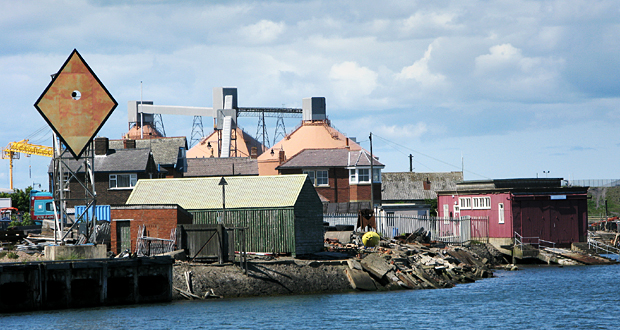
Last Sunday I went to Keswick to see Eliza Carthy at the Theatre by the Lake. It was a fine day that had the feel of the last day of summer. I strolled around the town – which was surprisingly busy, I thought – and browsed in the outdoor shops. It’s sale time because it’s the end of the season and next year’s stuff is about to come in, and perhaps also because the economic slow down is having an impact. I sat outside at the Lakeland Pedlar with my elderflower cordial and carrot cake and gazed up at Skiddaw. The mountains were lolling in a loose grainy mist, benign and summery. I was wishing I’d brought my boots. But I hadn’t.
I wandered along the lake path from Crow Park down to the National Trust Centenary Stone at Calfclose Bay. On the way back I sat for a while on a seat near the Ruskin Memorial at Friar’s Crag looking out over Derwentwater. Perhaps his unquiet ghost sat down with me for a while. Places are made of memories. I was thinking about how double-edged they are, how the past perpetually constructs and reconstructs the present, and how the present constantly reconstructs the past. I gazed at the soft roller coaster ridge of Causey Pike and the snaggy peak of Eel Crag, like a lover gazing at a beloved he cannot reach. Memory is a landscape of longing and loss. The power of association is greater than Ruskin wanted to admit. But I wasn’t thinking about any of the many days when I’d walked these hills, any particular adventure or experience. I was just opened up somehow, peculiarly undefended in the face of the mass and texture of the place. I seemed to be somewhere beyond the particularity of events, but somehow there and then in a very particular moment. I wished again that I’d brought my boots. I went past other walkers as if I was carrying a secret, as if I’d stolen one of the hills and it was in my rucksack, wrapped up in my black fleece. When I got back to my hotel room it struck me that I hadn’t taken a single photograph. Some days, I suppose, we must need to just let the moments be. Remembering, like art, is like an an act of love that sometimes feels like a violation.
I sat in my room near the window reading The Observer. But I wasn’t really paying attention. I wasn’t taking anything in. The articles floated by on the skin of my mind. None of them broke the surface tension or sank. I was preoccupied, wrapped in the paradox of being somewhere else at the very moment of being most fully here. It was probably beauty I was really wondering about, and how it had both immediacy and depth. The landscape of the Lakes is something that like most other people I experience as beautiful. There are paradigms of beauty we learn as children and find on every postcard. And yet while I knew that it was a common experience in its appearance and in its immediacy, I felt beauty must also be idiosyncratic and individual in its depth. Surely it’s more than a mere facade. Beauty is recognition. Beauty is knowledge of a kind. I was wondering if memory isn’t at its heart. I doubted that beauty could exist for a being without a memory. Beauty, I thought, in my Ruskinesque register, is a kind of angel of memory.
The articles in The Observer floated by. I was sounding a tad transcendental, I was thinking, a wee bit like a Platonist. A bit high-falutin’ and airy-fairy. Perhaps Ruskin’s ghost was still yammering inside me. I’d have to watch that. Beauty is recognition, but it is organic, material, iterative, cumulative, learnt, synthetic – I was looking for the words, the qualities to nail it down, to make sure it stays where it is, here in the real and ordinary lives of real and ordinary people. Beauty is not beyond us, not elsewhere, not the glimpse of another world. I was getting hungry. It was teatime. I was thinking that perhaps the study of idiosyncrasies of beauty must be like the archaeology or geology of memory. I was thinking I had wasted my money buying a newspaper today.
I had a quick shower and put back on the clothes I’d just taken off. I ate at Casa Bella, where the food is consistently good, much better than it ought to be for the price, I always think. I sat at a table near the window and watched the passers-by. I was feeling okay, I thought.
Eliza is lively and engaging, pale skinned and girlish, ordinary in a way. The intimacy of the venue suited her well and enhanced the sense of her being emotionally and personally close to her audience. This is probably particularly important for a folk artist, where being perceived as remote from her audience might be an unfortunate irony. The perceived distance between an artist and her audience is of course a key element in the experience of the performance. Eliza’s rapport seems utterly natural, as if it’s never had to be worked at. This is an illusion too, of course. She has a nice line in apparently spontaneous waffle, as she might call it, about things her audience of ordinary people know and can identify with, like boyfriends, mobile phones, families, babies, getting drunk, parties, rowing on the lake, and the pirate’s hook that happens to be hanging on the microphone stand. Tonight’s performance was ostensibly as much a conversation with the audience as a performance of the songs from her latest album. The conversation – in actuality a sort of monologue, of course – undoubtedly added context and thus depth to the songs and therefore altered and arguably enhanced them for her audience. The truth is that as entertaining and likeable as she undoubtedly was, I found myself at times wishing she would play a little more. There is depth and common experience – an inescapable humanity – about folk songs which is personal in any case and which can stand alone. I felt like a spoilsport at times, as if I was being a little churlish in my desire to hear her sing and play her fiddle more. And I was, because she is so personable and probably very genuine.
What I like about Eliza’s records – her music – is the intensity, the way the force of her music – rhythm, repetition, persistence, tone, texture, and what have you – ensnares me, wraps itself around me, possesses me. I like the way dark spaces are opened up- chasms – and the way the music is a kind of rope that swings and hauls me around spaces that seem simultaneously dangerous and safe, depraved, reckless and (ha ha – I’ve slipped this one past you once before!) sublime. I like how I’m made to lurch and stumble, teeter and soar, glide and fall. What I like is the palpable physicality of her music, how it reunites me with movement, with the dynamics or kinetics of being an animal in an animal’s world. Maybe this is one of the things the beauty of music remembers for us, the way the body moves, how we made and make the space where we find ourselves as bodies. I’d watched videos of Eliza on YouTube and she seemed to me to be also possessed by the physicality of her music. I had come to witness some of those moments. And I did. Eliza and her band are all strong musicians and seem to be deeply involved with their material. There were times when I got what I came for, the immediacy of Eliza fiddling and stepping and swaying around the stage like a distracted hobgoblin, driven to a dance that is as deep as we are, as deep as any of us can be, and stepping up to the microphone to fathom and release unfathomable emotions. Eliza surrenders her voice to her song, her body to her violin – that’s how good she is.
After the concert she came out into the bar and sat at the table with her CD’s. I bought another copy of Dreams of Breathing Underwater and asked her to sign it for me. She’s pregnant and I wished her good luck with the baby and she thanked me for that. Eliza wants to be the same woman off stage as she is on stage, I thought, and maybe she is, in some ways at least. But it would be a mistake to assume that a Yorkshire lass has any less of a secret life than Leonard Cohen.
The next morning I had intended to hire a rowing boat and go out on the lake for an hour. I was thinking I might drown the ghost of Ruskin once and for all. But it was raining steadily. I drove down past Thirlmere, over Dunmail Raise and through Grasmere in the quiet silvery rain and it looked very like the first day of autumn. I went to Ambleside and browsed around the outdoor shops there, but again bought nothing. I wandered around the town and spent a little while in the Old Courthouse Gallery looking again at the paintings of Libby Edmondson, which I particularly like and whose style in some ways reminds me of mine.
When I got back home there was only De Kooning in the house. I could hear the Napoleon still ticking in Margaret’s bedroom. De Kooning gave me a nudge with his head and I took him to the kitchen and gave him some prawns. I told him Eliza was good but asked him not to mention Ruskin. I went through to the conservatory as I checked my mail. There were seven large onions on the coffee table. The clatter and rumble of the Citadel men was relentless.
When Margaret came in I asked her if she’d wound the Napoleon up.
‘I have not,’ she said, emphatically. ‘I haven’t tampered with it at all. Brenda has advised me that intervening would not not a good idea.’
‘I didn’t know she knew about clocks.’ I said. ‘There’s no end to her talents, is there?’
Margaret rolled her eyes. She didn’t need to tell me that the awakening of a long dead clock would be regarded as a sign by Brenda. What it was a sign of was less obvious, of course.
‘Did you tell Brenda about my spider’s corpse theory?’ I asked.
‘Yes,’ Margaret replied, tersely. ‘She said that such an explanation is so far fetched and unlikely that it can be safely dismissed.’
And yet the idea that the clock might start up again in contravention of the laws of nature and in doing so have a higher meaning, which might be of very great significance indeed, isn’t so unlikely, it seems.
‘Oh,’ I said. ‘Okay.’
On Thursday I noticed the clock was still ticking and I asked Margaret again if she had wound it up. Again she said she hadn’t.
‘Then someone has,’ I said. ‘Because even if we don’t know why it started, what we do know is it won’t keep going unless someone keeps winding it up. Perpetual motion isn’t possible.’
‘I haven’t touched it,’ Margaret repeated. ‘And I won’t. But let me tell you this – that clock may never stop again. Brenda’s right, everything happens for a reason, and that Napoleon is no exception.’
‘I think I’ll call the Greek,’ I said.
‘You can call who you like,’ Margaret said. ‘There are some things that even the Greek can’t explain.’
I rang the Greek. He said to be patient. Sooner or later the Napoleon will fall totally silent again. But it hasn’t done so yet and it’s beginning to worry me. Imagine if the world according to Brenda just happens to turn out to be true.
.
a broken napoleon and a dead spider
Returning to work after a holiday is always a difficult transition, like stepping from a garden into a bullring. Transitions like this are often best managed by a ritual, and in my case this involves washing and ironing all my clothes, polishing my shoes, trimming my sideboards, and having a long bath. It’s as if the odour of recreation must be washed from me, as if to return to the old world I must make myself a new man. Going back to work is like rebirth. I must purify myself before my eviction from the womb.
Things have been surprisingly quiet at work. Sightings of the Arab have declined dramatically it seems (although Robin Hood may have become a permanent resident). Debs says that in part this is because Elephant Carmichael has been remanded in custody on charges of aggravated burglary and attempting to pervert the course of justice and Flinty’s keeping his head down. More significant though is that Flinty’s shacked up with Molly Armstrong in her flat at Rothesay Terrace down at the Station and is otherwise engaged, at least for the time being. What’s more, the schools are open again, the nights are drawing in a bit, and the weather hasn’t been good. The population of Flinties is dwindling rapidly, as if they’ve been nothing but summer migrants. I spoke to Gilmour a day or so ago and told him so and that I thought things were settling down. He told me that this was great news.
‘Looks like we’ve cracked this one, eh?’ he said. ‘I’ll let the Director know. Good work!’
‘Thanks,’ I said. ‘We do what we can.’
It rained heavily last weekend. Morpeth was flooded and Northumberland finally became the victim of freak weather and got the publicity and pity that for so long it has been denied. A disaster can be a cloud with a very silver lining. Eat your heart out the Vale of York: Charles and Camilla visited us today. They dallied a while, meandered along the loyal fringe of their postdiluvian subjects and shook a few of their damp northern hands. The television report showed them at a chip shop in Morpeth town centre. I think it was the Market Chippy on Newgate Street, next to the cheese shop. I like the look of Charles. He’s consistently odd. Somehow he reminds me of a gundog, one that perhaps lacks a little in the way of grey matter but who has an irrepressible sense of mischief. A springer spaniel perhaps. A one that would chew your furniture. He also sometimes reminds me of a bedraggled fledgling, an owlet perhaps.
The Widow Middlemiss hasn’t yet returned from Derby. Despite the heavy rain her property has suffered no further flooding. Griff has obviously taken steps to avoid another PR disaster. When I came in from work earlier this week Margaret was in the Widow’s garden dead-heading her French marigolds and hoeing the borders. I glanced across to see if Hugo was back. He wasn’t. I went inside and made myself a cappuccino. I was sitting in the conservatory with De Kooning pondering the realities of wage slavery when I became aware of a faint ticking. I followed the sound to the door of Margaret’s bedroom. I pushed it open slowly, as if I was about to find a bomb. What I found was a lot stranger: the ticking turned out to be the Napoleon Mantel Clock on her dressing table. It had come back to life. It was ticking enthusiastically. It had broken ranks with its twenty two silent and motionless companions. It now said it was almost five o’clock, which wasn’t right but suggested it had probably started working again about two hours earlier, at which time I knew Margaret would have still been at work.
‘The Napoleon in your bedroom is working,’ I said to Margaret when she came back in.
‘It can’t be,’ she said. ‘It’s broken.’
‘It can’t be broken,’ I replied. ‘It’s ticking.’
She went to the bedroom and checked. She was still wearing her wellies and green gardening gloves. She came back with her mouth hanging open.
‘How can this be possible?’ she said. ‘That clock is broken. The Greek said it was beyond repair.’
‘The Greek was obviously wrong,’ I said.
‘He’s never wrong. The Greek is never wrong. Never.’
My pizza was ready. I sat for a while eating and pondering the mysterious resurrection of the broken Napoleon. It had the look of a miracle about it. But it wasn’t, of course. I asked Margaret if it was okay if I examined it. I went into her bedroom and gazed at the ticking timepiece. I picked it up with both hands and looked deep into its face. It was now keeping perfect time. It had a sort of blank insolence about it. A smugness even. This was a clock that wasn’t about to give anyone an account of its baffling revival. I stood it back down on the dressing table, next to a copy of Eckhart Tolle’s book The Power of Now. Brenda had recommended this to Margaret a few days ago. I picked it up and flicked through a few pages. Zen meets narcissism. Absurd and incoherent. Pure Brenda. The perfect companion for a clock that rises from the dead, I thought.
I rang the Greek. He told me there was simply no way the Napoleon could be working. It was a broken clock. I told him it had. The Greek was puzzled.
‘Then I was wrong,’ he said. ‘It was never broken. A broken clock is a broken clock, and it cannot repair itself.’
I told Margaret I’d spoken to the Greek and that he’d said the clock must have been in working order all along.
‘If that’s so then why didn’t it start ticking before now?’ she said. ‘And why did it start now? There’s something funny going on here, I’ll tell you that. Clocks just don’t stop and then start again without reason months and months later. It doesn’t make sense.’
‘There’ll be an explanation,’ I said. ‘But we might never know what it is. Perhaps a dead spider was jamming the works and it has finally decomposed or its corpse has finally fallen from the cogs. That could have happened.’
She rolled her eyes. ‘Oh, yes, that’s very likely,’ she said. ‘The corpse of a spider falling from the cogs. I think I’ll give Brenda a ring.’
I glanced at De Kooning. He was washing his face with his paw. Behind me I could hear the television newsreader saying that a junior whip has come out and said openly that their should now be a leadership contest in New Labour. It was starting to rain and looking very dark outside. The economy’s in recession. I wondered what Gordon was doing tonight.
.
 yammering