Archive for the ‘tristan’ Category
the skies in nature aren’t made out of paint

At teatime last Friday I noticed a pair of glass earrings and a big green bottle of Becherovka on the table in the conservatory.
‘Have you seen Brenda?’ I asked Margaret, who was in the kitchen topping and tailing parsnips.
‘Yes,’ she said. ‘She brought me those crystal earrings back from Prague. Aren’t they lovely?’
‘Some of the old Czech herbal paint stripper too, I see. So how are things with her and Tristran?’
‘Oh they’re fine,’ Margaret replied, in an I don’t know what all the fuss was about sort of way. ‘They’re all loved up and happy again. They had an absolutely wonderful time. They bought each other amber amulets and they’ve both vowed to wear them forevermore. Brenda bought some really beautiful lace for herself too and a wooden marionette for her consulting room.’
I nodded. ‘That’s good,’ I said. ‘Tristan’s okay.’
I sat down to drink my cappuccino. De Kooning came in and jumped up beside me. I’m reading a book of poetry called ‘Beasts for the Chase’ by an American poet called Monica Ferrell. A friend in New Jersey sent me the book. Ferrell wasn’t a poet I’d heard of till then. She turns out to be a bit old-fashioned and prophetic in her tone at times, quite earnest, although quite good at her craft. She strikes me as one of those poets who imagine a poet is a seer, someone with special access to a world behind and beyond this one. Such a vision (!) always entails a belief in the supernatural, often under the guise of the primal. Such poets often invoke animals as their metaphorical selves or equivalents, their spiritual alter egos and agents in the other world. Such poetry always pretends to show us what we really are, what our essence is, and to show us the eternal world our souls inhabit, the world behind the veil of perception. It’s all seductive nonsense, of course. Poetry certainly somehow plugs fairly directly into the way we make the world and the ways in which we make it make sense. But it’s an exercise done with words, just as music is an exercise done with sound and painting an exercise done with pigment, canvas and brushes. I like Tam Lin as much as the next person, but anyone who thinks that at Halloween he was turned into an adder and a bear and a burning gleed really is away with the faeries. That sort of stuff doesn’t even happen in Glasgow. Poetry and truth have a much more oblique and complex relationship than some poets imagine. We need a poetics that is rigorously non-dualist. I’m sure there must be critics out there who’ve tried to formulate something to rescue us from the mire of misty-brained mythologies. I must go on to Amazon some time and see what I can find.
‘So, De Kooning’ I said. ‘What do we make of this stuff?’
He put his front paws on to my leg and looked up at me. His right ear flicked a couple of times.
‘Yes, you’re right, we prefer Ted Hughes, don’t we?’ I said. ‘We Brits like mumbo jumbo with a bit more muscle.’
It’s been much warmer for the past few days. On Sunday it was dry and almost spring-like. I went out for a bike ride to make the most of it. I rode across to Bebside and up the Heathery Lonnen to the Three Horse Shoes. I freewheeled down the hill from High Horton Farm and over the Horton Bridge and then went up through the new housing estates towards the Nelson Industrial Estate. There was a noticeable north westerly breeze. I took the road past the Snowy Owl towards Blagdon. I glanced over at the new opencast site. It’s on the estate of those famous stewards of the landscape, the illustrious Ridleys. Matthew Ridley was a prominent figure in the development of Northern Rock and not a man to let concern or consideration for the needs or feelings of other human beings get in the way of personal profit. In fact Matt can’t get his head around the idea that anyone can actually do such a thing, because surely it’s not human nature to think of anyone but yourself. The planning application was rejected by the County Council but overturned by the government on appeal. It’s another shameful mess. I turned left at Blagdon went south past the Holiday Inn to the Seaton Burn Roundabout. The wind was finally behind me. It’s about ten miles home from there. I went via Arcot Lane, High Pit and Shankhouse.
When I got home I did a bit of gardening. I took the secateurs to last year’s withered stragglers from the catmint, lopped some branches of some of the shrubs and cut back the fuschia almost to the ground. New growth is already beginning to appear from the earth and the snowdrops are already flowering. Winter’s on its way out.
I’d finished the painting I was doing of Seaton Sluice. During the week a pack of five Loxley 16″x16″ canvases had been delivered. I decided I’d do another painting of Seaton Sluice on one of those, using the first one as my source. I underpainted the canvas in cadmium yellow and read The Observer while that dried. Then with a big flat brush I scribbled, scrawled and slapped on a sky in titanium white, burnt sienna and burnt umber. It was dramatic and swirly and turbulent and as I let myself get into it I was aware that it was very Turneresque and that it was Turner I was stealing this sky from. It was probably the influence of the burnt sienna, a colour I have only recently added to my palette, used with white on a yellow ground. I think I was somehow remembering The Fighting Temeraire – there was a print of this painting on the wall at my old school, I now recall – and The Slave Ship, I think. Turner is hard to emulate in acrylic paint though because the paint dries too quickly and doesn’t allow you to use glazes very well or to achieve those beautiful subtle gradations and colour shifts. When I’m a better painter I’m sure I’ll want to use oils a lot more. The sky I produced was of course nothing like a sky you’ll ever see in nature. I don’t think that ever bothered Turner much, and it certainly doesn’t much bother me either. After all, the skies in nature aren’t made out of paint.
On Tuesday morning I had a meeting at the Blyth office. It was another nice morning and after the meeting I decided to have a walk over to the quayside to look at the river for a few minutes before I went back to Ashington. I spotted Tristan’s white PermaPlumba van parked on the quayside close to Eddie Ferguson House. Tristan was sitting alone on one of the benches at the other side of the fence.
‘Hi, Tristan,’ I said. ‘What brings you to these parts?’
‘Just killing time, mate,’ he said. ‘Nothing better to do, I guess.’
‘Still no work, eh?’
‘Dead as a door nail, my fweind. Dead as a door nail. I’m telling you, this wecession will close Bwitain down if Bwown doesn’t sort it out soon.’
‘Do you think he can do that?’
‘No, I know he bloody well can’t. But let’s not pwetend he had nothing to do with getting us into this mess. He should pay the pwice.’
‘So how was Prague?’ I said. ‘Margaret tells me it was the business.’
‘Did she?’ Tristan said, and turned to look me in the eye, as if to see if I was joking. ‘Well, Pwague’s a fine city, sure enough, a place worth seeing.’
‘But you wouldn’t go back?’
He shrugged and gazed out over the river towards the bauxite silos on the far bank. A couple of kids were fishing on the jetty just downstream from there. The first wind turbine loomed above them. ‘Can I ask you something off the wecord?’ he said. ‘Just between me and you?’
‘Sure,’ I said. ‘Anything you like.’
‘Have you heard of a bloke called Elvis Devlin? Wuns a bus company called Mephisto Twavel?’
‘Listen, I know about it, Tristan,’ I said. ‘Margaret told me.’
‘Yeah,’ he said. ‘Yeah, I thought you might know.’
‘It’s no big thing,’ I said. ‘It’ll go no further than me.’
‘Oh no, no,’ he said. ‘That’s fine. That’s fine.’
‘I thought you and Brenda had sorted that out. I thought things were cool between you again.’
‘Bwenda’s vewy needy, you know. She’s vewy insecure. She’s got twust issues, weally big twust issues.’
‘But this isn’t about anything you’ve done, is it?’
‘The thing about Bwenda is you’ve always got to do something to pwove you love her. That’s what the Pwague twip was about. All the fuss she made about her Chwistmas pwesents. Bwenda doesn’t know what the weal thing is. If I was the wichest man in the world and gave her evewything money could buy, it wouldn’t be enough. Tomowwow she’d want something else. Bwenda thinks that if you don’t give her pwesents you don’t love her. The thing is, she’s almost got me bwoke – but I daren’t tell her. I’m wunning our welationship on my cwedit card now. The cwunch is bound to come!’ He laughed a little.
‘Now you know how Gordon feels,’ I said, laughing too, trying to keep the thing in the air. ‘So what you’re saying is that the only way to make sure Brenda doesn’t believe you’re not about to go off with some other woman is to keep on giving her things, and that if you don’t she won’t trust you anymore?’
‘Yes, exactly. You know how matewialistic she is. But it’s weally about twust, not gweed.’
‘But surely there’s no way you can give her things indefinitely? You’re not Richard Branson!’
‘No, you’re damn wight, I’m not Wichard Bwanson. I’ve told her that. I said “Bwenda this is about twust. For you pwesents are pwoof that someone loves you.” That’s why she’s attwacted to wich men, like this Elvis bloke. It’s because they can give her an endless supply of expensive pwesents. You know, that’s why I think she pwobably went for me now. Because when we met I was doing well. I was wolling in it. She’s so insecure she needs you to give, give, give. I asked her: “Bwenda,” I said, “Would you still think I loved you if I couldn’t buy you things?” “Of course I would,” she said. “What on earth do you take me for?!” But she wouldn’t, I know for sure she wouldn’t.”
‘So what’s the answer?’ I said. ‘Maybe she needs to life coach herself a bit.’
‘Oh, yes, I’ve pointed out the iwonies of this situation, believe you me I have. Maybe there is no answer. But the cwunch is going to come before long, that’s for sure. I’m spent up and there’s no work coming in. You can’t wun a welationship on cwedit. Pretty soon I’ll be bankwupt.’
‘Maybe things’ll take a turn for the better soon,’ I said. ‘Gordon’s green shoots might be springing up all around us any day now.’
‘Fat chance of that!’ Tristan said. ‘And besides that would only pwolong the agony. It wouldn’t solve the pwoblem. Bwenda needs to learn to twust. The thing is of course that it isn’t weally men she doesn’t twust – it’s herself she doesn’t twust. And evewy time she cwaves for another pwesent she knows she can’t be twusted. People who can’t be twusted don’t twust others, isn’t that twue? Because they think evewybody’s just like them. Bwenda can’t see that anyone could ever love her for what she is. It’s a self-worth thing with her. It’s as if she thinks only expensive things will ever make her good enough. But of course they never will.’
We sat quietly for a minute or two watching the river. A seal popped up and I pointed it out to Tristan. He said it had been there all morning.
‘He’s cute, isn’t he?’ I said.
‘Yeah,’ Tristan said. ‘He’s really beautiful.’
‘Anyhow,’ I said, ‘I need to be making my way back to work. I hope things work out okay for you and Brenda.’
‘Thanks, mate. Me too. Oh, and by the way, do me a favour, don’t tell Margawet you’ve seen me. I don’t want it getting back to Bwenda where I spend my days.’
‘Brenda thinks you’re working?’
Tristan nodded. ‘Yeah, and I need to keep it that way. God knows what she’d do if she knew I wasn’t’
‘Your secret’s safe with me,’ I said.
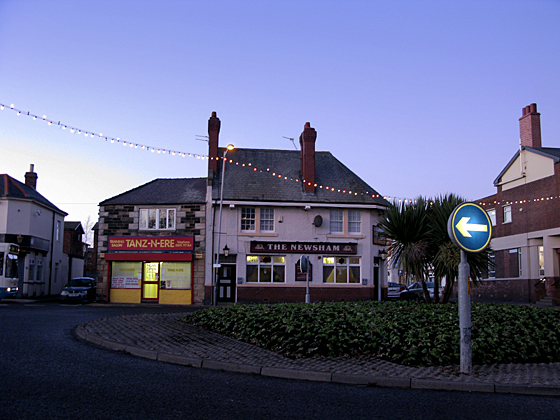
I drove past Ridley Park and along Wensleydale Terrace, past the site of the demolished Wellesley School which now stands deserted waiting for the economy to turn to make it worth building houses there. I reached the South Shore estate and glanced over at the sea. At the roundabout I went up South Newsham Road. It struck me that Blyth no longer has outskirts. It has a settlement boundary which marks the point where fields will turn into housing estates. The transition is sudden, in no way gradual. You can’t really say you’re coming into Blyth these days. You’re either in or you’re out. You’ve arrived or you haven’t. I turned on the CD player and listened to The Killers’ Sam’s Town album. I played it loudly. I crossed the railway at South Newsham and cruised up the Laverock and on to the Spine Road.
I parked in the public car park at the bottom of the street. As I was walking up to the office I met Owen Vardy coming down the hill. He was wearing a loose wrinkly oatmeal-coloured linen jacket – it was at least a size too big for him – and pale baggy Chinos. He had a stripey brown and pink scarf wrapped around his neck, Dr Who style. He was leaning into every step, each of which appeared cautious and measured. Owen walks like a man on a treadmill, a treadmill he thinks might at any moment either stop completely or speed up dramatically. He was carrying an Asda ‘Bag for Life’.
‘Hi, Owen,’ I said. ‘Have you been shopping?’
‘No,’ he said. ‘Well, not really. I’ve been to a meeting about the Collingwood children. I carry my files in this bag. It’s the perfect size, you see. Actually, between you and I, I did take a quick toddle over to the high street to pick up a few vitamins.’
‘Oh, so what vitamins do you take?’
‘Oh, you know – zinc, vitamin C, B complex, vitamin A, vitamin D, vitamin E, selenium, folic acid, echinacea, evening primrose oil, flax oil, omega-3 and omega-6, saw palmetto, feverfew, calcium, magnesium, potassium, ginkgo biloba, ginseng, garlic, CoQ10 . . . you know, just the usual stuff.’
What, no Becherovka? I thought to myself.
‘So are you ever ill, Owen?’ I asked.
‘Oh yes, of course. I’m just the same as everyone else, you know, I catch colds and what have you. But there’s no point in taking unnecessary chances, is there? Oh, by the way, did you hear the latest about Jack?’
‘No,’ I said. ‘I don’t think so. Don’t tell me he’s been dressing up again?’
‘No, no. He’s got rid of his Skoda and bought a motorbike. A big shiny black one. I think it might be a Kawasaki. It’s a very dangerous machine, a very dangerous machine. I think he’s being very foolish, actually.’
‘It’s his life, Owen,’ I said. ‘Or death, as the case might be.’
‘Exactly. Do you know he’s the same age as me? In fact we were born on exactly the same day. You’d never catch me on a motor bike.’
‘I don’t think I’d bother trying,’ I said. ‘I wouldn’t stand a chance.’
For a moment Owen missed the joke. He looked at me quizzically, his head slightly to one side, a half smile frozen on his face. What was he listening for, I wondered. Then he got it.
‘Ho ho,’ he laughed. ‘Very good. Yes, very good.’ And then he slid straight back into parson-like caution and prudence. He put his fingertips on my sleeve. He leaned in close to me.
‘And you’ll not have heard what he said to Tallulah either, have you?’ he said. ‘He offered to buy her a full set of leathers – a red leather bodysuit. He offered to take her out on his pillion.’
I laughed. ‘Oh my God, he’s shameless, isn’t he?’ I said.
‘Exactly,’ Owen said. ‘He is shameless, and lacking in any sort of dignity too, I think.’ Just for a moment I fancied I caught the elusive vinegary whiff of piety and prurience.
‘Any how,’ he said, looking at his watch, ‘I really must be getting along now or I’ll miss my bus.’
Owen always travels by bus, for road safety and environmental reasons, he says, although given how much he must spend on vitamins I wonder if he could afford a car in any case. As we parted I was thinking I must read George Herbert again.
When I went into the office Mandy Potts was in reception with Apple and Sparky. She looked like she’d been crying.
‘Hi, Mandy,’ I said. ‘Are you all right?’
She shook her head slowly. She wasn’t. When I went through to the team room I asked Angie what Mandy wanted.
‘She wants to go to a refuge.’
‘Again?’ I said. ‘Why? Surely Mr Zee hasn’t turned nasty?’
‘No,’ Angie said. ‘Anything but. No, it’s not that. Elephant Carmichael called to see her last night. He gave her a message. He told the Arab said not to forget that what’s his is his forever. He told her the Arab said to say hello. When they got up this morning there were four piles of sand on the step. She said they looked like four little graves. ‘
.
prague, the skylark, the mephisto express
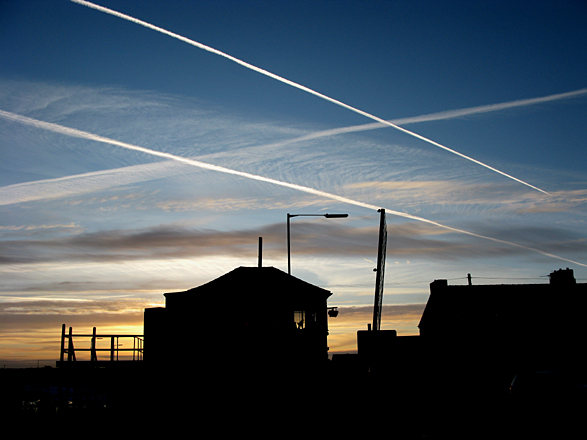
We had more snow last week, again on Thursday. For a while it looked like it would never stop. ‘So this is how the world ends,’ I thought to myself. Most members of my team went home early. There were rumours that the Spine Road might be closed so at about half four I set off for home. It turned out that the snow was already turning to sleet and rain by then. The wild apocalyptic blizzard was a false alarm. Nevertheless it was a slushy slither back down the Laverock and along Newcastle Road into Newsham.
The snow almost interfered with Tristan and Brenda’s Valentine trip to Prague. Once or twice on Thursday the airport at Ponteland was closed for a while. But the snow is the least of their problems, it seems. Tristan had discovered earlier in the week that Brenda has become friendly with a man she’s been life-coaching. The man’s problems revolve around his marriage, it seems, and making decisions about how he is going to spend the rest of his life. He owns and runs an executive coach company called Mephisto Travel and he has a big house in Tynemouth, it seems. He’s made his fortune and he’s looking forward to taking it easy and seeing the world. What he doesn’t now know is who he wants to be with him on his travels. The man’s name is Elvis Devlin.
‘Elvis Devlin?’ I said to Margaret when she told me the tale.
‘Yes,’ she replied. ‘That’s right. Do you know him?’
‘Do I know Elvis Devlin?’ I said. ‘Do I know Elvis?’
‘Yes, Elvis. Do you have a problem with that? It’s no sillier than your name, is it?’
‘You’re right. I just hope he’s not an impostor,’ I said. ‘I just hope he’s not a Devlin disguise.’
Margaret groaned and got on with cutting up the onions.
It seems that on a couple of occasions Brenda has been seen having coffee with Elvis Devlin at the Milkhope Centre near Blagdon. This is far enough from Whitley Bay to suggest that these encounters did not happen by chance, although that apparently is exactly how Brenda claims they did happen. (But in any case doesn’t everything happen for a reason, Brenda? I heard myself thinking.) Tristan’s suspicion is that Elvis might be singing Viva Las Vegas in her ear. So Prague nearly didn’t happen. Margaret says it’s a make or break weekend for them. She’s convinced that Tristan’s fears are unnecessary, but you know what the song says about suspicious minds.
On Friday morning the roads were okay and most people made it in. At about lunchtime I went downstairs to make myself a coffee. Lily was checking out the weather on the Met Office website. Michelle was having a sandwich and doing her sudoku book.
‘We’ve got another one,’ Lily said. ‘I’ve got another mother who’s got a spirit in her house. She says it knocks thing off the windowsills at nights and taps on the window.’
‘Has she got a cat?’ Michelle chipped in. Lily laughed.
‘No,’ she replied. ‘She hasn’t even got a broom. The place is mingin’!’
I stood in the kitchen with my hands in my pockets, gazing at the filing cabinets and waiting for the kettle to boil. I filled my cup and wandered back out into the team room. Angie came in and Lily asked her how the roads were. I sat down in Debs’ chair and put my feet on her desk.
‘You don’t believe in ghosts, do you, Lily?’ I said.
‘Nah!’ she said. ‘It probably is the cat. Actually it probably isn’t. She’s probably just nuts.’
‘Oh, I believe in ghosts,’ Angie said. ‘We used to have one on the house we had in Forest Hall.’
‘So do you think Lily should call in an exorcist for her client?’
‘Yes, why not?’
‘Probably for the same reason we don’t make assessments from star signs,’ I said. ‘And because it’d get me the bloody sack.’
‘What sign are you, Lil?’ Angie said. ‘Let me guess. Okay, okay, I’ve got it. You’re a Virgo. Am I right?’
‘No,’ Lily said. ‘I’m an Aries.’
‘Oh, yes, of course. How didn’t I see that? How stupid am I?’
‘I’m an Aries too,’ I said.
‘You’re not!’ Lily said. ‘You could never be an Aries.’
‘I am,’ I said. ‘Honestly.’
‘I don’t believe you,’ Lily said. ‘You couldn’t be.’
On Friday night I began a new painting of Seaton Sluice. I’ve painted it before. I’m ambivalent about doing it because it is making a concession to the conventionally picturesque, something I’m trying to get away from. I decided on a low horizon. I was doing a view from the bridge of Rocky Island and the Kings Head pub. I used the canvas I’d underpainted in vermillion a week or two ago. I painted the sky quickly with a big flat brush. Square chunks of white and yellow ochre clouds careering wildly around in a Prussian blue sky.
On Saturday I rode along to my dad’s on the bike. It wasn’t a bad afternoon and the paths were mostly completely clear of snow.
During the week my dad had been to the library. As I was drinking a glass of pineapple juice he gave me a photocopy he’d made of an article from The Blyth News at the end of May 1936. The article reported the death at age eighty one of Harry Clough, the father of Tom Clough, the Newsham Nightingale. “FAMOUS PIPER DEAD”, was the headline, with the by-line “Newsham Man Who Played Before Royalty”. He is said to have died at his home in Plessey Road, of which Brick Row must have been considered a part.
The article said that in 1905 Harry Clough had played for King Edward VII at Alnwick Castle. Until a few weeks before his death Harry had acted as a caller at Cowpen Coal Company, the article said. Here’s a typical paragraph from the article, which is really a eulogy:
His music like his character delighted his audience. In both cottage and palace he enchanted with the folk music of Northumberland. His nature was kind and genial without ostentation. Unassuming and without any love of fame, his art was always at the disposal of charity.
As I recall Harry was buried at Blyth Cemetary, back down on the beach road. I’d ridden past it on the way along. I wondered if I should stop off on my way back and see if I could find his grave. But no doubt I’d have no more luck looking for the grave of the Nightingale’s father than I had looking for the grave of his son.
I asked my dad which route the old road out of Newsham followed. The book on the Cloughs had said it was very rough.
‘It followed the route of Newcastle Road along to where the little roundabout is now, and it turned right there and went up towards the Laverock,’ he said. ‘Of course in those days the houses on the right weren’t there. The store field was there, where they used to turn out the ponies from the pit in summer.’
‘So was it a rough road?’ I asked.
‘It was wet. When it got over the old railway line to the relief pit it took a big sweeping bend around before going up the Laverock. It was often flooded there.’
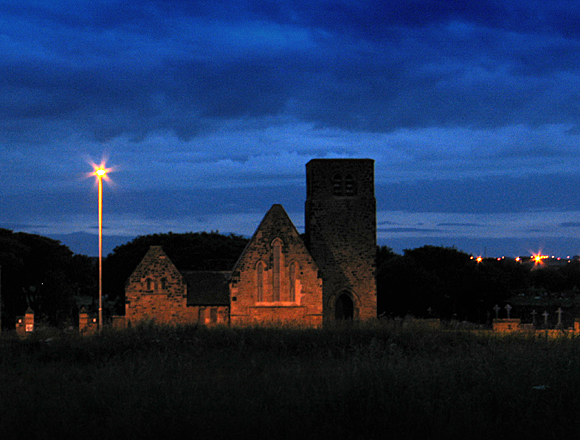
Laverock is an old word for a skylark. Most people assume this is how the farm on the ridge got its name and that the road got its name from the farm. I’ve never seen any real evidence for this. My alternative theory is that the place name may have nothing to do with the skylark at all. In Cumbria there’s a place called Laversdale. The first element of this is from the Old English personal name Leofhere. I wonder if this name or something similar isn’t the first element in Laverock and that the second is rigg, meaning ridge. There are ridge and furrows in the field beside Laverock Hall Farm and these will date back to the medieval period at least. The farm is also on a ridge, the ridge along which the road from Seaton Delaval to Horton runs. So the history and topography are arguably there to support the possibility that this might be Leofhere’s Ridge. Furthermore, local people usually talk about going up or coming down the Laverock, as if the land form itself is the thing they are climbing or descending. They do not say they are going up to the Laverock. The word is also said with a final vowel that is very close to the i sound in rigg, although admittedly inevitably somewhat neutral. There are other examples around here of false etymologies arrived at and imposed by mapmakers, and this may be another. Rigg and rick are close enough together to allow an obvious aural mistake to be made. It was perhaps this mistake that threw an imaginary skylark into the sky above the ancient ridge.
As I rode home I glanced over to the cemetery, but rode straight by. It was getting late and the light was beginning to fail.
At about eight o’clock tonight I went out for a walk. It was a mild dry evening and there wasn’t much wind. I walked along Sixth Avenue past the front gate to the site of the Citadel. The gates were closed and the security lights were shining eerily on the colossal towering structure. It really is a hellish, oppressive monstrosity, the wrong building in the wrong place. No wonder it reminds me of Kafka’s Castle. I walked through the cut and on to Newsham Road. I walked up into Newsham and down past the first school. From there I crossed Winship Street into Elliot Street. They are already building on the site of the demolished Big Club. As I walked across I was thinking how these sites aren’t like widows: they don’t have to wait for a respectable period before they allow another building to occupy them. I had thought that apartments would be built here and I was therefore a bit surprised that building had started so soon, given the current depression in the housing market. I noticed a sign on the fence. It said “Considerate Construction”. You’ve got to laugh, haven’t you? I went over for a closer look and discovered that the new building appears to be going to be a new library. I was pleasantly surprised and for a moment impressed.
I went down Elliot Street past the take-aways and the betting shop, which was still open for business. An old guy in a flat cap was leaning in the doorway telling the woman inside a story about a bet he’d made. I crossed over to the Willow Tree, which was also open, although there weren’t many in. It seems to be under new management. I noticed there were flyers on the windows for a group called The Buskers, who it seems are playing there on Friday this week. I glanced over to the Brick Row open space. I wondered what sort of music they’d be playing. I wondered if the Cloughs would all be tapping their ghostly pipers’ feet. I walked back down Plessey Road, past the old Grammar school and on under the trees beside the bus stop.
When I got home Margaret was in. She was polishing the old Napoleon from her bedroom. It wasn’t ticking.
‘How did Brenda’s trip to Prague go?’ I asked.
‘I’ve no idea,’ she said. ‘I haven’t heard from her.’
‘But she is back, isn’t she?’ I asked.
‘Oh yes, they came back yesterday, I think.’
Or maybe she didn’t, I thought to myself. Maybe she’s already riding the Mephisto Express to Vegas.
I put the kettle on and went looking for De Kooning. I wanted to put him out in the garden for a while before I did a bit more on my painting of the Sluice.
.
a fish called bwenda
On one of the days between Christmas and New Year Margaret sent me over the Brenda’s to deliver a box of sale slippers. Tristan came to the door.
‘Oh hello, mate,’ he said. ‘Mewwy Chwistmas. Are you coming in?’
‘Merry Christmas, Tristan,’ I replied. ‘Yeah, I’ve just got to deliver this box for Brenda. Is she around?’
‘She’s in with a client at the minute, but should be fwee soon.’
‘What’s she doing, a bit of post-Christmas life coaching for one of Santa’s little elves?’
‘Not quite,’ Tristan laughed. ‘But it’s not far off. She’s got Mrs Bywo in with her. This lady is about as tall as a painted teapot and dwesses like a demented wagamuffin. Bwenda knows her from her poetwy group. I tell you she has twied just about evewy thewapy Bwenda knows, for evewything fwom colour blindness to celebwityphilia. She’s come in today for some urgent acupuncture because of stwange tingles in her feet, which she thinks she got from being too close to a starfish while she was talking to the mermaids on the wocks at Cullercoats on Chwistmas Eve.’
‘I didn’t know acupuncture worked for that,’ I said.
‘Imaginawy tweatments often work well for imaginawy complaints,’ Tristan replied.
‘Hmm, good point,’ I said. ‘Any way, how are you? Did you have a good Christmas? Was Santa good to you?’
Tristan grimaced and shrugged, in the way that Trostskyists do. ‘It could have been better,’ he said.
‘Don’t tell me Santa didn’t come,’ I said.
‘Oh, I did okay that way,’ he said. ‘The usual chocolates and aftershave and what have you, and Bwenda got me an electwic scwewdwiver, which will come in vewy handy if business ever picks up again. Oh, and thanks for the socks, by the way, which I thought were weally wadical for me. No, the pwoblem is that I’ve been a bit in the doghouse with Bwenda since she opened her pwesents fwom me.’
‘Oh bloody hell, mate,’ I said. ‘You didn’t cut corners, did you?’
‘No, I shelled out an arm and a leg. But it seems I got the wong bwands for her. You know, Bwenda, she’s got expensive taste, and I thought the stuff I got her was wight up her stweet. I got her a Louis Vuitton handbag, a Cartier watch and a Burbewwy twench coat. When she unwapped them I thought she’d be cockahoop, but she wasn’t. She looked a bit down in the mouth. “Are they fakes?” she says to me. “Fakes?!” says I. “Of course they’re not fakes. You’ve no idea what that little lot cost me.” “Are you sure?” she says, looking at me thwough her hair as if I might be pulling a fast one here. “Absolutely sure,” I says. “Do you want to see the weceipts?” Eventually she came awound to accepting that they were all the weal thing, but she still wasn’t happy – because, she says, evewyone knows you can easily get fakes of these bwands. “Even Chavs wear them,” she says. “Yes,” I says, “but yours aren’t fakes, are they? Not like theirs.” “Yes, but how will anyone know that?” she says. “They don’t look any diffewent.” I tell you mate at that point I was wishing I had bought bloody knock-offs and saved myself a lot of money. “So what do you want me to do, Bwenda?” I says. “Pin a These Are Not Fakes label on them to tell the world they’re weal?!”‘
‘It’s a strange world we live in, isn’t it?’ I said. ‘Someone wearing a fake imagines the world thinks it’s the real thing, and someone wearing the real thing imagines the world thinks it’s a fake! Maybe we should all go back to going around naked, eh?”
‘Anyhow,’ Tristan went on, ‘she eventually came awound, but not before I said I’d make it up to her by taking her for a short bweak in Pwague for Valentine’s Day. Not that I can afford it, of course. Work’s all but dwied up. You can’t get moved for bloody plumbers now that house building’s stopped.’
At that point I heard the door of Brenda’s consulting room open. Mrs Byro came out and shuffled down the hall to the front door. I could see what Tristan meant. At first glance Mrs Byro appears to be to haute couture what Hugo is to horticultural design and you’d assume that her wardrobe must be a junkyard, a random accretion of disparate garments. She is no bigger than a hobbit and has long hippy dippy hair of a curiously neutral colour. She struck me as the kind of woman you’d imagine must always choose her outfit for the day before she puts the light on. She has that sort of ostensibly accidental charity shop eclecticism that you never actually see among the poor (who are for the most part running around in fake Levi’s carrying fake Louis Vuitton handbags, of course). But I suspect it would be a mistake to think that the Mrs Byros and the Brendas of this world are at opposite ends of the spectrum in terms of their wardrobe strategies. They are in fact sisters.
‘Hi, Brenda,’ I said. ‘Merry Christmas.’
‘And a very merry Christmas to you too,’ she replied, giving me a big hug and a kiss on each cheek. ‘Did Tristan tell you about Prague? Oh, I’m so excited!’
‘Yes, he did,’ I said. ‘It sounds fab. Hey, and thanks for the Christmas present. It’s really interesting and, er, you know, unusual.’
‘Yes, I thought you might like it,’ she said. ‘I thought it would look good on your desk at work.’
‘Hey, I’d never thought of that. Yeah, I see what you mean, though. It’d be really good to be able to just turn it on whenever things become a bit too stressful. I must remember to get some batteries for it on my way home.’
I gave Brenda the box of sale slippers and drove back up the coast, listening to Lucinda William’s latest album. She’s made better, but it’s good. It hardly matters what she sings though, her blistered paint and rusty broken nails voice says it all.
When I got back Margaret was peeling some carrots. I asked her what Brenda had got her for Christmas. ‘Did she get you a fountain too,’ I asked.
‘No,’ Margaret replied. ‘She got me a Strength Rune silver necklace, a collection of Nam Champa soaps, a Green Man candle holder and some candles. Oh, and a black beret. It’s all very good quality stuff, of course.’
‘Yes, it all sounds very Brenda to me,’ I said. ‘But it doesn’t sound especially you. When did you last wear a beret?’
Margaret continued peeling carrots. She said nothing. I picked up The Guardian and wandered through to the conservatory. De Kooning joined me.
‘If you had a friend who was a goldfish,’ I said, ‘and she had bought you a Christmas present, what would you have liked her to have got you?’
De Kooning looked up at me for a moment. He licked his paw and began to clean his face.
‘Okay’ I said, ‘if the choice was between a wrecked pirate ship aquarium ornament and a catnip-filled fluffy toy mouse, which one would you go for?’
De Kooning stopped cleaning himself for a moment and looked at me as if I was daft.
‘Okay, okay, it’s a no-brainer, you’re right. Unless the goldfish was called Brenda. If Brenda was your goldfish friend you would have got the pirate ship.’
Sunday was bright and frosty. I drove up to Lordenshaw. I walked over to Spylaw and from there contoured across the moors around the southern slopes of Simonside before climbing up to the crag on the path that passes Croppy’s Hole. There was a fair amount of ice here and there and the peat on top was frozen rock solid. But it was dry and sunny and it was easy walking over the top on the newly laid stone slabs. To the north there was snow on Cheviot and Hedgehope Hill, shining like a bride in the winter sun. It was a beautiful day. It was 2009. As I walked east off Dove Crag I began to think about Basil Bunting.
When I got home Hugo was on his drive. He was working on the Alligator with what appeared to be an angle grinder. He gave me a wave as I went up my path. I went out into the back garden and looked over the fence into Hugo’s garden, which I hadn’t seen for a while. It was much the same as before, except that there was a straggle of silvery tinsel on the moose’s antlers. The waterfall was turned off and the pond was frozen. The ducks and the otter were in there usual places. The grey heron gazed at the ice and never blinked, not even once. It was late afternoon. The last rays of the sun were glinting on the still naked girders of the Citadel.
.
tallulah and the good catastrophe
It looks like Debs will be off sick for a few months. Earlier this week I held an emergency meeting with the whole team to talk about redistributing her cases.
‘How do you want to do this?’ I said. ‘Do you want me to decide who gets what or should I just throw all the names into a hat and let you take turns picking one? Or do you want to discuss them one by one and see who’s interested?’
They decided that I should decide. I divided the couple of dozen most serious cases on Debs’ caseload between the five workers left standing. Angie copped for Mandy Potts, who as it happened turned up just as the meeting ended. She had Apple and Sparky with her. Mr Zee wasn’t with her. Mandy was upset.
‘Seems like a good time to introduce yourself,’ I said to Angie.
‘Oh, isn’t her weird boyfriend with her?’ Angie said. ‘I was looking forward to meeting him. I like young men in uniforms.’
‘A Zorro outfit’s hardly a uniform, Ange,’ Lily said.
‘Isn’t it?’ Angie pulled her pondering face, and wandered off to meet Mandy and the kids.
‘What’s up?’ Lily asked, when Angie came back along.
‘They’re going to make Mr Zee get a job. The dole’s on his back. Mandy doesn’t want him to because she’s scared that if she’s on her own Flinty will come to her door.’
‘She has a point,’ Lily said. ‘But it’s not a point the dole will take.’
‘No, they won’t,’ Angie said. ‘He’s down there now and he thinks they’re going to send him for an interview.’
‘He should go,’ Lily said. ‘No-one’s going to give a job to a man dressed as Zorro, are they?’
‘Well, that’s the other thing,’ Angie said. ‘Mr Zee isn’t prepared to not dress the way he does. He thinks he has a human right to do so, like Christians wearing crucifixes and Muslims wearing the veil.’
‘Another good point,’ Lily said. ‘But again, not one the dole will buy.’
‘No, they won’t,’ Angie said. ‘They’ve suggested he may need to take work at MacDonald’s.’
‘Oh my God,’ Michelle said. ‘Can you image that, Zorro appearing in the drive-thru window! Imagine asking Zorro for a couple of Happy Meals and a regular Coke!’
‘It could bring them business!’ Lily said, chuckling to herself as she tried to get on with inputting stuff on to the computer. ‘It’s a shame MacDonald’s aren’t likely to think the same.’
‘Mandy thinks that Mr Zee will leave her and return to Newcastle if they force him to take a job where he can’t continue to dress the way he does.’
‘That surprises me,’ Lily said. ‘I always had the impression from Debs that he’s really committed to Mandy and the kids. Things will fall apart if he does leave, that’s a certainty. Mandy will never cope without him.’
‘Bloody men!’ Angie said. ‘Is there a single one out there that isn’t a complete waste of space?!’
It snowed on Thursday. I sat in the team room for a while first thing going through the post and listening to the team talking about the BBC documentary on the Shannon Matthews case which had been on the previous night. Fairy tale explanations are the bedrock of the world according to the popular media, and on this occasion the police seem especially ready to give the story the right slant by stating that this girl’s mother was ‘pure evil’. Here we have The Cruel Mother. ‘I thought that police officer was about the tell us the story of Hansel and Gretel or something,’ I heard Angie say. The police are hardly more self-aware or enlightening as social narrators than The Sun or The Daily Mail. It is within the terms of the crude and narrow narratives the popular media constructs that the identities and aspirations of their audience will to a significant extent arise. Karen Matthews, who no doubt is a person who came to see herself in the terms of those narratives, was and is stupid, dysfunctional, misguided, and inadequate. But this description could equally as well be applied to the police themselves who had four hundred officers in the area for almost a month and failed to find a child who all the time was under their very noses. The same could also be said for the troops of journalists who traipsed around the area 24 hours a day for the same period. And now they’re blaming social workers for not seeing this coming two years earlier. Lily wondered when we would get our crystal balls.
‘It’s a pity Shannon didn’t think of dropping pieces of bread as a trail to her wicked uncle’s house, isn’t it?’ Angie said. ‘That’s always the thing to look for in a case like this.’
I went upstairs. About mid morning I was sitting up in my office looking out over the car park watching the white stuff falling hypnotically, like a weird quiet currency being repaid to the world. Nature has a fascinating economy. A pale blue Favorit slithered into the car park. It was Jack Verdi. He got out and pulled the collar of his black reefer jacket up around his face. He was wearing his Ray-Bans. His long grey hair was tied back in a pony tail by what looked like a red elastic band. In his pale desert boots he gingerly made his way across the snow into the office. He brought to mind something vaguely Russian, maybe someone from a Gogol story. He’d come for a meeting with Debs and forgotten she was off. He asked if I was free and came upstairs for a chat.
‘Hi, Jack,’ I said when he came into my room. ‘How’s tricks?’ He shook my hand. As he leant forward to do so I briefly caught sight of his pale blue eyes peering out over his sunglasses.
‘Hey, I’m not so bad, mate. Bloody awful weather though.’
I looked out of the window and nodded.
‘Actually I like the snow,’ I said.
‘Aye,’ Jack said, ‘to look at, but not to drive in!’
I made him a cup of tea and for a while we talked about music, as we always do. He always asks me who I’m listening to as a preamble to him telling me what I might want to try instead. On this occasion I swapped him Teddy Thompson and Josh Ritter for a classic album from Jefferson Airplane and Neil Young’s Live at Canterbury House 1968, Sugar Mountain album.
‘Hey, that was quite a performance you gave at Rosie’s leaving do,’ I said, finally mentioning the elephant in the room. ‘Man, you certainly blew them away that night!’
Jack shook his head and looked down into his lap. ‘Yeah, well, maybe. I just wish I’d stuck to bloody well playing the piano, as I was supposed to do.’
‘Yeah, me too,’ I said. ‘Banging out Chas and Dave numbers in a room so thick with the reek of HRT isn’t exactly my bag either.’
He laughed. But he had something more on his mind, and I thought I knew what it was.
‘Hey, Jack,’ I said, ‘I’d just let it go if I were you. Most people will already have forgotten about it, you know how they are. You’re the only person who’s thinking about now.’
‘Oh yeah, yeah, I know that,’ he said. ‘No, it’s not that, it’s what it’s telling me about me that bothers me. I’m becoming desperate. I can’t seem to let myself ever be anything but young. You know why I did that? Because I’m scared to death of getting old. I’ve seen this happen to other guys, guys who I was once in bands with. I’m starting to do what they’ve done and make a bloody fool of myself.’
‘Well, as they say, if you recognise a problem you’re half way there to solving it.’
‘Yeah, but how do you solve the problems of decrepitude and death?’
I laughed. I wanted this conversation to remain light. ‘Euthanasia’s good,’ I said. ‘I’ve already booked myself a one-way ticket to Switzerland.’
‘I don’t want to go,’ Jack said, shaking his head.
‘You don’t want to go to Switzerland, Jack? Compact land-locked mid European country? Bankers, watchmakers, Toblerone, Heidi, St Moritz, lots of big snowy mountains? It’s the sort of place where there’s never any litter and they don’t ever have to think about Asbo’s. Switzerland’s not such a bad place, Jack.’
‘I don’t mean I don’t want to go to Switzerland, man. No, I mean I don’t want a die. At least not yet. I’ve still got some good times left in me. The problem really is that the rest of the world is starting to disregard me. It’s as if as you get older there’s a quiet conspiracy to exclude you from things. It starts when you’re about thirty. The world begins to tell you that you can’t do that. And do you know why it says that? It says it because it embarrasses them if you do. They just don’t want you around. They discard you, like you’re an old-fashioned appliance of some sort. I don’t buy it, mate. There’s some stuff I’m just not ready to say goodbye to.’
‘Like good old rock and roll, eh?’
‘Well, yeah, but not just that.’ His Aviators looked straight at me and for a moment or two he paused. ‘You read poetry, right?’ he said.
I said I did sometimes, yes.
‘You know I’m into Keats, don’t you? Yeah? Okay, can I show you something? It’s like a modern take on something he wrote. I’d be interested to know what your response to it is.’
He bent over and unbuckled his brown leather satchel bag. He took out a couple of sheets of A4 and handed them to me
‘You’ll know the original,’ he said. ‘It’s La Belle Dame Sans Merci.’
I.
O what’s bothering you now, my bonny lad, Alone and palely loitering? Has thy assessment slithered into the sink?Are you waiting for the telephone to ring?
II. O what can ail thee, fostering man!
So flushed and so woe-begone?
The question from the Chair was crass,
The Police Checks were never done.
III. I see a cloud across thy face
Your reviews are all long over due,
And in thy diary a fading date
When your anxious manager last hounded you.
IV. I met a damsel in the tearoom,
Full beautiful-an Ashington child,
Her hair was red, her foot was light,
And her laughter was quite wild.
V. I bought a cosy for her napper
And sent her a text from my mobile phone;
She texted me back and asked me to sing
‘Will you give this little dog a bone.’
VI. I sat her in my Skoda’s front seat
And put Crosby, Stills and Nash on,
I whizzed her around the slippery bends
Till all her lingering doubts were gone.
VII. She bought me bags of morish sweets,
And Honey Tunes and herbal tea,
And then in an accent strange she said-
“Bonny lad, aa’ve got the hots for ye.”
VIII. She took me to her terraced grotto,
And swept the sawdust from her floor,
And I gazed into her wild wild eyes
Until my heart could take no more.
IX.
And with a tambourine she lulled me asleep,
And I dreamt I heard a terrible din
‘Twas the scariest dream I ever did dream,
I dreamt I was trapped inside her bin.
X.
I saw pale ploughmen, businessmen too, Old heartthrobs, death-pale as if without feelings; They cried-“The Bonny Lass Without Pity Has dumped us amang her peelings!”XI.
I saw their starved lips in the garbage With horrid warnings gaping wide, And I awoke and found me dumped, With another old scratter at my side.XII.
And this is why I sojourn here, Alone and palely loitering, My assessments all soggy in the sink, And my mobile phone not ringing.
After I’d finished reading it I said nothing for maybe a minute or so. Nor did Jack.
‘Okay,’ I said. ‘This is, er, interesting.’
Jack looked at me. He wanted more than just, er, interesting.
‘Hey, Jack,’ I said. ‘What do you want me to say here? How I’d feel if I was the woman you wrote this for?’
‘It shows, then?’
‘Yeah, Jack, it shows. It’s about Tallulah, right?’
He nodded slowly.
‘So,’ I said, tentatively, ‘have you and her got a thing going on, or what?’
‘No,’ he said. ‘That’s just tittle tattle. Emma Pope started that rumour as a put down to me.’
‘But you would like to have something going on with her, yeah?’
He nodded, safe behind his sunglasses. ‘Yeah.’
‘And? . . .And? . . . And what? You think she’s too young for you?’
‘No,’ he said. ‘Not at all. What bothers me is that she’ll think I’m too old for her.’
‘She’s not a kid, Jack. She must be well into her thirties now. What are you saying, that she’s shallow?’
‘No, she’s definitely not shallow,’ Jack said, almost indignantly. ‘She’s a woman with deceptive subtlety and depth. She’s like a great river and her complexion is forever changing as she makes her course through her days. Sometimes she’s wild and tempestuous, sometimes she trickles and gurgles, but sometimes she’s quiet and still and just so damned profound. No, she’s not shallow, man, but I’ve got twenty years on her, and she knows it.’
I nodded. I almost smiled. I looked at the poem again.
‘This dustbin metaphor,’ I said. ‘That’s serious, right, a deep concern hidden behind a daft joke?’
‘Yeah,’ he said. ‘Exactly. What bothers me is that even if I got something off the ground with Tallulah she’d pretty soon dump me for a younger model. She has a bit of a reputation for chewing guys up and spitting them out.’
‘And the bin, that’s the bin of decrepitude, yeah? It’s a bin you fear that once she dumps you in you’ll be in for the rest of your days?’
‘It’s more than that,’ Jack said. ‘It’s a bin I fear I’m already in. Not because I want to be there or because I’m really need to be. It’s just the bin the rest of the world has put me in. It ‘s like that Yeats line, isn’t it, the one about old age being tied to you like a tin can to a dog’s tail. It stinks, man!’
‘And the bonny lass without pity, that’s not just Tallulah, is it? She’s society too, isn’t she, and young mistress Time herself. This bonny lass is The Reaper.’ A picture of Tallulah Hudspith wielding a giant scythe crossed my mind. It was an image from a Tarot card.
‘Yeah, something like that, I guess,’ Jack said.
‘You know what I’d do if I were you, Jack? I’d go for it. What’s the worst that can happen – you don’t get the gig. Or if you do you don’t get booked for a second night. But hey, Jack, for you this might just be the gig to end all gigs. One night with Tallulah might be your Madison Square Garden moment, the one gig you’ll never forget!’
Jack stood up. He very deliberately buttoned up his black reefer jacket. He smiled quietly and flicked his pony tail back over his collar. It was indeed a red elastic band holding it together.
‘Carpe diem, eh, man? I kinda knew that would be your take on it. Thanks, man. It helped.’
Jack picked up his brown satchel and slung it over his shoulder. ‘Hey, and one more thing, eh? This conversation we’ve had, strictly between me and you, right?’
‘Yeah, of course, Jack,’ I said. ‘Between me, you and the gatepost.’
He smiled and shook my hand again. I walked along the landing with him. As he was making his way down the stairs he turned and asked me if I knew Warren Zevon’s stuff.
‘Yeah,’ I said. ‘He’s good.’
‘He wrote a song called I’ll Sleep When I’m Dead,’ Jack said. ‘Give it a listen some time.’
‘I will’ I said. ‘But isn’t poor old Warren now fast asleep himself?’
‘He is, man. But what a way to hit the mattress, eh?!’
I laughed. Jack left. The snow had turned to rain.
When I got home I had a quick pizza and then put my boots on to go for a walk. It was turning cold and the slushy snow was beginning to freeze into crusty waves. I walked along Broadway and then on as far as the Thoroton Hotel. I went up Marlow Street and cut through past the sports centre and over on to Newsham Road. I walked up into Newsham and down Winship Street past the site of the Big Club, which is still fenced off but now completely razed. At the roundabout I stood for a moment or two and looked at the strings of Christmas lights slung above the road. I then made my way back down Plessey Road. In the last few days a lot more Christmas lights have appeared on houses and a lot more Christmas trees in their windows, but Christmas still seems slightly reluctant to appear this year, even though the Angel Alistair and the Good St Gordon from every television in the land sing, ‘Spend, Spend, Spend!’
‘Spend what?!’ the world sings back.
When I got back home Brenda was there again, gathering more slippers into boxes to take away for dispatch.
‘Hi, Brenda,’ I said. ‘How’s business?’
‘Brisk!’ she replied. ‘Surprisingly so. Things have really picked up in the past few days.’
‘Well, you can never go far wrong with slippers at Christmas, can you?’
‘Yes, I think you’re right. Folks may not have much money this year, but everyone can afford a good old fashioned pair of slippers, can’t they?’
Brenda didn’t have her Auguries of Innocence cardie on that day. She had a sort of long very expensive looking camel-coloured wrap around coat. She was also wearing green knee high leather boots with big shiny silver buckles on them, and out of the collar of her coat the leafy frills of a spring green blouse of some sort erupted. She also wore a coffee-coloured knitted hat of some kind, a one with a peak and a small chocolate brown button on the crown, the sort of hat that reminds me vaguely of Barbra Streisand. For a moment it crossed my mind that Brenda looked rather like a tortilla wrap.
‘So what’s Tristan getting you for Christmas?’ I asked.
‘Oh I don’t know that!’ she replied. ‘That would take all the fun out of it. I like surprises.’
‘But there must be something you hope he gets you.’
‘Oh well, yes, of course. What I’m hoping for is a Matthew Williams Chapelle weave coat and some Jimmy Choo Erica ankle boots, as well as some lovely smellies and maybe some nice stocking fillers, such as earrings and brooches and choccies and things. Just lots of lovely lovely delicious surprises really. I’ve pointed Tristan in the direction of net-a-porter.com and I know for certain that he’s looked. I’m quite excited really. But what about you? What do you want for Christmas?’
I paused for a moment, as if taking thought. ‘The emancipation of the working class, I think,’ I said, very calmly and seriously. ‘Yes, that definitely. That and world peace.’
Brenda nodded her head approvingly. ‘That’s just such a beautiful wish,’ she said. ‘Yes, of course, you’re absolutely right. It is the spiritual aspect of Christmas that really matters, not all the shopping and materialism. And in any case it really is better to give than to receive. You know, I don’t really care what anyone gets me actually. Christmas is just such a special time of year. Just be close to someone you care about and to know they’re there, that’s all any of us really needs.’
So I’ll tell Tristan to just send you a note and prod you from time to time then, I thought. I know what great joy and cheer that will bring.
‘So what are you getting Tristan?’ I asked.
‘An electric screwdriver set.’ Brenda replied. ‘I saw one at B & Q. It was such a good buy and it will be all he’ll ever need. He’s always saying how much he wished he had one.’
‘That’s nice, Brenda,’ I said. ‘If you’ve got to spend then a practical gift is always the way to go, I think.’
Lucky Tristan, I thought. But of course I’m sure Brenda will get a huge amount of pleasure from giving Tristan his electric screwdriver set.
‘Oh, but what do presents matter?’ Brenda said. ‘Christmas really is first and foremost a spiritual time, a time to think of others. As you said, a time for peace and love. Material things are such a terrible distraction sometimes, aren’t they?’
For a moment I wanted to ask her what the word ‘spiritual’ meant. But I thought better of it. In any case I think I already know how spiritual Brenda is: she’s about as spiritual as a checkout till. She has exactly the sort of spirituality the Angel Alistair wishes we all had this year.
‘Do you know anything about the Tarot, Brenda?’ I said, changing the subject. It was like asking a seagull if it knew about fish heads.
‘Yes, of course,’ she replied, becoming animated. ‘Do you want me to do a reading for you?’
‘No, not really,’ I said. ‘But thank you for the offer. No, I was wondering about one of the cards and what it means.’
‘Which one?’ Brenda said, always ready to share her esoteric knowledge with the curious.
‘The one with the reaper on’ I said. ‘Is it called the Tallulah?’
‘The Tallulah?’ Brenda said, screwing up her face. ‘The Tallulah? The Tallulah’s not a Tarot card. No, no. No, the card you’re describing is the Death card.’
‘Oh,’ I said. ‘The Death card. So there’s not an expression which is like “turning the Tallulah” or something like that?’
‘No,’ Brenda said, a little sharply. ‘No, there isn’t. The reaper is on the Death card.’
‘And if that card turned up for you it would be bad news, right?’
‘No, not necessarily,’ Brenda said. ‘That’s a common misconception. The Death card does not necessarily signify death. But it does signify that major change will occur in your life. Catastrophic change, in fact, but not necessarily for the worse.’
So, I thought to myself, turning the Tallulah foretells catastrophe. But not necessarily a bad catastrophe. The idea of a good catastrophe appealed to me. This was an idea it would be good for Jack to know about.
‘So have you ever done a reading for anyone when the Death card has turned up?’
‘Oh, yes, of course,’ Brenda replied. ‘Many times.’
‘And are any of those people still alive?’ I asked.
‘Yes, so far as I know, they all are.’
‘But they will have all encountered a catastrophe by now, yes?’
Brenda had rumbled my game a while ago of course. She was prepared to play along no longer.
‘You should stop taking the mick,’ she said. ‘You know, many people have been helped to make important decisions in their lives through the Tarot. Just because you think it’s nonsense, doesn’t mean it is nonsense, you know.’
I nodded. She was right of course. I began to wonder about making a catastrophic decision, or rather, making a decision to have a catastrophe in your life. It seemed to me that since the future can’t really be foretold, this must be the way the Tarot works. The cards suggest that decisions of a certain kind should be made. It sets an agenda in someone’s mind. Decisions are then made according to the cards’ suggestions and hey presto – the cards appear to have done what cards never can and to have foretold the future. The classic self-fulfilling prophecy. Perhaps most divination works in exactly the same way. The effect is that you take active responsibility for your own future but that by some sleight of hand you can always say that whatever happens was bound to be, that it was written in the cards.
I wandered through to the conservatory. De Kooning was sitting on the windowsill, looking out into the dark where the snow had fallen among the gaping spaces of the Citadel. Sometimes I think I’m too passive about the future. It’s not something I get a hold of and try to make for myself. Maybe it’s that working class thing. Maybe it’s something else. I just seem to be happy to sit and watch the river flow by. I could dip my foot in, I know that. Maybe I fear a catastrophe if I do. Maybe I think I might turn the Tallulah if I get my feet wet.
I wondered if I should get a Tarot pack and do a reading for De Kooning. I know of course that this sort of stuff doesn’t work for cats. Cats sit on life’s windowsill and sing Que Sera Sera. They sing it nine times over.
.
a queer sort of petrified sphinx
I finally watched I’m Not There. Todd Haynes’ method was immediately clear to me. I was quite amused when the Richard Gere Dylan – a man who seemed to be looking for the part of an ordinary man in an extraordinary world – wandered into the town of Riddle on Halloween. Here we have the familiar conceit of the world as a riddle, perhaps in a modernist incarnation. Riddles have an answer, have a sense and a meaning even if they are elusive. Nietzsche’s ‘World Riddle’ came to mind, the Welträtsel, and Pope’s poem ‘The Riddle of the World’. The riddle is second cousin to the jigsaw and the scheme in cosmological terms. Dylan Gere is a clear contrast to Dylan Blanchett , the one who just a year or two earlier had looked out on the world as an apocalyptic junkyard.
While Dylan Gere is wandering pensively around this place of Riddle, the narrator says something like ‘nobody’s who they seem to be’. Ha ha, I thought. He should have been in Glasgow on that night!
I suppose that the question watching the film threw up for me was whether Dylan was just an ordinary man in an extraordinary world or whether he was an extraordinary man in an ordinary world. (For the sake of completeness the other possibilities are an ordinary man in an ordinary world or an extraordinary man in an extraordinary world). The modern world itself of course never settles long enough to be called ordinary, so we might say that extraordinariness is the normal condition of existence in a society like ours. Extraordinary is the ordinary condition of late modernity. And the sixties were an extraordinary time. America at war with itself, a tortured nation, a nation disintegrating. Assassinations, napalm, the space race, the arms race, the cold war, television, rock and roll, paranoia. These were apocalyptic times. But isn’t modernity in any case pretty much the normalisation of apocalypse?
The film presents the self as a fragmented, vulnerable and contested reality. If we accept this premise then perhaps we should recognise that as a person Dylan was both ordinary and extraordinary, and that this was perhaps key to his difficulties. And yet it is the idea that Dylan was arguably Everyman in the film that interests me most, the notion that in reality Dylan is much the same as you or I and that (increasingly?) our situations are becoming like his. Nowadays we all have to deal with shifting personae and shifting expectations. And with the lure of celebrity. We can no longer be satisfied with ordinary lives and in our world of greedy media an extraordinary life will make you famous; we are somehow fooled into thinking the corollary of this is that to be famous will make your life extraordinary and transform you into an extraordinary person. It won’t. But to be a celebrity is an almost normal goal now. The opportunities are many, from Big Brother to The Weakest Link. And yet how will being a celebrity even for a day change us? We will expect a transformation, a sudden coming into real being. And yet the opposite is likely to happen. The half-hearted realities of ordinariness will vanish from out hand; we will suddenly become no-one at all.
Of course Dylan’s burden as a celebrity was exceptional. But perhaps only different in scale, not in nature. We all want to ‘live the dream’. Haynes’ tale from this perspective is a cautionary one: the dream is only a dream and once you see that you will collapse into yourself. Anomie and dissociation will follow. You may want to refuse them. You will not be able to.
Haynes has his Dylans speak lines from various Dylan sources – sleeve notes, poems, Tarantula, interviews and so on. At one point one of them says a poem is a naked person. It’s interesting Dylan didn’t say self: a self and a person are not the same thing. A person is an outward reality, a social and political entity. The self is a supposed inner entity, a psychological item. People will say Dylan is a complex person. Did anyone ever suggest he had a complex self? The self is something we imagine we see when gaze into ourselves (ha ha – did you notice the tautology here?!) The self is like a soul. Like an essence. We imagine each self as having a unique simplicity. Can we imagine a person without a self? This seems almost like asking if we can imagine a person without a body.
Bob Dylan is a complex person and it is this complexity that Haynes film seems to want to unravel. And yet ironically I think the film falls into the trap of trying to show us Dylan’s soul, even though it takes its primary text from the song which says ‘I’m not there’. Maybe it needs to do this for dramatic reasons, since where would a western narrative be with a protagonist too elusive or transient for the audience to identify with? There is no narrative to chaos, and without a narrative there may be no space for a me. Maybe there is something to be said for the idea of the self as a centre of gravity for the narrative of a life. Maybe the self is a necessary fiction, the unavoidable consequence of giving chaos an order. I accept chaos, Dylan Blanchett says, but I don’t know if chaos accepts me.
In Haynes’ narrative we are presented with a succession of selves we are to suppose Dylan to have had. We like to imagine the self as an onion, and think perhaps some people have more layers than others. Dylan’s layers are peeled away, one after another. I think the film is structured so that the reflective persona of Dylan Gere perhaps represents Dylan’s curious soul, the simplicity that he finally is. Dylan Gere appears almost as if he’s the father of the others, the one from whom the seed of all the others came.
Maybe this is a stretch, but does it make sense? Was Dylan more than one person – one self – at any one time? Dylan’s selves were successive rather than simultaneous. One didn’t lie beneath the other; one lay next to the other, succeeded it. Each self was performed and the performances were repeated until they were succeeded by a different performance – a different self. Haynes is right to give these selves different names; the extent to which they can be said to be the same self is problematic. Dylan’s life is a succession of selves, none of which has any privileged or higher reality. His life, like all our lives, is a life caught between becoming and having been. The self is not there, only the performance that is what we are. Dylan Gere appears to perhaps be the real Dylan, the inner man, a meta-self, a self beyond performance. But even this is an illusion.
Dylan breathed in the chaos that is America and breathed out shapes that made sense, the shapes of a new America, brave new versions of traditional identities, hanging in the air, fragile and flickering, as vulnerable as ghosts in a hurricane, like projections on the screen of the nation. Dylan performed a succession of American selves. Or perhaps a succession of American personae. In the end Bob Dylan found he could not escape from Bob Dylan, because Bob Dylan was never really there at all. He sang America and America sang him. A song is anything that can walk alone, he said. A song falls short of selfhood. A song is not even a person, it seems. A song might be no more than a ghost.
The thing that I wonder about is whether Dylan in this film is Everyman. But the thing I remember about the film is the music, the way the songs seep from the scenes and haunt the images. The songs ambush you, taunt you, lure you into places you had forgotten about. The songs unsettle you and reassure you, sooth you and pierce you, empower you and terrify you. They do all these things at once. This is a film for Dylan freaks by a Dylan freak. In the end this is what the choice of songs says to me. These are legendary, hallowed songs, the songs from which the myth of Bob Dylan is woven.
I’m a bit worried about Tom Ridley. Tom is the admin manager for the area and works between three sites. I met him at the photocopier today. It’s a Xerox Workstation M35 model, a freestanding square box that’s about the size of chest freezer, or in animal terms, a small horse. Tom was talking quietly to it, promising it a ‘special treat’ if it was a ‘good boy’ and behaved itself for him.
‘Hi, Tom’ I said. ‘How you doing?’
‘Yes, fine,’ he replied. ‘Just trying to encourage Frodo to be a good boy for me.’
‘Frodo?’ I said. ‘The photocopier’s called Frodo?’
”Yes,’ Tom replied. ‘If he’s good all day I’ve promised him that I’ll take him out this afternoon.’
‘Out, eh? Anywhere special?’
‘The beach. He just loves the beach. Of course I’ve got to keep him on his lead in case he runs into the waves and gets washed out to sea. He’s still just a puppy really and very excitable.’
Tom leaned on Frodo’s stout ivory plastic frame as he spoke about him. I was wondering which end was which.
‘Of course the other thing about the beach,’ he went on, ‘ is that he gets to meet other photocopiers. That’s good for him because he needs to learn how to socialise with them and not to be aggressive or snappy.’
‘Yeah, that’s a good point,’ I said. I asked him if Frodo was almost finished his current job and could I perhaps copy a couple of reports.
‘Of course,’ Tom said. ‘You’re such a good boy, aren’t you? Now be nice for the man and copy his things carefully for him, do you hear?’
Tom patted his ivory friend affectionately on the shoulder, picked up his wad of documents and set off down the corridor towards his office.
About mid afternoon I went down to the photocopier to copy some documents. The photocopier was gone. I abandoned the idea and decided I’d go home early. I decided to drive down through Sleekburn and along through Cambois. I’d seen a television news item about E-on’s proposal to build a new coal fired power station there on the site of the old one and that local people were protesting about it. Quite understandably so too, because the government isn’t insisting that only so-called ‘clean’ coal fired power stations can be built. But did we really expect them to? Next thing you know the local MP’s will be telling us how this will be good for jobs, our own brave Socialist warrior foremost among them, no doubt.
It was dusk on the beach. As I drove south listening to Dengue Fever I saw a figure close to the shoreline making his way north. It was Tom. He was pulling along the Xerox M35 by a leash, like a man dragging a mule. Frodo seemed to me to be a rather more reluctant walker than Tom made him out to be. I was somehow reminded of Pozzo and Lucky in Waiting for Godot. For a moment I fancied I saw two small photocopiers run up to Frodo and sniff at him. Frodo set himself back on his haunches and his hackles went up. Tom is right, Frodo isn’t yet well socialised. I drove over the crossing and up through East Sleekburn, past the site of the old power station and Wilson Avenue. It was dark and there wasn’t a soul around. I wondered if I shouldn’t email Tom’s manager about his behaviour, but I decided it was really none of my business so long as he returned Frodo by morning and wiped the sand from his wheels before taking him back into the office. It’s certainly odd for a grown man to adopt a Xerox M35 as a pet and take him for walks on the beach, but it isn’t something which is very likely to harm children, at least not as long as Frodo is properly muzzled when they are around him.
When I got home that night Brenda was there. She had come to collect some more slippers to send out. She was wearing a knitted garment of many colours, a long wrap-around cardigan of sorts. It had multi-coloured words of some sort embroidered all over it.
‘Hi, Brenda,’ I said. ‘Nice cardie.’
‘Thank you, kind sir,’ she said. ‘It’s handmade. We bought it from a textile artist in Hawick a couple of weeks ago. It’s beautiful, isn’t it?’
‘It’s a doozy,’ I said. ‘What do the words say?’
‘You mean to say you don’t recognise them?!’ she said. She turned around to let me read her back. Entangled in meandering lines were phrases I struggled at first to recognise and disentangle. And then one of them became clear to me: a robin redbreast in a cage puts all heaven in a rage.
‘The Auguries of Innocence?’ I said. ‘Your cardie’s got lines from Blake embroidered all over it?’
‘Yes,’ Brenda said, swinging back around. ‘Isn’t it fab?! Tristan bought it for me on a day out. I just had to have it. I’m going to wear it when I go to my next poetry weekend. What do you think? I think they’ll just adore me in this!’
I tried to read Blake’s entangled utterances as they crept and crawled and snaked and snaggled over her shoulders and down her arms and across her torso and around her hips. If the sun and moon should doubt in mustard yellow criss-crossed by the poison of the snake and newt in dull maroon. In emerald green, the beggar’s dog and widow’s cat giving birth to the long divergent slate blue arc of the wanton boy that kills the fly.
‘I think it’s fantastic, Brenda,’ I said. ‘Does she also do the Proverbs of Hell?’
‘Yes, she does. Oh, that one’s really beautiful too. Oh, did Margaret tell you about her horoscope, by the way?’
‘Not really,’ I said, remembering how last night I’d noticed Orion again for the first time this winter. ‘What star sign are you again, Brenda?’ I asked.
‘Taurus, of course,’ she replied. ‘Loving, loyal, prosperous and patient, the creative type. Doesn’t it show?’
‘It shows in your cardie,’ I said.
‘What sign are you, again?’
‘I believe I was born under the sign of hammer and sickle,’ I said.
De Kooning wandered in. I picked him up.
‘Have you got your stock of sunglasses in yet?’ I asked.
‘No, not yet. Why? Are you after a pair.’
‘Yeah, I was thinking about getting a friend a pair of Ray-Bans for Christmas.’
‘Aviators?’
‘No, Wayfarers.’
‘I’ll see if I can get you some, if you like.’
‘Thanks, Brenda. Yes, that would be great.’
Margaret came through from the kitchen. She’d put on a big pan of onions to boil. I went through and put a pizza in the oven for tea. I gave De Kooning some prawns and sat in front of the television to watch the news. Later I went upstairs and rummaged among my books to find something William James wrote about the notion that the world might be a riddle to which there is a single answer.
All the great single-word answers to the world’s riddle, such as God, the One, Reason, Law, Spirit, Matter, Nature, Polarity, the Dialectic Process, the Idea, the Self, the Oversoul, draw the admiration that men have lavished on them from this oracular role. By amateurs in philosophy and professionals alike, the universe is represented as a queer sort of petrified sphinx whose appeal to man consists in a monotonous challenge to his divining powers. THE Truth: what a perfect idol of the rationalistic mind!
After I’d eaten I went out in the dark and walked through the town. Christmas is coming. The streets were remarkably quiet. I caught sight of my reflection in Woolworth’s window and for a moment thought it was a stranger. I was thinking about Nietzsche and Descartes and the Wizard of Oz.
.
the return of the muslim vampires
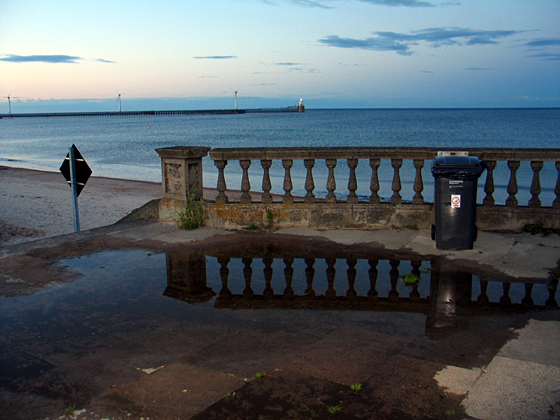
Yesterday morning I went to a meeting in Shiremoor. On my way back I decided to call and see my dad in Seaton Sluice. He’s getting his house refurbished – rewired, new kitchen and all that palaver – and I was wondering how things were going. When I got to the Sluice I saw Tristan’s white PermaPlumma van parked just around the corner of the Collywell Bay Road, more or less opposite the social club. I spotted Tristan himself in his white boilersuit and blue jacket, leaning against the fence looking out over into the harbour. It was sunny and cold, quite suddenly like winter. The white buildings on Rocky Island were gleaming in the sun and the whole scene looking north had a picture postcard quality about it. I parked up and went over.
‘Hey, Tristan, what’s happening?’ I said. ‘Have you got as job up this way to do?’
‘No, mate,’ Tristan said. ‘No job. Work’s dwied up a bit, I’m afwaid.’
He looked just a little despondent, a little stoical.
‘So what you doing in the Sluice?’ I asked.
‘I’m just getting out of Bwenda’s way,’ he replied. ‘She’s got clients all morning. I didn’t want to be under her feet.’
I nodded and shared the view with him for a few seconds.
‘Hey, so what do you think of the response of the Left of the credit crunch, Tristan?’ I said.
‘What wesponse?’ he replied, suddenly becoming more animated. ‘The so-called Left squats like a bullfwog on a log and cwoaks and cwoaks but never jumps.’
‘So what’s it waiting for?’
‘I dunno, mate! A sign, maybe, or a call from heaven.’
‘So what should it do, Tristan? What would it look like if the bullfrog jumped?’
‘You know something, mate, I don’t think this bullfrog knows how to jump. I don’t think it’s actually got the legs for it anymore. It isn’t organised, that’s the problem. Who are the Left? Who’s leading them? Without organisation, mate, this fwog ain’t jumping anywhere.’
I laughed and said that maybe this was true, but surely that it just begged the question of why there was no organised Left in the first place, why we had a frog that couldn’t jump.
‘Maybe it’s because it can’t see anywhere to jump to?’ I suggested. ‘Maybe that one smug log in the backwater is the only one this frog can sit on these days. There’s no other log for the socialist frog to swim towards, is there?’
‘This is a chicken and egg situation,’ Tristan said. ‘Pwaxis, mate, that’s the way to deal with this kind of pawadox. You’ve always got to be weady to jump. Jumping’s what changes the world. Jump and the future weveals itself! Wemember what Marx said: in the past it was the job of philosophers to understand the world, the job now is to change it. The fwog needs to get on with jumping, I say, and stop gazing at its navel and cwoaking. A fwog that loves the sound of its own cwoak is a fwog that will soon be dwowned in the tide of histowy.’
‘You make this frog sound a bit like Hamlet, Tristan,’ I joked. ‘To jump or not to jump, that is the question. A frog with its head up its own backside.’
I told Tristan I needed to be on my way. I found his position frankly a little undisciplined for a Trotskyist, somewhat lacking in theoretical rigour. But he is right, the Left’s response to the current global financial crisis has been remarkably passive, and you can only surmise that this is because they either don’t know how to respond or no longer have the capacity to do so. These two things are probably inextricably linked, of course. Marxists can gloat over their man’s acumen about capitalism, but which of them can tell us where to go from here? The Left seems to have lost the belief it once had that it can make history, and that it can even do so in circumstances not of its own choosing. The Left seems to be mostly comprised of Lutherans nowadays. They don’t need to be organised. All that’s needed is that each individual believes in the God of history. If everyone sits quietly in their soon to be repossessed homes praying to this God the revolution will inevitably occur. Capitalism will magically wither and die while they dream.
As I walked back to my car I mused on Tristan’s brave and perhaps slightly incoherent analysis, that the Left is a frog with no legs and nowhere to jump but somehow ought to jump anyway. Basho’s famous haiku came to my mind.
The old pond,
A frog jumps in:
Plop!
This poem has been translated by just about everyone, of course. The version I always recall is Alan Watts’ translation. I wasn’t sure how enlightening it was in terms of the Left and the global crisis in Capitalism, but it’s a fine little poem, isn’t it?
I called across to see my dad. His flat is upside down, polythene covering every floor surface, workmen coming and going, the door permanently open. My dad had his coat on and was obviously very cold. He offered me a sandwich; I declined. I told him I needed to get back to work and left. As I drove back down past the social club I could see Tristan. He was still looking out over the bay.
The schools are on holiday this week and it’s Halloween on Friday. Some of the kids in Ashington are using their cast off pillowcases as spook outfits and wandering from house to house knocking on doors. Just after I got back from the Sluice Gilmour rang me about this phenomenon.
‘We don’t have a resurgence of the Flinties, do we?’ he asked. ‘Tell me how worried we should be about this.’
‘Not at all,’ I suggested. ‘They are just kids trick or treating. They’re also wearing witches hats, Frankenstein masks and carrying pumpkin lanterns from Asda. Some of them have luminous plastic vampire teeth and fake knives through their heads. Do they sound like a bunch of Muslim terrorists to you?’
Gilmour agreed, they didn’t, although not without observing that stranger things have happened. And by chance he’d listened to Alan Robson on Night Owls last night and there had been some alarming calls from worried listeners in the Ashington area.
‘A lady called Hettie from Bomarsund rang up,’ Gilmour said. ‘This lady sounded quite agitated. She said to the presenter something like “It’s all happening again, Alan.” He tried to reassure her, but she was having none of it. He asked her if these children were throwing paper aeroplanes at windows again and then as a sort of Halloween joke he said, “Or is it bats this time, Hettie?” Hettie was not at all amused. “Alan, with all due respect,” she said, “this is not funny.” Alan apologised. Oh, Hettie wasn’t a happy bunny. Later a bloke called John from Westerhope came on. This guy was obviously some kind of conspiracy theorist. He seemed to think Ashington police were in cahoots with the Flinties to destroy the British way of life. The next caller was a drunken woman from Ashington.’
‘Oh, Cheryl!’ I said.’ Ha ha. Yes, we know Cheryl. She’d be complaining that the authorities weren’t taking her seriously, was she?’
‘Yes, that’s right. She said she’d seen someone dressed as – ‘
I interrupted him: ‘Robin Hood! Yes, she says that all the time!’
‘No,’ Gilmour said. ‘Not Robin Hood. The Lone Ranger.’
‘Oh,’ I said.
‘Anyhoo, my boy,’ Gilmour said, ‘It sounds like we don’t have to get ourselves into a lather about any of this, do we? So, tell me, how’s your dad doing? Is he okay?’
‘Yeah,’ I replied. ‘He’s fine. Still mending fuses in the factory and what have you. How’s yours?’
‘Oh, father’s absolutely chipper. He’s a bit worried that the demand for meat might drop off a bit if there’s a recession, and of course like anyone else he’s getting a bit nervous about property values and his investments. But all in all he’s very well, thank you. Oh, by the way, did I tell you my lad’s driving the quad now?’
‘Is he? The quad, eh? Hey, that’s great. He’s really coming on, isn’t he? By the way, how’s your daughter’s horse doing?’
Gilmour told me the horse and his daughter were both doing remarkably well. I then asked him why he didn’t turn up at Rosie Lake’s leaving do last Friday.
‘Oh, it clashed with something my wife had arranged,’ he said. ‘How did it go? Did they give her a good send off?’
‘Well, Jack Verdi did,’ I said.
‘Jack finally performed?!’ Gilmour said. ‘My goodness, miracles will never cease, eh? What did he do, the old hits from his back catalogue?’
‘Yeah, well, his back catalogue was certainly involved. Nobody’s told you about, have they?’
‘No. No-one’s mentioned it. Hey, it sounds like I missed a good night? I really wish I could have been there. I’ve got a couple of Jack’s old albums, you know. I like his stuff. Is his voice still as good as it was?’
I chuckled. Gilmour asked me why I was laughing. ‘Oh, I guess you just had to be there,’ I said. ‘I’m sure Freddy will give you the full low down when you see him.’
I think our call ended with Gilmour in much better fettle than when our conversation began. It certainly cheered me up.
Debs came up and told me that Mandy was in the office. She was thinking of trying to get a private tenancy outside of Ashington, maybe in Morpeth or Seaton Delaval. She wanted to live somewhere where Flinty might not find her.
‘If she found somewhere could we help her out with a bond?’ Debs asked.
‘Is running away from him the answer, Debs?’ I said.
‘Oh, come on,’ she said. ‘What else is she going to do? The man’s a nutcase. He’s never going to leave her alone.’
I looked at her and shook my head. ‘Aye, all right,’ I said. ‘It’s only money, I guess.’
It was another cold afternoon. As I drove down Alexandra Road at dusk the sky was icy blues, violets and orange. The streetlights had just come on. An old white Mercedes passed me going in the other direction. The driver was dressed like an Arab. I turned on the radio. On the five o’clock news I heard that Gordon had stepped into the furore about Jonathan Ross and Russell Brand acting like a couple of prats on Brand’s late night radio programme a week or so ago. Gordon’s the man with his finger on the pulse of the nation.
It was dark before I got home.
.
waiting for the miracle

My computer’s been down. In a way it was if the world had stopped. A bit like not going to work. A bit like being without a television.
Last week Boz got himself locked up. At the beginning of the week he was in the office talking to Lily about abducting his children and hiding away with them in the caravan at Sandy Bay. Lily pointed out that he had already sabotaged his own plan by disclosing his secret whereabouts. Boz threw a wobbler and stormed out. He went into the car park and began methodically ripping the wing mirrors off cars. This is no easy task – a bit like pulling out a rhinocerous tooth, I thought. Once extracted he threw the detached mirrors over the wall into the street. He detached five in all, including both the driver’s and passenger’s side from Meg Bomberg’s BMW. At least no-one will notice the wiggly scratch now, as Lily said.
Boz then went and sat on the wall and had a cigarette. He was sitting there almost serenely when the police arrived in their Ford Focus panda car. They rolled down the window. The officer asked him if he knew anything about the five broken mirrors lying in the road.
Boz shook his head. ‘Me?’ he said. ‘Naw, nowt to do with me, mate. Do I look like a vandal? Naw, it must be the numpties from Newbiggin.’
Lily walked out into the car park at this point. Boz glanced at her.
‘So do I look like a kidnapper to you?’ he asked the police officer. ‘Do I? Do I have the look of a man who would abduct children? Well, come on – do I?’
The police officer glanced across at his colleague. He had a wry smile on his face. Lily hadn’t said a word.
‘You think that’s funny, do you? Eh?’ Boz said, throwing his cigarette down and standing up. He scrunched his stub into the pavement. For a moment he stood looking at the police officer, nodding his head slowly. Then like a leopard he suddenly pounced on the Focus wing mirror and began riving at it.
The police officers leapt out, twisted his arm up his back, slapped him in handcuffs, and threw him in the back seat of the panda, its passenger side mirror dangling like an almost severed limb. Boz bellowed and sang that they were numpties, numpties, numpties, that all policemen are numpties. They took him away to the station.
Lily looked at me and shrugged. ‘Do you think it’s time to cancel the anger management sessions?’ she said.
That night when I got home the clock was still ticking. The global economy was in a state of chaos. De Kooning wanted me to pick him up and carry him to the kitchen. I did so and then went for a walk before night fell.
On Thursday morning I caught the beginning of In Our Time as I drove to work. By sheer coincidence, I would suggest, the programme was looking at miracles. In the introductory part they looked at the Jewish and Christian versions of the idea and the way it was bound up with the idea of God and His power to intervene in the world. It seems that the Hebrew word used in the Bible means both ‘wonder’ and ‘sign’. It interested me that these two concepts could be separated. The programme moved on to the Hindu and Taoist view of miracles, where a miracle can just be a wonder and not a sign at all. It seems that someone with these world views can witness as a miracle and regard it with a sense of wonder – and be fully aware that it defies the laws of nature – but not think it has a meaning. Such things are not signs. The Taoist has no idea why they happen and isn’t much bothered in any case. They just do. This is an attitude that is alien to the west, I was thinking. Western cultures are heavy on ‘the need for cognition’, so much so that some Western psychologists consider it to be one of our fundamental traits. We need to know why things happen. We want explanations. Everything happens for a reason. We need to give an event a meaning.
The programme mentioned the case of the Hindu milk miracle, which occurred in 1996, and involved a stone statue of Ganesha the sacred elephant drinking milk. Or seeming to drink milk, depending on your point of view. This caused great excitement in the Hindu community and Hindus from far and wide came to witness the phenomenon. Even in Britain sales of milk near Hindu communities soared as people went off to get a bottle and feed a spoonful to their local stone elephant. The excitement was about something wonderful happening and the desire to witness a supernatural event. There was little concern about what the event might mean, it seems. Of course even in India the need to explain quickly asserted itself in some quarters. Scientists rapidly came up with the explanation that the stone elephant appeared to drink the milk because of capillary action: the stone was porous. Hindus resented this wonder being taken from them. Why is it that things that have an explanation cannot still be wonderful?
I was thinking, of course, about the Napoleon in Margaret’s bedroom. Its tick was nagging at me. Maybe I should just regard it as a wonder, a clockwork Ganesha. Maybe I should try to persuade Margaret that this magic ticking really had no meaning, that it was a sign of nothing at all. What in fact was the evidence that it had a meaning, and what was the evidence that it had any particular meaning? Was there a message in the ticking, a secret language of ticks that a suitably inspired listener might translate? Is there a Rosetta Stone of ticking? I doubted it somehow.
When I got in De Kooning ran up to me, as if he had great news. Had the Napoleon stopped? I picked him up, but before I got to the door of Margaret’s bedroom I knew it hadn’t. I pushed open the door and looked over at it. It gazed back smugly. It was ticking steadily, indifferently, like a cow chewing the cud of time.
‘I think I’ll have a cappuccino,’ I said. ‘Do you want a few prawns?’
I sat in the conservatory with my cappuccino, trying to read The Guardian. I wondered if I should ring the Greek, but I knew what he would say: the clock will stop, be patient. I began to think I would have to take matters into my own hands and take a spanner to this insolent clockwork wonder. I began to fear that once word got out about the Napoleon’s perpetual motion, miracle freaks from around the globe would flock to our house for a glimpse of this wonder. They would come with camcorders, digital cameras and mobile phones and probably pay for the thrill of recording it, although what the value of a recording of a ticking clock – albeit an impossibly ticking one – would be was a little unclear to me. What would be important, however, was that Margaret and Brenda didn’t realise the money making potential of this freak clock.
Scientists and horologists from around the world would descend upon us. Theories would proliferate. The government would call for calm. Gordon would have to decide upon some Calvinist neo-liberal position on the question, a view with which all cabinet ministers would be bound to agree. It would have to be made very clear that even if this miracle is a sign, it’s not a sign of anything about the economy. There were clear dangers that it would be read that way in the current climate, given that the miracles the unregulated global markets have brought to us are now falling apart around their ears. Gordon would have to act to marginalise and neutralise the miracle of Margaret’s Napoleon.
It was becoming clear: a miracle can lose its gloss fairly quickly. Miracles might not be all they’re cracked up to be. Naturalists and supernaturalists, deists and atheists and Seventh Day Adventists, Neo-Druids and a host of other New Age pilgrims would squabble and debate night and day at our gate. Makeshift camps would spring up on the grass verges, mini-Glastonburies. The faithful would be found asleep or urinating in gardens. The neighbours would complain. Geraldine would probably go to the press. The miraculous clock would be as bad as the Citadel – worse possibly – another dreadful blight on their peaceful existence. The police would put permanent traffic cones down the street. Celebs would arrive for a photo opportunity. Robbie Williams might arrive. Or Jade Goody. My mind went back to the spanner: surely it would be better to nip this curse in the bud? But how could I do that without admitting that a miracle may have occurred? How could I destroy the evidence that I might be wrong about the nature of the world? I was in a cleft stick. I’d have to hold firm and wait. The Greek was surely right: the Napoleon would stop any day now.
I spent a lot of last weekend out and about, walking or cycling. I was avoiding the ticking, I suspect. When I was in the house I’d sit in the Conservatory staring at the dark dreadful matrix of the Citadel with De Kooning, playing music loudly enough to make absolutely sure not a tick could be heard. I listened a lot to Teddy Thompson’s latest album. It turns out to be an especially good record to drive away unwanted ticks. I think De Kooning liked it too. From time to time I got up with him and we danced a little as we looked out together at the darkening world.
On Monday I was going first thing to a meeting in North Shields. Margaret asked me to drop off another box of slippers at Brenda’s on the way. I got there at about half nine. Tristan answered the door. He came to the door in pale blue pyjamas and a pair of checky brown slippers, which looked brand new to me. His hair was tousled.
‘Morning, Tristan,’ I said. ‘Are you not working today?’
‘No jobs,’ he said. ‘Business is slow. It’s the cwedit cwunch, mate.’
Yes, of course, I thought to myself, the cwedit cwunch. It has consequences for us all, even a Trotskyist plumber from Whitley Bay.
‘So is this the beginning of the end for capitalism, do you think?’ I asked. ‘Is this the way the system collapses?’
‘It’s in sewious twouble, mate, that’s for sure. But they can’t afford to let it fall. They’ll pwop it up no matter what it costs. No point in expecting miwacles, as the man said. And as my father always weminded me, capitalism is adaptable. It’s wuthless. It’s survived this long and it’ll survive a while yet. And he was wight. I’m beginning to think the world will be on its knees before we’ll see socialism.’
It was nice to be reminded of the illustrious Wupert. Tristan, of course, is probably right.
‘So is Brenda in?’ I said. ‘I’ve got a box of mules for her.’
‘Yes, she’s just getting weady.’ Tristan said. ‘She’s got a client in about ten minutes. She’s been away for the weekend and she got back late last night.’
‘So where’s she been? Anywhere special?’
‘A poetwy festival. She loved it. She seems to get a lot out of mixing with poets. She finds it exciting. It’s a load of pwetentious wubbish to me. But each to their own, eh? ‘
I nodded. ‘So what kind of client does Brenda have this morning, Tristan – someone for acupuncture?’
‘No, weiki, I think.’ Tristan replied. ‘Mr Armitage. He’s been having twouble with his kidneys. Or is it his knees? Anyway, here he is now.’ Tristan nodded towards the road. An old man in a blue Rover was pulling up. I gave Tristan the box of slippers and bid him farewell.
‘Say hello to Brenda for me,’ I said. I was wondering what kind of poetry she reads. I was wondering if she reads Lorca. Perhaps she prefers Bukowski.
I drove on the North Shields, listening to some more Teddy Thompson. I was noticing the ways he reminds me of his dad, something that wasn’t very obvious to me at first.
When I arrived at the office Boz was sitting in reception.
‘So they let you out, Boz, did they?’ I said.
‘Of course they did,’ he said. ‘Do I look like a criminal? I hadn’t done anything in the first place. It was their fault, not mine. That’s the trouble with the police, they show people no respect.’
Mandy Potts was in the interview room with Debs. Debs told me she was worried because the phone calls had started again. Over the weekend they’ve had Yvonne Fair on three separate occasions. Someone has also told her that a white Mercedes was driving around the estate in the early hours of Sunday morning and that Elephant Carmichael’s been released on bail.
‘And she says Molly Armstrong’s on the game,’ Debs said. ‘Mandy says Flinty always tried to get her to go on the game when he needed money for drugs. She thinks he must be desperate. When he can’t get drugs he’s unpredictable.’
‘So what does she want you to do?’ I asked.
‘’Nothing, I think. She just wants to talk about it. She wishes he would just disappear, but she knows I haven’t got a magic wand.
‘Is she still with Mr Zee?’ I asked.
‘Yeah,’ Debs said. ‘The kids were with him while she came in.’
I listened to Teddy Thompson again as I drove home that night. When I got in I heard the Napoleon ticking. I let De Kooning out and got changed. I went out for a walk. I walked over to the old campsite beside the reservoir at South Newsham and then down to the beach. I walked along the promenade and then followed the beach road and Wensleydale Terrace to the park. I went along the quayside and through the footpath on Ballast Hill. I walked along York Street and from there through Morrison’s car park. I went all the way up Bowes Street and then along Renwick Road and past the council offices on my way home.
When I got back Margaret was in. As soon as I came through the door she asked me if I’d done anything to the Napoleon.
‘Nothing,’ I said. ‘I won’t touch it, I promise.’
‘It’s stopped,’ she said.
‘It’s stopped?!’ I said. ‘Your Napoleon’s stopped?!’
‘Yes,’ she said. ‘It’s stopped. Have you done anything to it? Please tell me the truth. Have you?’
‘No,’ I said. ‘No, I swear I haven’t. I’d thought about, of course, more than once. But, no, I haven’t touched it.’
Margaret shook her head. ‘I can’t believe it,’ she said. ‘I can’t believe it. What am I going to tell Brenda? Why would it suddenly stop?’
This was an odd question, the exact opposite of the question that had been bothering me. I had ideas, but I didn’t think Margaret was in the mood for them. What I wanted to tell her was that Teddy Thompson was to blame. But I didn’t.
De Kooning came trotting in from the garden. It was almost dark. I picked him up and went into the kitchen. I stood him on the bench and put the kettle on.
‘So what do you think of that?’ I said to him, almost gleefully, scratching his head for him in that way he likes so much. ‘The clock’s stopped. Just think – no Robbie Williams, no Katie and Peter, no Jade Goody. It’s a miracle, isn’t it, an absolute bloody miracle!’
.
 yammering